

IEC Science Equipment: Australian-Made Apparatus Built for Schools
August 24, 2026
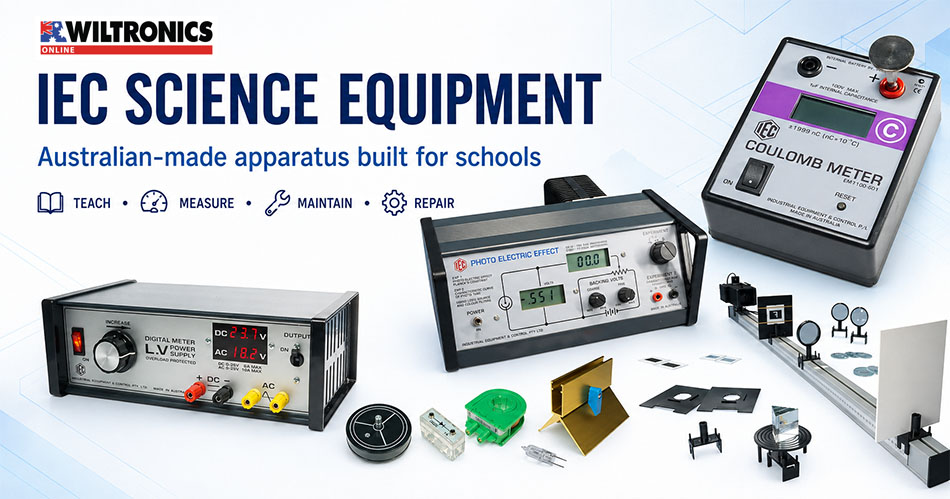
IEC Science Equipment: Australian-Made Apparatus Built for Schools
IEC science equipment is designed around those long-term classroom requirements. The Australian-made IEC range includes robust demonstration apparatus, student experiment systems, laboratory power supplies and specialised senior-physics equipment. Just as importantly, Wiltronics supplies an extensive range of genuine IEC replacement parts.
That combination makes IEC equipment more than a collection of individual products. It is a maintainable laboratory system that schools can build on, standardise and keep operating over many years.
Why whole-of-life value matters in a school laboratory
The lowest purchase price does not always represent the lowest cost to a school.
If an apparatus becomes unusable when a belt stretches, a lamp fails or a small fitting disappears, its true cost includes replacement, lost lesson time and the work required to introduce a new system. Equipment with accessible components and available spares can often be restored without replacing the complete unit.
When comparing educational apparatus, consider:
- how frequently the equipment will be used;
- whether it can tolerate repeated student handling;
- whether consumable and wear components are replaceable;
- whether lost kit pieces can be purchased individually;
- whether instructions and experiment resources are available;
- whether the design makes the physical principle easy to see;
- whether the same apparatus supports several experiments; and
- whether the system can remain consistent across classes and year levels.
These factors are particularly important for foundational physics equipment, which may be used by successive groups of students for many years.
What makes IEC equipment suitable for education?
IEC apparatus is developed for teaching rather than adapted from equipment intended for another market. Controls, terminals, scales and moving parts are arranged so that students can connect the physical setup with the scientific principle being studied.
The range covers major areas of school physics, including:
- motion and mechanics;
- electricity and magnetism;
- motors, generators and induction;
- light and optics;
- waves and sound;
- electrostatics;
- thermal physics and gas laws; and
- atomic and quantum physics.
Many systems are modular. A core apparatus can be supplemented, repaired or expanded with individual parts, helping science departments retain an established practical program instead of redesigning it around a replacement product.
Repairable equipment reduces avoidable replacement
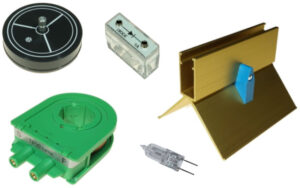
The breadth of the IEC spare-parts range is one of the strongest reasons to consider IEC when planning a school laboratory.
Available categories include parts for:
- hotplates and magnetic stirrers;
- inclined planes;
- induction and motor-generator kits;
- optical benches;
- laboratory power supplies;
- recording timers;
- ripple tanks;
- spectrum-tube equipment;
- Van de Graaff generators; and
- instrument housings, knobs, lamps, sockets, leads and cables.
A missing slider, worn belt or failed lamp should not automatically bring an entire teaching system to the end of its useful life. Genuine replacement parts also help preserve fit, alignment and compatibility within the original apparatus.
Repairability has an educational advantage as well as a financial one. Students can see that scientific instruments are engineered systems made from serviceable components—not sealed objects that must be discarded when one part fails.
Motion and mechanics: making forces visible
Mechanics is easier to understand when students can observe motion, collect measurements and repeat a setup under controlled conditions.
Free fall
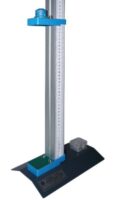
The IEC Free Fall Apparatus with 1.5 m rail and solenoid release allows students to investigate falling objects from adjustable heights. A mechanical or electromagnetic release can improve repeatability compared with releasing an object by hand.
Wiltronics also provides IEC Free Fall Apparatus spare parts, including replacement release components and steel balls. This enables a school to restore an established apparatus if a smaller component is damaged or misplaced.
Circular motion
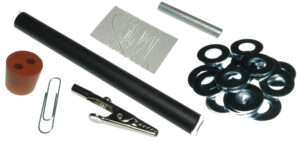
The IEC Circular Motion Kit PSSC provides a direct way to investigate centripetal force using a glass handle, cord, masses and rotating stopper. The low-friction handle helps students relate rotational speed, radius and force through a physical system they can see and operate.
For a larger apparatus, the IEC circular-motion system is supported by a dedicated range of replacement drive units, balls, rods, chains and catches. Even the PSSC glass handle can be replaced separately.
Inclined planes and friction
The IEC Inclined Plane can use a replaceable glass working surface for motion and friction investigations. Wiltronics also stocks a broader category of IEC inclined-plane replacement parts, allowing an existing school apparatus to be maintained rather than discarded.
Collisions and dynamics
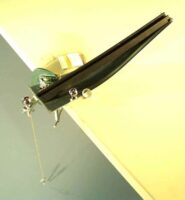
The IEC Collision in Two Dimensions Kit supports investigations of momentum and two-dimensional motion. Replacement tracks and steel balls are available individually, which is valuable for equipment containing small loose components.
These systems turn equations into measurable events. Students can change one variable, repeat the motion and evaluate whether the results agree with a model.
Electricity and magnetism: one system, many experiments
Electrical and electromagnetic equipment benefits from standard connectors, visible components and a safe classroom-scale supply.
IEC Hodson Induction Kit
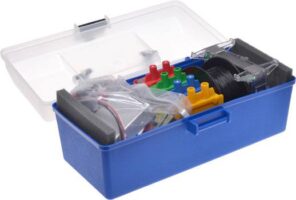
The IEC Hodson Induction Kit supports experiments involving magnetic induction, transformers and AC/DC motor theory. It operates at 12 V and includes components for constructing and examining several electromagnetic systems, including a squirrel-cage induction motor.
Because the kit can be rearranged for different investigations, it provides broader teaching value than a single-purpose demonstration. Students can explore:
- transformer action;
- electromagnets;
- magnetic fields around coils;
- eddy currents;
- synchronous and induction motors;
- iron losses; and
- energy conversion.
The IEC Induction Kit instruction sheets help schools retain the intended experiment sequence. Individual components—including the motor rotor, eddy-current disc, Thomson’s ring and even the complete storage housing—are available separately.
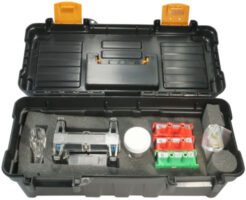
For a more compact introduction, the IEC Small Dissectible Transformer provides U- and I-shaped cores, coils, iron bars and magnets for studying transformers, induction and magnetic losses at 12 V AC.
Electricity and circuits kits
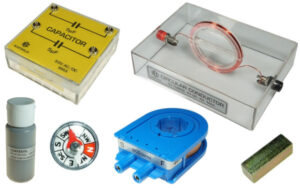
The extensive IEC Electricity Kit spare-parts range includes cell holders, coils, cores, switches, lamp holders, lamps, plotting compasses, wire, resistors, capacitors and an experiment manual.
This modular approach is useful when multiple class kits are used simultaneously. A school can replace a missing switch or lamp holder, add extra components to a popular experiment or rebuild incomplete sets discovered during a laboratory audit.
Laboratory power supplies built around classroom use
Reliable low-voltage power is central to electricity, electronics, induction and motor experiments. IEC provides several supply configurations developed for educational laboratories.
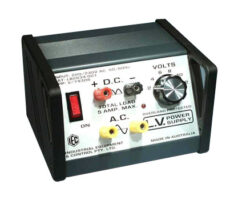
The IEC Switchable Power Supply 5 A provides selectable 2, 4, 6, 8, 10 and 12 V AC and DC outputs, with overload protection and a front-panel warning LED. Its sloping panel, built-in handles and 4 mm connections are practical features for shared laboratory benches.
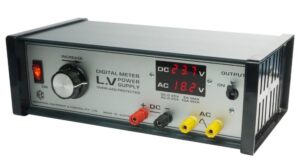
The IEC Variable Power Supply 0–25 V provides adjustable AC and DC outputs with separate digital displays, allowing both values to be monitored simultaneously.
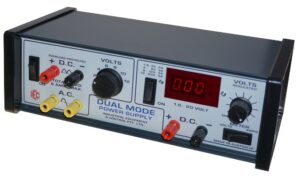
For laboratories that need both general switched outputs and smooth regulated DC, the IEC Dual Mode Power Supply combines the two functions with automatic overload protection and metering for the regulated section.
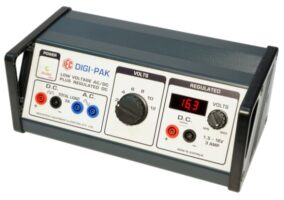
The IEC Digi-Pak Power Supply provides a compact regulated output with a digital display for electronics and general laboratory work.
Schools should select power supplies according to the apparatus, voltage range, current demand and need for regulation—not simply the highest current rating. The IEC laboratory benchtop power-supply range provides options for different classroom requirements, while replacement plug-paks, cables and power-supply components support ongoing maintenance.
Light and optics: stable alignment for repeatable results
Optical experiments depend on alignment. A stable bench enables students to change lens position, object distance and screen distance while keeping components on a common axis.
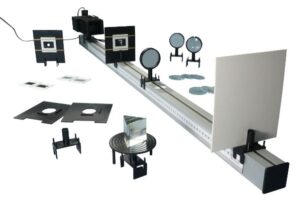
The IEC Optical Bench and Kit with Hodson Light Box includes a 1.5 m bench, metric scale, convex and concave lenses, targets, prism, prism table, photographic slides, screen and sliding supports. It supports experiments in:
- reflection and refraction;
- converging and diverging lenses;
- focal length;
- real and virtual images;
- image size and distance;
- prism dispersion; and
- optical-system alignment.
A version of the IEC Optical Bench and Kit without the light box is available for laboratories that already have a compatible source.
The value of the system is reinforced by its replaceable components. Schools can obtain an optical bench slider and stem, 60-degree glass prism, transparency set and other IEC optical-bench parts individually.
This is especially useful in busy laboratories, where a small lens holder or transparency may be misplaced while the main bench remains completely serviceable.
Waves: building a complete ripple-tank system
Ripple tanks make otherwise abstract wave behaviour visible. Students can observe reflection, refraction, interference, diffraction and the relationship between frequency and wavelength.
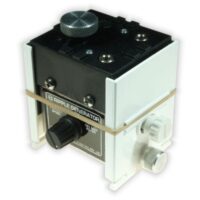
The IEC Ripple Maker is a variable-speed, gear-driven generator with adjustable phase. It works with interchangeable source attachments to create straight, circular or multiple wave patterns.
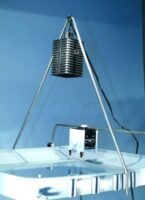
The IEC Ripple Tank Illuminator directs light through the water so wave patterns can be displayed on a surface below. The IEC aluminium barrier set includes straight, parabolic and semi-circular pieces for reflection, diffraction and slit experiments.
Schools can add or replace point-source ripplers, wave-generator cams and other parts from the IEC Ripple Tank spares range. The IEC Ripple Tank instruction book supports correct setup and experiment planning.
This modularity allows a school to restore an older system, replace a lost attachment or assemble a ripple-tank setup around an existing suitable tank.
Electrostatics: memorable demonstrations with serviceable equipment
Van de Graaff generators can create some of the most memorable demonstrations in school physics. Their value depends on reliable charge generation, correct earthing, careful operation and the ability to maintain belts and drive components.
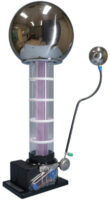
The IEC Large Van de Graaff Generator with 250 mm terminal is a 240 V classroom instrument with adjustable belt tension, a removable cover and an accessible drive system. It includes an earth cable, spare charging belt and spare motor-drive belt.
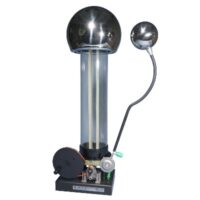
The IEC Hand-Operated Van de Graaff Generator provides a compact manual alternative that does not require electrical power.
The IEC Van de Graaff Accessory Set expands the range of electrostatic demonstrations. Individual parts—including the 250 mm stainless-steel terminal, motor drive unit and electrical control components—can also be replaced.
High-voltage electrostatic equipment must be operated according to its instructions, school procedures and appropriate supervision. Repairability does not replace inspection, safe earthing or competent maintenance.
Senior physics: apparatus for abstract concepts
IEC also produces equipment that helps senior students investigate concepts that are difficult to demonstrate with general laboratory supplies.
Planck’s constant
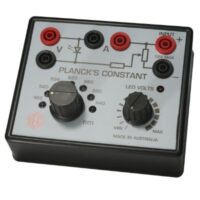
The IEC Simple Planck’s Constant Apparatus uses LEDs of different wavelengths to provide a cost-effective method of estimating Planck’s constant. Students relate the voltage at which an LED begins conducting to photon energy and wavelength.
The activity links circuit measurement with quantum theory and allows students to graph experimental data rather than treating Planck’s constant only as a value in an equation.
Photoelectric effect
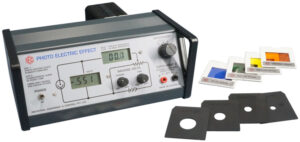
The IEC Photo-Electric Effect Planck’s Digital Meter provides separate displays for phototube current and the reverse voltage required to reduce that current to zero. Displaying both readings simultaneously simplifies the experimental workflow.
Supporting parts such as the photoelectric-effect lamp and lamp-and-filter experiment kit are available separately.
Electron charge and mass
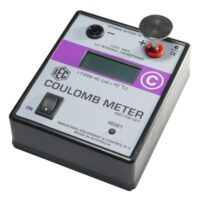
The IEC Coulomb Meter acts as a digital electroscope, measuring charge up to 1.999 nC for capacitor, resistance and static-electricity investigations.
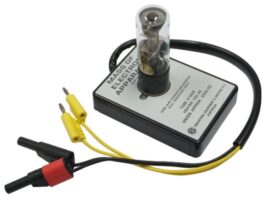
The IEC Mass of Electron Apparatus uses a visible electron fan and magnetic field to support an approximation of electron mass. These specialised instruments make otherwise abstract atomic-physics concepts observable and measurable.
Why standardisation helps science departments
Standardising around a maintainable equipment system can simplify laboratory management.
Consistent setup
When teachers and technicians know the same terminals, controls and component families, practical preparation becomes faster and troubleshooting becomes more predictable.
Easier inventory management
Replacement parts can be stored and labelled against known apparatus codes. Incomplete kits can be audited before a teaching unit rather than discovered during a lesson.
Reusable teaching resources
Existing worksheets, risk controls, setup diagrams and experiment notes remain relevant when equipment is repaired instead of replaced with a different design.
Reduced staff retraining
Teachers can become confident with a stable set of apparatus and share practical knowledge across the science department.
Progressive purchasing
A school can begin with core apparatus and add accessories or additional units as curriculum needs and budgets develop.
A practical annual IEC equipment audit
An annual audit can prevent small faults from becoming lesson-day failures.
- List each complete apparatus and kit. Record model and product codes where available.
- Check electrical condition. Inspect leads, plugs, sockets, switches, housings and power cables according to school procedures.
- Examine moving parts. Check belts, pulleys, bearings, springs, sliders and adjustment mechanisms.
- Count loose components. Compare kit contents with manuals or inventory lists.
- Test lamps and light sources. Replace failed or deteriorating lamps before optics and wave units are scheduled.
- Check scales and alignment. Confirm that rails, stages, screens and measurement markings remain usable.
- Review consumables. Stock spare lamps, belts, fuse wire and other frequently needed items.
- Test complete experiments. Confirm that the apparatus still produces the expected observable result.
- Order genuine replacements. Use the correct IEC part for compatibility with the existing apparatus.
- Update records. Note repairs, missing items and equipment that requires professional electrical attention.
Electrical safety testing and repairs must be carried out in accordance with applicable requirements and by appropriately competent personnel.
How to evaluate an IEC purchase
Before purchasing, consider the complete teaching requirement rather than the apparatus in isolation.
| Question | Why it matters |
|---|---|
| Which experiments will it support? | A multi-experiment system can provide greater curriculum coverage |
| Which year levels will use it? | Controls, complexity and supervision should suit the students |
| Is an appropriate power supply required? | Voltage, current and regulation must match the apparatus |
| Are instructions included or available? | Good resources improve setup consistency and learning outcomes |
| Which parts are likely to wear or be misplaced? | Planning spares reduces future disruption |
| Can existing accessories be reused? | Compatibility can lower the cost of expanding a system |
| Where will it be stored? | Proper storage protects alignment and keeps sets complete |
| Who will maintain it? | Clear responsibility helps extend service life |
For higher-value apparatus, whole-of-life cost is a more useful measure than purchase price alone.
Built for practical science—and built to be maintained
IEC science equipment gives schools a way to invest in apparatus that is designed for education, supports hands-on measurement and can remain serviceable through genuine replacement parts.
From free fall, circular motion and induction to optics, waves, electrostatics and quantum physics, the range covers both foundational demonstrations and specialised senior practical work. Its modular construction also allows schools to replace a small component, expand an experiment or restore an established kit without automatically purchasing an entirely new system.
Explore IEC spare parts, browse Wiltronics’ wider range of physics equipment or contact Wiltronics for help identifying the correct IEC apparatus or replacement component for your laboratory.
© Electrotech Brands Pty Ltd 2026
Write a Comment
You must be logged in to post a comment.