

Separation Techniques in Chemistry: Methods, Equipment and Examples
September 7, 2026
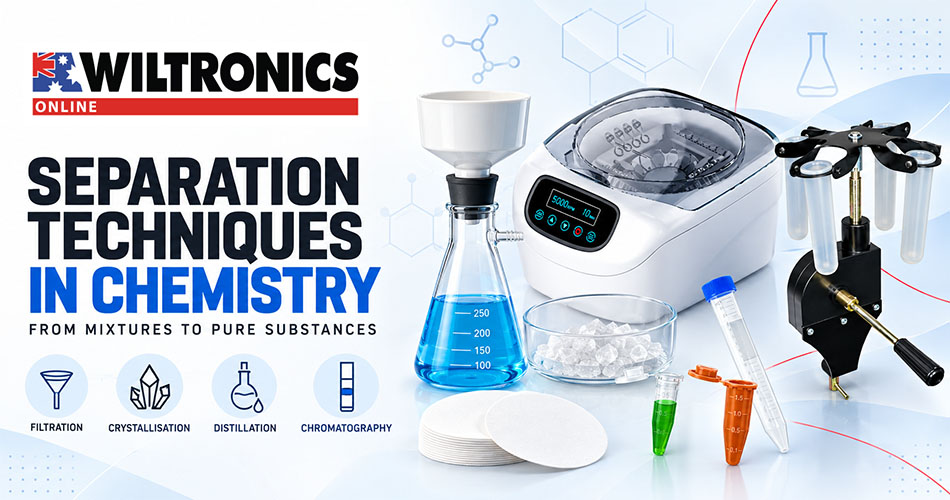
Separation Techniques in Chemistry: Methods, Equipment and Examples
Separating a mixture is rarely a matter of choosing the most complicated apparatus. The best method depends on a difference between the substances in that mixture.
One component may dissolve while another remains insoluble. Two liquids may form separate layers because they do not mix. A dissolved solid may remain behind when its solvent evaporates. Pigments may travel at different rates through paper, while suspended particles may settle faster under centrifugal force.
These differences make separation techniques an excellent part of practical chemistry. Students must observe a mixture, identify a useful physical property, choose appropriate equipment and judge the quality of the result. They learn that an effective procedure depends on reasoning as much as technique.
The Wiltronics chemistry equipment range supports demonstrations and student investigations involving filtration, crystallisation, evaporation, extraction and other laboratory processes. This guide explains the underlying principles and helps schools plan suitable equipment for each method.
What is a separation technique?
A separation technique divides a mixture into two or more components without necessarily changing the chemical identity of those components.
Mixtures differ from pure substances because their constituents are physically combined rather than joined in one fixed chemical composition. That means a physical property can often provide a route to separation.
Useful properties include:
- particle size
- solubility
- boiling point or volatility
- density
- miscibility
- magnetic behaviour
- attraction to a stationary surface
- movement through a fluid
Before selecting equipment, students should ask three questions:
- What type of mixture do we have?
- Which property differs between its components?
- Which component do we need to recover—the solid, the liquid or both?
That final question matters. Evaporation can recover a dissolved solid, but it normally loses the solvent. Distillation can recover the solvent as a condensate. Gravity filtration can clarify a liquid, while vacuum filtration more efficiently collects and dries a solid product.
Quick guide: choosing a separation method
| Mixture or objective | Property used | Suitable technique | Typical equipment |
|---|---|---|---|
| Insoluble solid in a liquid | Particle size | Gravity filtration | Filter funnel, filter paper, beaker or flask |
| Solid product from a suspension | Particle size and pressure difference | Vacuum filtration | Büchner funnel, filter flask, filter paper and vacuum source |
| Dissolved solid required; solvent not required | Volatility | Evaporation | Evaporating dish and controlled heat source |
| Purified crystals required | Solubility changes with temperature | Crystallisation | Beaker or flask, heat source, crystallising dish and filtration equipment |
| Solvent or liquids with different boiling points | Boiling point | Distillation | Boiling flask, condenser, thermometer, receiver and heat source |
| Two immiscible liquids | Density and immiscibility | Separating funnel | Separating funnel, stand, clamp and receiving vessels |
| Coloured soluble components | Different affinities | Paper chromatography | Chromatography paper, chamber, solvent and spotting tools |
| Fine suspended particles | Density under rotation | Centrifugation | Balanced centrifuge, compatible tubes and rack |
| Ferromagnetic material in a mixture | Magnetic attraction | Magnetic separation | Suitable magnet and collection vessel |
Essential equipment checklist
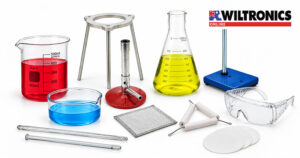
Most school separation activities can be supported with a well-chosen core set:
- glass beakers, Erlenmeyer flasks and labelled receiving vessels
- glass or polypropylene filter funnels
- several diameters or grades of filter paper
- glass stirring rods, plus spatulas and wash bottles
- evaporating dishes and crystallising dishes
- retort stands, bosses and clamps
- a controlled heating method and heat-resistant bench mat
- balances for mass and recovery calculations
- suitable eye protection and other laboratory PPE identified by the risk assessment
Add Büchner funnels, filtering flasks and a vacuum source for solid-product recovery; condensers and compatible quick-fit glassware for distillation; separating funnels for immiscible liquids; and balanced centrifuge equipment where the curriculum requires it.
1. Gravity filtration
Gravity filtration separates an insoluble solid from a liquid. The liquid and suspended solid enter a funnel lined with filter paper. Liquid passes through the paper as the filtrate, while larger solid particles remain as the residue.
This technique suits mixtures such as sand and water, precipitated solids and solutions containing an insoluble contaminant. It does not remove dissolved substances because dissolved ions or molecules travel through the paper with the solvent.
Equipment for gravity filtration
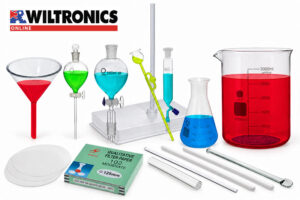
A basic setup requires:
- a glass or polypropylene filter funnel
- appropriately sized laboratory filter paper
- a beaker or Erlenmeyer flask to collect the filtrate
- a glass stirring rod for controlled pouring
- a retort stand and funnel support when the setup needs additional stability
Fold circular filter paper into a cone that fits the funnel closely. Wetting it with a small quantity of the solvent can help seat it against the funnel wall. Pour the mixture steadily down a stirring rod and keep the liquid level below the top edge of the paper.
Choosing filter paper
Filter paper diameter must suit the funnel, but pore size and flow rate also affect performance. Coarse paper filters rapidly but may allow fine particles through. Finer paper captures smaller particles but takes longer and clogs more readily.
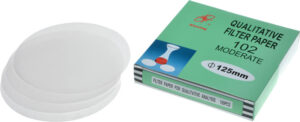
Wiltronics supplies filter-paper packs in multiple diameters for qualitative analysis and general laboratory use. Specialised applications can require a different filter medium, such as a 47mm glass-fibre membrane filter.
Common filtration problems
Cloudy filtrate: The paper may have torn, the particles may be smaller than its retention rating or liquid may have travelled between the paper and funnel. Refilter with intact, more suitable paper.
Very slow flow: Fine solids may have blocked the pores. Allow the mixture to settle and decant part of the liquid first, or use vacuum filtration when appropriate.
Product lost during transfer: Rinse the original vessel with a small amount of solvent and transfer the washings. Avoid excessive solvent when the goal is to recover the solid efficiently.
Equip a class set: Explore Wiltronics filter funnels and filter paper in compatible sizes.
2. Vacuum filtration
Vacuum filtration uses a pressure difference to draw liquid through the filter. It usually works faster than gravity filtration and helps remove more liquid from the collected solid.
This method is particularly useful when the solid is the desired product, as in the collection of crystals or a precipitate. Gravity filtration often remains preferable when the hot filtrate contains the desired dissolved substance because premature cooling in a vacuum apparatus can cause crystals to form inside the funnel.
Building a vacuum-filtration system
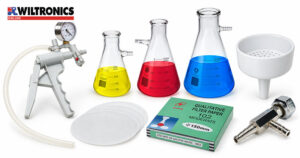
A typical system includes:
- a porcelain Büchner funnel or durable polypropylene Büchner funnel
- correctly sized filter paper that covers the perforated plate without curling up the walls
- a heavy-walled borosilicate filtering flask
- a suitable funnel adaptor and vacuum hose
- a controlled vacuum source, such as a manual vacuum pump with gauge or compatible aspirator filter pump
Seat the filter paper by wetting it with the same solvent used in the mixture, then apply a gentle vacuum. Transfer the suspension and rinse the solid only when the procedure calls for it. Break the vacuum before switching off or disconnecting the source to reduce the risk of backflow.
Only use glassware designed for reduced-pressure work. Ordinary thin-walled flasks can implode under vacuum. Inspect the filtering flask, hose and connections before each activity, and use eye protection and appropriate shielding where the risk assessment requires it.
Build the system: Pair a Büchner funnel with a purpose-made filtering flask, correctly sized paper and a controlled vacuum source.
3. Sedimentation and decanting

Sedimentation allows denser particles to settle under gravity; decanting removes the upper liquid without disturbing the sediment. It offers a simple introduction to density and settling rate and can reduce the load on a later filtration step. However, it rarely produces a completely clear liquid or complete recovery. Clear borosilicate beakers help students observe the boundary between sediment and supernatant liquid.
4. Evaporation
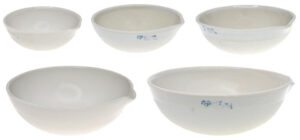
Evaporation separates a non-volatile dissolved solid from a volatile solvent. As solvent molecules escape, the solution becomes more concentrated. Continued evaporation can leave the dissolved solid behind.
This method suits small-scale recovery of salts from water when the solvent does not need to be collected. A round-bottom porcelain evaporating dish provides a broad surface that encourages evaporation, while a glass evaporating dish allows students to see the solution more clearly.
Evaporation is not always “boiling dry”
Strong heating can cause bumping, spitting, sample loss or thermal decomposition. In many school experiments, students should concentrate the solution with gentle heating and stop before complete dryness. Residual heat can continue evaporation after the dish leaves the heat source.
Use small quantities, a stable support and an appropriate controlled heating method. Handle hot porcelain and glass with suitable tongs or heat protection, and place hot items on a heat-resistant surface.
5. Crystallisation
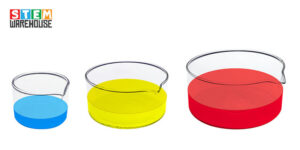
Crystallisation produces a purified solid from a solution. It relies on a change in solubility, often as a hot saturated solution cools.
A typical process dissolves an impure solid in the minimum practical amount of hot solvent, removes insoluble material, concentrates the solution and allows it to cool undisturbed. Students then collect the crystals, wash them with a small amount of cold solvent, dry them and calculate the yield.
A crystallising dish provides a broad vessel for controlled solvent loss and crystal growth. Beakers, Erlenmeyer flasks, filter equipment and a laboratory balance complete the workflow.
What controls crystal quality?
Slow cooling generally favours the growth of fewer, larger crystals. Rapid cooling or vigorous disturbance can produce many smaller crystals. Too much solvent reduces yield because more solute remains in the mother liquor. Too little solvent can cause premature crystallisation during hot filtration.
This makes crystallisation an excellent investigation in experimental design. Students can change one variable—cooling rate, solvent volume, temperature or seeding—then compare crystal mass, size and appearance.
Prepare for crystal recovery: Combine a crystallising dish with suitable filtration equipment and a balance for calculating yield.
6. Distillation
Distillation separates substances through differences in volatility or boiling point. Heating produces a vapour richer in the more volatile component. A condenser cools that vapour and returns it to liquid form as the distillate.
Simple distillation can recover a solvent from a solution or separate liquids when their boiling points differ sufficiently. Fractional distillation adds a fractionating column and suits liquids with closer boiling points.
Essential distillation equipment
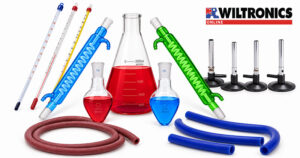
A school-scale setup may include:
- a suitable pear-shaped boiling flask
- a compatible distillation head and correctly positioned laboratory thermometer
- a Liebig condenser or, for greater condensing surface area, a Graham condenser
- rubber tubing for coolant flow
- retort stands, bosses and clamps
- a borosilicate Erlenmeyer receiving flask
- boiling chips or another approved anti-bumping method
- a controllable Bunsen burner or other suitable heat source
Run cooling water into the lower condenser connection and out through the upper connection so the jacket fills effectively. Support the apparatus securely without creating stress at the glass joints. Never seal a distillation system: expanding gases and vapours require an open path to the receiver.
Schools should restrict solvent choice and apparatus scale according to their chemical risk assessment, ventilation, ignition controls and local procedures. Teachers should supervise heating and dismantle the apparatus only after it has cooled.
Plan a teaching setup: Browse Wiltronics laboratory condensers and select compatible flasks, joints, clamps, tubing and receiving vessels as one complete system.
7. Separating immiscible liquids
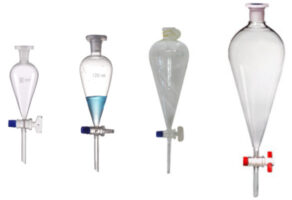
Some liquids, such as oil and water, do not form one uniform phase. When left undisturbed, they separate into layers according to density. A separating funnel allows controlled removal of the lower layer through a stopcock.
Wiltronics offers several designs, including a robust polypropylene pear separating funnel with PTFE stopcock, a transparent glass pear funnel with glass stopcock and glass separating funnels with PTFE stopcocks.
Close the stopcock before adding the mixture, secure the funnel in a stand and vent it away from people whenever mixing creates pressure. After a clear interface forms, remove the stopper and drain the lower layer into a labelled vessel. Do not assume that water forms the lower layer: density determines the order, and some organic liquids are denser than water.
8. Paper chromatography
Paper chromatography separates soluble components because they divide differently between a mobile solvent and the water or cellulose associated with the stationary paper.
The solvent rises through the paper by capillary action. Components that interact strongly with the mobile phase tend to move farther; components that interact more strongly with the stationary phase tend to move less.
For a reliable chromatogram, draw the baseline in pencil, apply small concentrated spots and keep the solvent below them. Cover the chamber, remove the paper before the solvent reaches the top and mark the solvent front immediately.
Students can compare food dyes or water-soluble marker inks using an approved solvent system. When conditions remain constant, they can calculate a retention factor:
Rf = distance travelled by component ÷ distance travelled by solvent front
Rf values support comparison, but they do not prove identity by themselves. Paper type, solvent composition, temperature and sample concentration can all affect the result.
9. Centrifugation
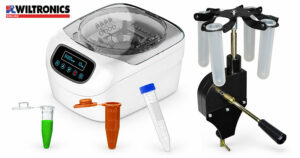
Centrifugation accelerates the separation of suspended materials by rotating samples. Components respond differently according to particle size, density, fluid viscosity and applied centrifugal force.
For introductory classroom demonstrations, the hand-operated four-tube centrifuge provides a direct way to explore rotation and sedimentation. Laboratories requiring controlled speed and time can use a universal 500–6000rpm centrifuge with compatible centrifuge tubes.
Balance every centrifuge load
Place tubes with equal total mass opposite each other. Similar liquid volume does not always guarantee equal mass, particularly when samples contain different concentrations or solids. An unbalanced rotor can vibrate, damage the instrument or release tubes.
Check tubes for cracks, close the lid and keep it locked until the rotor stops completely. Follow the centrifuge manufacturer’s limits for tube type, capacity, speed and rotor configuration.
10. Magnetic separation and sieving
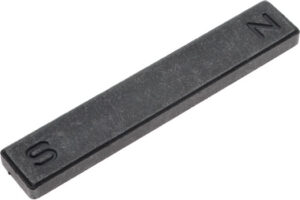
Magnetic separation removes a responsive material such as iron or steel from non-magnetic matter. A bar magnet with marked polarity supports a simple introductory activity. Sieving instead divides dry solids by particle size. Both methods work well as first stages in a multi-component separation challenge.
Designing a multi-stage separation
A mixture of iron filings, sand and salt requires a sequence: remove the iron magnetically, dissolve the salt in water, filter out the sand, then evaporate or crystallise the filtrate. The order matters; evaporating before filtration would leave salt mixed with sand.
Ask students to draw a flow chart first. Each stage should name the property used, material recovered and next step, making their reasoning visible before practical work begins.
Five classroom investigations
| Investigation | Variable to change | Evidence to collect |
|---|---|---|
| Which filter paper works best? | Paper grade or fold | Filtration time, clarity and recovered residue |
| How does cooling rate affect crystals? | Slow or rapid cooling | Crystal size, appearance and mass |
| Can every component be recovered? | Student-designed sequence | Component mass and percentage recovery |
| Which solvent gives the best chromatogram? | Approved solvent composition | Spot separation and Rf values |
| Gravity or centrifuge? | Separation method | Clarity after a fixed time |
Each investigation should change one main variable while keeping sample composition, volume, equipment and observation time consistent. Students should define success before beginning; the fastest method may not produce the purest material or highest recovery.
Planning equipment for a class set
Keep common beakers, funnels, paper, stirring rods, dishes and PPE at student stations. Share stands, clamps, balances, separating funnels and approved heat sources between groups. Keep vacuum systems, distillation apparatus, powered centrifuges and higher-risk chemicals under teacher control.
Standardising sizes simplifies storage and replacement. Match funnel and filter-paper diameters, confirm that adaptors fit filtering flasks, and purchase centrifuge tubes rated for the intended rotor and speed.
Explore the full Wiltronics range of chemistry equipment, laboratory glassware and plasticware and laboratory hardware and consumables when planning or replenishing practical stations.
Laboratory safety
Every activity requires a documented risk assessment based on the exact chemicals, concentrations, quantities, student group and equipment involved. Consult current safety data sheets and follow school, jurisdictional and manufacturer requirements. Safe Work Australia’s hazardous-chemicals guidance provides information about identifying hazards, safety data sheets, controls, PPE and emergency planning. Schools should also follow the requirements of their state or territory regulator.
Core controls include:
- wear the specified eye protection, protective clothing and closed footwear
- label all samples, filtrates, residues and waste containers
- inspect glassware for chips, cracks and damaged joints before use
- clamp apparatus securely without overtightening glass
- keep ignition sources away from flammable solvents
- use appropriate ventilation for volatile substances
- point vented vessels away from people
- never heat a sealed system
- balance centrifuge tubes by mass and position
- use only pressure-rated flasks for vacuum filtration
- allow hot glass and porcelain to cool in a designated area
- dispose of chemicals according to the approved waste procedure
Students should also learn that separated material is not automatically safe or pure. A clear liquid may still contain dissolved chemicals, and a dry residue may remain hazardous.
Frequently asked questions
Can filtration remove dissolved salt from water?
No. Dissolved ions pass through ordinary filter paper. Distillation can recover the water; evaporation or crystallisation can recover the salt.
When should students use vacuum filtration?
Use it to collect and partially dry a solid after precipitation or crystallisation. Use only pressure-rated glassware and a controlled vacuum source.
How do evaporation and crystallisation differ?
Evaporation removes solvent, potentially to dryness. Crystallisation aims to produce an ordered, purified solid through controlled cooling or solvent loss.
Why use distillation instead of evaporation?
Distillation condenses and collects the volatile component. Evaporation normally sacrifices it.
Why must a centrifuge be balanced?
Unequal mass distribution causes vibration and excessive mechanical load. Balance opposing tubes by total mass and follow the approved rotor-loading pattern.
Build practical understanding through separation
Separation techniques connect particle theory with visible, measurable results. Students see that a mixture’s properties determine the procedure, that equipment choices influence efficiency and that no method produces a perfect result without careful technique.
A well-planned sequence can begin with simple dry mixtures and progress towards filtration, crystallisation, chromatography and multi-stage separations. Along the way, students learn to plan procedures, control variables, measure recovery, explain losses and evaluate whether their evidence supports a claim.
Browse chemistry equipment at Wiltronics to find filtration equipment, filter paper, Büchner funnels, crucibles and other resources for practical school chemistry.
© Electrotech Brands Pty Ltd 2026
Write a Comment
You must be logged in to post a comment.