

Educational Robotics for Schools Australia | Robotics Kits & STEM Learning
June 26, 2026
Educational Robotics for Schools Australia | Robotics Kits & STEM Learning
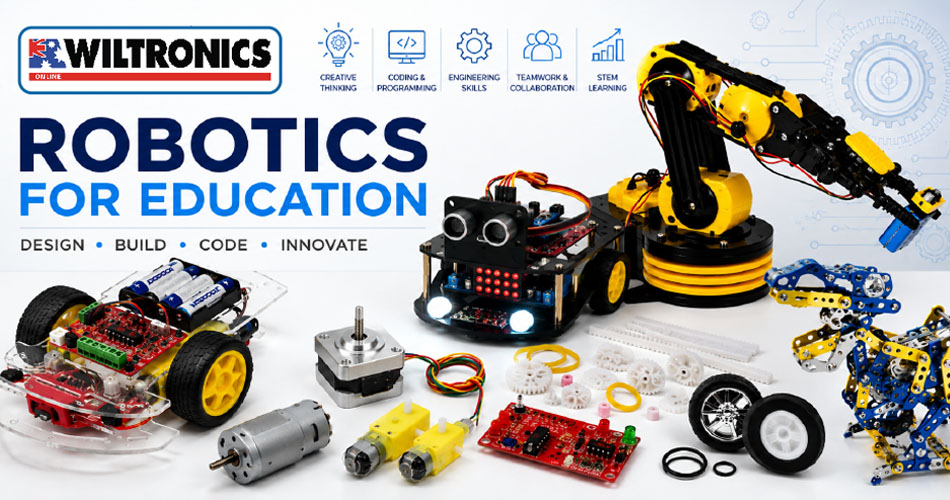
Robotics is transforming STEM education across Australian schools by bringing together engineering, electronics, programming and mechanical design in a way that encourages curiosity, creativity and practical problem-solving. Rather than simply learning scientific theories or coding concepts, students design, build and program robots that interact with the real world, making learning engaging, collaborative and meaningful.
Hands-on robotics projects allow students to investigate movement, sensing, automation and intelligent decision-making while developing valuable technical and transferable skills. From constructing simple wheeled robots in primary classrooms through to programming autonomous robotic systems in senior secondary education, robotics supports inquiry-based learning that prepares students for an increasingly technology-driven future.
Educational robotics also provides an ideal platform for integrating multiple STEM disciplines within a single project. Students combine engineering principles with electronics, coding and scientific investigation while developing resilience, teamwork and critical thinking through iterative design. Every prototype becomes an opportunity to test ideas, solve problems and improve performance.
For more than 50 years, Wiltronics has supplied Australian schools with quality science equipment, electronics, robotics components and STEM learning resources. Our extensive range of Robotics Kits & Accessories, Make & Create, Simple Machines, Educational Electronic Kits, ARD2 Arduino Compatibles and Arduino-Compatible Modules helps educators deliver engaging, curriculum-aligned robotics programs that inspire innovation and hands-on learning.
At a Glance
| Best For | Primary, Secondary, STEM Programs, Coding Clubs |
|---|---|
| Curriculum Areas | Digital Technologies, Design & Technologies, Science, Mathematics |
| Skills Developed | Coding, Engineering, Electronics, Mechanical Design, Problem Solving |
| Popular Resources | Robotics Kits, ARD2 Controllers, Make & Create, Simple Machines |
| Typical Projects | Line Followers, Robot Arms, Autonomous Vehicles, Obstacle Avoidance Robots |
In This Guide
- Supporting the Australian Curriculum
- Why Robotics Matters
- What is Educational Robotics?
- Educational Robotics Kits
- Choosing the Right Robotics Platform
- Robot Chassis Systems
- Motors and Drive Systems
- Mechanical Components
- Sensors for Robotics
- Robot Control Systems
- Coding and Autonomous Robotics
- Classroom Robotics Projects
- Robotics Competitions
- Robotics Across Year Levels
- Choosing Robotics Resources
- Frequently Asked Questions
Supporting the Australian Curriculum
Educational robotics naturally supports multiple learning areas within the Australian Curriculum, making it one of the most effective platforms for integrated STEM education.
Robotics activities support learning across:
- Digital Technologies
- Design and Technologies
- Science
- Mathematics
- Engineering-focused STEM programs
Through practical robotics investigations, students develop:
- Computational thinking
- Design thinking
- Systems thinking
- Scientific inquiry
- Critical thinking
- Creativity
- Collaboration
- Communication
- Problem-solving skills
Unlike traditional classroom activities that often separate subjects into individual lessons, robotics encourages students to combine scientific knowledge, engineering principles, electronics and programming while designing practical solutions to authentic challenges.
Students progress through the complete engineering design cycle by researching problems, developing concepts, constructing prototypes, testing performance, evaluating results and refining their solutions. This mirrors the processes used by engineers, software developers and technology professionals throughout industry.
Robotics also provides meaningful opportunities to investigate automation, sensing technologies, embedded systems and mechanical engineering while strengthening digital literacy and computational thinking.
Teacher Tip
Encourage students to document each stage of their robot’s development using photographs and engineering journals. Recording design changes helps reinforce reflective learning while demonstrating the engineering design process.
Why Robotics Matters
Modern robotics extends far beyond industrial factories.
Today, robots assist surgeons, inspect mining equipment, monitor crops, automate warehouses, explore oceans, investigate hazardous environments and support scientific research. Classroom robotics introduces students to many of the same engineering principles used across these industries while building practical STEM skills that remain valuable regardless of future career pathways.
Educational robotics helps students develop confidence in:
- Engineering design
- Coding and programming
- Electronics
- Mechanical engineering
- Systems integration
- Critical thinking
- Creativity
- Communication
- Collaboration
- Project management
- Problem solving
Because robotics projects rarely have a single correct solution, students quickly learn that engineering is an iterative process. Prototypes are continually refined as problems are identified, solutions are tested and performance is improved through experimentation.
This process develops resilience, analytical thinking and confidence while reinforcing the importance of evidence-based decision making.
Classroom Activity
Design an Obstacle Avoidance Robot
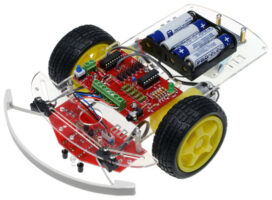
Students design a robot capable of navigating a classroom while detecting desks and chairs using an ultrasonic sensor. After testing several designs, students compare different wheel sizes, motor speeds and sensor placements to determine which configuration produces the most reliable navigation.
Students develop
- Engineering design
- Coding
- Electronics
- Mechanical engineering
- Critical thinking
- Teamwork
What is Educational Robotics?
Educational robotics combines mechanical engineering, electronics and computer programming to create intelligent machines capable of interacting with their environment.
Every educational robot consists of several interconnected systems working together.
These typically include:
- Structural chassis
- Mechanical components
- Wheels or tracks
- Motors
- Motor drivers
- Sensors
- Controller
- Power system
- Software
Each subsystem performs a specific role, and students quickly discover that successful robotics requires much more than simply writing code.
Mechanical engineering determines how the robot moves.
Electronics distribute power and communication throughout the system.
Sensors gather information about the surrounding environment.
Programming processes that information before controlling motors, outputs and decision-making.
Understanding how these systems interact helps students appreciate robotics as a multidisciplinary engineering field rather than simply another coding activity.
Many schools begin with complete Robotics Kits & Accessories before expanding projects using products from the Make & Create and Simple Machines collections.
Educational Robotics Kits
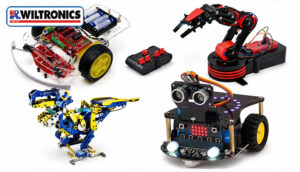
Educational robotics kits provide structured learning platforms that simplify classroom implementation while supporting increasingly sophisticated engineering projects.
By combining controllers, motors, mechanical assemblies, sensors and electronics into complete systems, robotics kits allow students to progress from introductory construction activities through to autonomous robotic applications.
Recommended resources
- Robotics Kits & Accessories
- Educational Electronic Kits
- Tekky STEM Kits
- Make & Create
- ARD2 Arduino Compatibles
Students investigate
- Robot construction
- Mechanical engineering
- Electronics
- Programming
- Systems integration
- Engineering design
- Design thinking
- Computational thinking
Many robotics kits are modular, allowing schools to progressively introduce additional controllers, motors, sensors and mechanical assemblies as students become more confident.
This flexibility makes robotics suitable for primary classrooms, secondary STEM programs, coding clubs, engineering electives and extension activities.
By combining products from the Robotics Kits & Accessories collection with Make & Create and Simple Machines, educators can create engaging project-based learning experiences that continue to grow alongside student capability.
Choosing the Right Robotics Platform
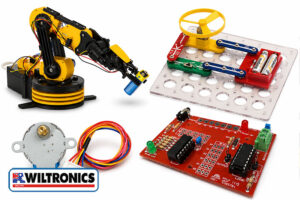
Every school has different teaching objectives, student experience levels and curriculum requirements. Selecting the right robotics platform allows educators to introduce engineering concepts progressively while building confidence through practical investigation.
| Learning Goal | Recommended Wiltronics Resources |
|---|---|
| First robotics projects | Robotics Kits & Accessories |
| Mechanical engineering | Simple Machines |
| Coding and automation | ARD2 Arduino Compatibles |
| Electronics investigations | Educational Electronic Kits |
| STEM construction projects | Make & Create |
| Primary STEM activities | Tekky STEM Kits |
Starting with complete robotics kits allows students to understand the relationship between mechanics, electronics and programming before progressing to custom-built robotic systems using individual motors, sensors, controllers and engineering components.
Robot Chassis Systems
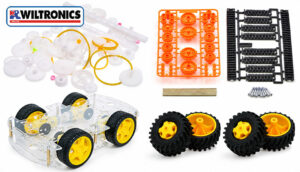
Every successful robot begins with a well-designed chassis. Acting as the structural framework, the chassis supports the controller, motors, batteries, sensors and mechanical components while determining how the robot moves, balances and performs. A strong chassis improves stability, manoeuvrability and reliability while giving students practical insight into engineering design.
Students quickly discover that the chassis is much more than a frame—it influences weight distribution, turning performance, climbing ability and the robot’s overall efficiency. Even small design changes can significantly affect how a robot behaves.
Different chassis configurations also allow students to investigate how robots are designed for specific applications. Two-wheel differential drive robots provide excellent manoeuvrability for introductory projects, while four-wheel and tracked platforms offer increased stability for more advanced engineering challenges.
Many classroom projects begin with complete Robotics Kits & Accessories before incorporating additional components from the Make & Create and Simple Machines ranges.
Recommended Resources
Students Investigate
- Structural engineering
- Centre of gravity
- Load distribution
- Mechanical stability
- Weight reduction
- Vehicle dynamics
- Engineering design
- Mechanical efficiency
Classroom Activity
Students compare two robot chassis with different wheelbases to determine which design produces greater stability while carrying a payload around a classroom obstacle course.
Teacher Tip
Encourage students to sketch their chassis before construction. Planning component placement often produces better-balanced robots and reduces troubleshooting later.
Motors and Drive Systems
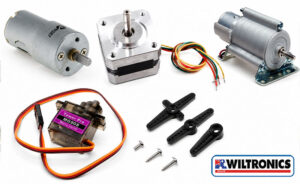
Motors convert electrical energy into controlled movement and are central to every robotic system. Understanding how different motors perform allows students to investigate engineering concepts such as torque, speed, gearing and mechanical efficiency.
Simple DC motors introduce continuous rotation and drive systems, while gear motors provide increased torque for heavier robots. Servo motors offer precise positional control for steering systems, robotic arms and articulated mechanisms, while stepper motors demonstrate accurate incremental positioning used extensively in industrial automation and CNC equipment.
By experimenting with multiple drive systems, students learn how engineers select components based on performance requirements rather than convenience.
Recommended Resources
- Simple Machines
- Robotics Kits & Accessories
- ARD2 Arduino Compatibles
- DC Motors
- Gearboxes
- Servo Motors
- Stepper Motors
Students Investigate
- Rotational motion
- Torque
- Gear reduction
- Speed control
- Steering systems
- Precision positioning
- Power transmission
- Mechanical efficiency
| Motor Type | Typical Classroom Applications |
|---|---|
| DC Motor | Robot drive systems |
| Gear Motor | High-torque vehicles |
| Servo Motor | Steering and robotic arms |
| Stepper Motor | Precision positioning and automation |
Classroom Activity
Students build identical robots using different gear ratios before measuring acceleration, climbing ability and battery life. The investigation demonstrates how mechanical design directly influences robotic performance.
Mechanical Components for Robotics
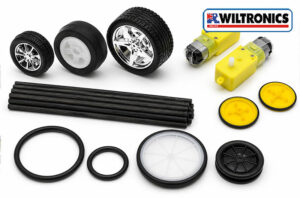
Although programming often receives significant attention, the mechanical system determines how effectively a robot moves, carries loads and performs useful tasks.
Students investigate how wheels, gears, pulleys, shafts and bearings work together to transfer motion throughout a robotic system. These practical investigations provide an excellent introduction to engineering principles while reinforcing concepts studied in Physics and Design & Technologies.
Changing wheel diameters, experimenting with different gear ratios or strengthening a chassis gives students valuable opportunities to analyse performance using evidence gathered through testing.
Recommended Resources
Students Investigate
- Gear ratios
- Torque multiplication
- Mechanical advantage
- Traction
- Structural design
- Motion transfer
- Mechanical efficiency
- Engineering optimisation
Featured Classroom Project
Warehouse Delivery Robot
Students design a robot capable of transporting small objects around a warehouse layout. By experimenting with different gear ratios and wheel sizes, students compare carrying capacity, speed and manoeuvrability while investigating mechanical engineering principles.
Sensors for Robotics
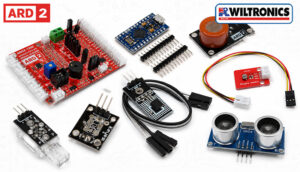
Sensors transform a mechanical machine into an intelligent robotic system. While motors provide movement and the chassis provides structure, sensors allow a robot to observe its surroundings, collect information and respond to changing conditions.
Educational robotics introduces students to feedback systems where a robot continually measures its environment before making decisions based on programmed instructions. This mirrors the operation of autonomous technologies used throughout manufacturing, agriculture, healthcare, transport and scientific research.
As students experiment with different sensors they gain practical experience collecting data, analysing environmental conditions and developing increasingly sophisticated robotic behaviours.
Recommended Resources
- ARD2 Arduino Compatibles
- Arduino-Compatible Modules
- Arduino
- Educational Electronic Kits
- Robotics Kits & Accessories
Popular Sensors
- Ultrasonic Sensors
- Infrared Sensors
- Line Tracking Sensors
- Light Sensors
- Temperature Sensors
- Humidity Sensors
- Colour Sensors
- Sound Sensors
- Hall Effect Sensors
- Soil Moisture Sensors
- Water Level Sensors
- Tilt Sensors
Students Investigate
- Distance measurement
- Environmental sensing
- Obstacle detection
- Automated decision making
- Data collection
- Environmental monitoring
- Sensor integration
- Autonomous navigation
| Sensor | Common Robotics Application |
|---|---|
| Ultrasonic | Obstacle avoidance |
| Line Tracking | Line-following robots |
| Light Sensor | Light-seeking robots |
| Colour Sensor | Object sorting |
| Soil Moisture | Smart agriculture |
| Temperature | Environmental monitoring |
Classroom Activity
Students program an obstacle avoidance robot using an ultrasonic sensor before comparing different sensor mounting positions to determine which provides the most reliable navigation.
A successful robot combines strong mechanical engineering with intelligent electronics and reliable programming. However, developing an effective classroom robotics program also requires selecting appropriate equipment, planning progressive learning activities and choosing resources that support different year levels and curriculum objectives.
In Part 3, we’ll explore how schools can build sustainable robotics programs, select the right equipment for their classrooms, answer frequently asked questions and discover why Wiltronics has become a trusted supplier of robotics, electronics and STEM education resources for Australian schools.
Choosing Robotics Resources for Your School
Establishing a successful robotics program begins with selecting resources that match your students’ experience, curriculum objectives and available classroom time. While robotics may appear complex, many schools successfully introduce engineering and programming using a staged approach that allows students to progressively build confidence through practical, hands-on projects.
One of the greatest strengths of educational robotics is its flexibility. A classroom might begin with complete robotics kits before expanding into custom-built robots using programmable controllers, sensors, motors and mechanical components. This modular approach enables educators to continually extend learning opportunities without replacing existing equipment.
Wiltronics offers one of Australia’s most comprehensive ranges of robotics and STEM education resources, allowing schools to develop sustainable robotics programs that grow alongside student capability.
Classroom Pathway
Students might begin by constructing simple wheeled vehicles using components from the Simple Machines collection before progressing to complete Robotics Kits & Accessories. As confidence grows, programmable ARD2 Arduino Compatibles and Arduino-Compatible Modules can be introduced to create increasingly sophisticated autonomous systems.
Teacher Tip
Introduce one new concept at a time. Students typically achieve better outcomes when they master mechanics first, followed by electronics, sensors and programming.
Integrating Robotics Across STEM Learning
Robotics naturally combines multiple curriculum areas into authentic, project-based learning experiences. Rather than studying engineering, mathematics or programming as isolated subjects, students apply knowledge from several disciplines while designing and testing practical solutions.
Robotics investigations commonly explore:
- Motion and force
- Electricity and electronics
- Mechanical engineering
- Measurement
- Coding and algorithms
- Automation
- Environmental monitoring
- Systems engineering
Many schools extend classroom activities by combining robotics with Educational Electronic Kits, Make & Create, ARD2 Arduino Compatibles and Tekky STEM Kits to deliver integrated STEM programs.
Featured Classroom Project
Smart Greenhouse
Students construct an automated greenhouse capable of monitoring soil moisture, light intensity and temperature before automatically activating irrigation or lighting systems.
Students develop
- Coding
- Data logging
- Environmental science
- Electronics
- Engineering
- Problem solving

Why Schools Choose Wiltronics
For more than 50 years, Wiltronics has partnered with Australian educators by supplying reliable science equipment, electronics and STEM education resources.
Our extensive range enables schools to source complete robotics solutions from a single supplier while building programs that support every stage of learning.
Educators choose Wiltronics because we provide:
- Extensive robotics and STEM product ranges
- Quality educational electronics
- Reliable classroom resources
- Australian-based expertise
- Curriculum-aligned products
- Modular systems that grow with student capability
- Resources suitable for primary, secondary and tertiary education
- Long-term support for STEM programs
Whether you’re introducing robotics for the first time or expanding an established engineering program, Wiltronics provides practical solutions that encourage curiosity, creativity and innovation.
Choosing the Right Resources
| If you want to… | Explore… |
|---|---|
| Introduce robotics | Robotics Kits & Accessories |
| Investigate mechanical engineering | Simple Machines |
| Build engineering projects | Make & Create |
| Learn coding and automation | ARD2 Arduino Compatibles |
| Expand with sensors | Arduino-Compatible Modules |
| Learn practical electronics | Educational Electronic Kits |
| Primary STEM projects | Tekky STEM Kits |
Frequently Asked Questions
What is educational robotics?
Educational robotics combines engineering, electronics, programming and mechanical design to help students build and program robots while developing STEM knowledge through practical investigation.
What age can students begin robotics?
Many primary school students begin with guided construction activities and simple programming, while secondary students investigate autonomous robotics, advanced sensors and engineering design.
Do students need coding experience?
No. Many robotics platforms are specifically designed for beginners and allow students to develop programming skills progressively through practical projects.
What equipment should schools purchase first?
Many schools begin with complete Robotics Kits & Accessories before expanding into programmable controllers, sensors and mechanical components.
What’s the difference between robotics and Arduino?
Arduino is a programmable controller platform, while robotics combines mechanical engineering, electronics, sensors, motors and programming to create complete robotic systems. Many educational robots use ARD2 Arduino Compatibles as their control platform.
Which sensors are best for beginners?
Ultrasonic, line tracking, light and temperature sensors provide an excellent introduction to environmental sensing and autonomous robotics.
How many robotics kits does a classroom need?
This depends on class size and teaching style. Many schools begin with small group projects before gradually expanding their robotics resources over time.
Can robotics support the Australian Curriculum?
Yes. Robotics naturally supports Digital Technologies, Design and Technologies, Science, Mathematics and integrated STEM learning.
Can robotics be used for coding clubs?
Absolutely. Robotics is ideal for coding clubs, STEM extension programs, engineering electives and extracurricular competitions.
Why choose Wiltronics?
Wiltronics offers one of Australia’s most comprehensive ranges of robotics, electronics and STEM education products supported by decades of experience supplying Australian schools.
Additional Resources for Schools
Explore these related resources to support STEM, coding and technology education:
- Science Equipment for Schools Australia
- Electronics & Science Equipment for Schools
- Essential Physics Equipment for Schools
- Essential Chemistry Equipment for Schools
- Essential Biology Equipment for Schools
- Educational Electronic Kits
- Arduino for Education Australia
- Make & Create Resources
- Tekky STEM Kits
Together, these resources help educators create engaging STEM programs that support creativity, innovation, problem-solving and inquiry-based learning.
Inspiring the Next Generation of Engineers
Educational robotics is far more than learning to program a moving vehicle. It encourages students to think like engineers by identifying problems, designing solutions, testing ideas and continually improving their work through evidence-based investigation.
From constructing a simple robot in a primary classroom to developing sophisticated autonomous systems in senior secondary STEM programs, robotics inspires curiosity while building practical skills in engineering, electronics, programming and mechanical design.
Whether you’re introducing robotics into a primary classroom, expanding a secondary STEM program or equipping an engineering laboratory, Wiltronics offers one of Australia’s most comprehensive ranges of robotics, electronics and STEM education resources.
From complete classroom kits and programmable controllers to motors, sensors, mechanical components and educational electronics, our products help educators create engaging learning experiences that prepare students for the technologies of tomorrow.
Explore our complete range of Robotics Kits & Accessories, Make & Create, Simple Machines, ARD2 Arduino Compatibles, Arduino-Compatible Modules and Educational Electronic Kits to inspire the next generation of engineers, innovators and problem-solvers.
© Electrotech Brands Pty Ltd 2026
Write a Comment
You must be logged in to post a comment.