

Why Stackable Banana Plug Test Leads Belong in Every School Electronics Lab
May 5, 2026
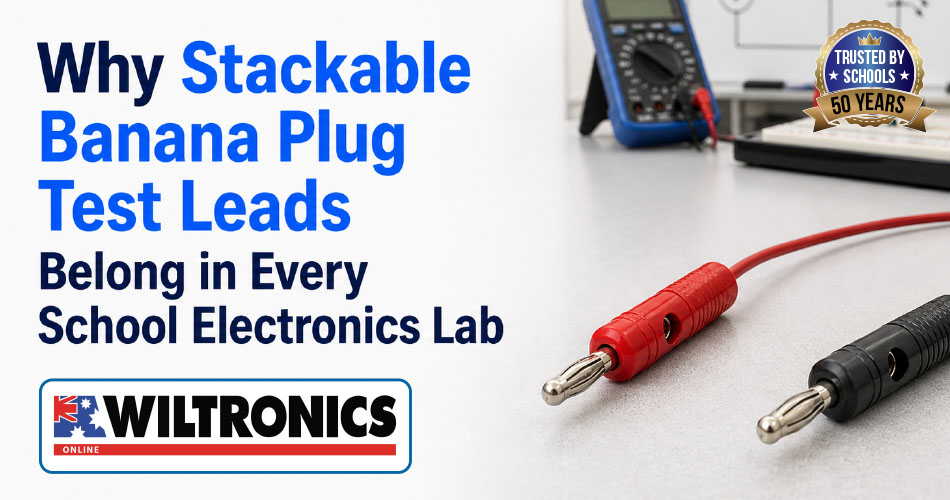
A school electronics lesson can fall apart for a surprisingly simple reason: poor connections.
Loose leads, unreliable contact points, confusing polarity and messy bench wiring can slow down practical lessons and make troubleshooting harder than it needs to be. When students are learning about voltage, current, resistance, power supplies or microcontroller-controlled circuits, the connection hardware should make the activity clearer — not more confusing.
That is why 4mm stackable banana plug test leads remain one of the most useful pieces of equipment in a science, STEM or electronics lab.
They are simple, reusable, easy to colour-code and fast to connect. They help students build circuits, test measurements and understand how a physical circuit relates to a circuit diagram. For teachers and lab technicians, they make classroom setups easier to repeat, inspect and maintain.
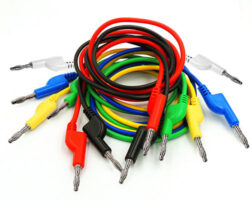
Wiltronics’ Banana Plug Test Lead – 4mm, Stackable is a strong everyday option for this role. It uses flexible 1.0mm² silicone cable and has a stackable 4mm banana plug-socket on each end, making it suitable for repeated classroom, electronics and physics lab use.
Browse the full Banana Plugs & Sockets range for stackable test leads, shrouded leads, banana plugs, sockets and binding posts.
What is a banana plug test lead?
A banana plug test lead is a cable fitted with banana plug connectors, commonly used to connect test equipment, power supplies, multimeters, binding posts, sockets and demonstration circuits.
The common 4mm banana plug format is widely used in classrooms and electronics benches because it is quick to connect and disconnect. Instead of twisting wires together or relying on loose temporary contact, students can plug leads into compatible equipment and focus on the circuit itself.
Banana plug test leads are commonly used with:
- Bench power supplies
- Multimeters
- School circuit kits
- Physics demonstration boards
- Electronics test panels
- Binding posts
- Banana sockets
- Lamps, motors, resistors and other low-voltage loads
- Workshop and lab test equipment
Wiltronics stocks banana plugs, sockets, binding posts and test leads for educational labs, electronics benches and test setups, making the category useful for both classroom activities and ongoing lab maintenance.
Why stackable banana plugs are better for classroom circuits
A standard banana plug creates one connection. A stackable banana plug lets another banana plug connect into the back of it.
That matters in a classroom.
Students often need to add a multimeter connection to a circuit that is already powered. Teachers may need to demonstrate voltage across a component without pulling the circuit apart. Lab technicians may want flexible leads that work across different activities and equipment setups.
Stackable banana plug leads make these tasks easier because they allow multiple connections at the same point.
They are especially useful for:
- Measuring voltage across a component
- Adding a multimeter to an existing circuit
- Splitting a low-voltage supply point
- Building series and parallel circuit activities
- Connecting demonstration equipment
- Linking circuit boards to power supplies
- Reducing the need for improvised wiring
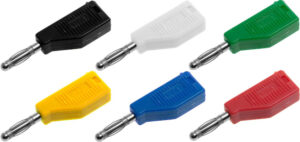
For separate plugs, Wiltronics’ Stackable Banana Plug 4mm is a piggyback-style 4mm plug that allows another banana plug to be inserted into the back, making it useful for repairs, custom leads and colour-coded classroom equipment.
The classroom problem banana plug leads solve
Banana plug test leads are not useful because they are complicated. They are useful because they remove friction from practical lessons.
In a school lab, the same leads may be used by many students across multiple classes. They need to be easy to identify, easy to connect, durable enough for repeated use and simple to check when something goes wrong.
Good banana plug leads help solve four common classroom problems.
1. Faster setup
Students can connect circuits quickly without stripping wire, twisting conductors or trying to hold loose connections in place.
This helps practical lessons start faster and gives teachers more time for instruction, observation and discussion.
2. Clearer polarity
Red and black banana leads make positive and negative connections easier to identify.
Other colours can be used for signal paths, test points, student groups or different sections of a demonstration circuit.
3. Easier troubleshooting
When a circuit does not work, a banana plug setup is easier to inspect than a tangle of loose wires.
Teachers can quickly check whether the issue is polarity, an open circuit, a misplaced meter lead or a faulty connection.
4. Better reuse
A good set of test leads can support many different lessons, including basic circuits, voltage and current measurement, resistance investigations, electronics testing, power supply demonstrations and microcontroller-related activities.
That makes them a practical investment for science labs and STEM classrooms.
Where banana plug test leads fit in science and STEM lessons
Banana plug leads are useful wherever students need to build, test or measure real circuits.
They suit lessons involving:
- Series and parallel circuits
- Voltage, current and resistance
- Ohm’s law
- Power and energy transfer
- Continuity testing
- Multimeter use
- Lamps, motors and resistive loads
- Power supplies
- Fault-finding
- Data collection and practical investigation
For example, students can build a simple low-voltage circuit using a power supply, lamp and resistor, then use stackable banana leads to add a multimeter connection across the load.
That helps students understand an important practical concept: voltage is measured across a component, while current is measured in series with the circuit. The physical lead arrangement helps make the theory visible.
How banana plug leads support microcontroller projects
Banana plug test leads are not usually the direct connector for an Arduino UNO R3, Raspberry Pi Pico or ESP32 board. Microcontrollers normally use jumper wires, breadboards, pin headers, screw terminals or module connectors.
That distinction is important.
The best way to connect this topic back to microcontrollers is to treat banana plug leads as part of the test and demonstration environment around the project, not as a replacement for jumper wires.
In a microcontroller lesson, banana plug leads may be useful for:
- Connecting a bench power supply to a larger demonstration circuit
- Testing lamps, buzzers, motors or loads before connecting them to a driver circuit
- Measuring voltage at key points in a system
- Connecting classroom-built panels to test equipment
- Linking low-voltage power rails in a demonstration setup
- Helping teachers show how the controlled output relates to the wider circuit
For example, students may use an Arduino UNO R3 to control an output, while banana plug leads are used around the bench to connect the power supply, meter or demonstration load. The Arduino UNO R3 is based on the ATmega328 and includes 14 digital input/output pins, 6 analogue inputs, a 16 MHz ceramic resonator, USB connection, power jack, ICSP header and reset button.
This links naturally to Wiltronics’ earlier guide, Best Microcontrollers for Schools: Arduino, Raspberry Pi Pico and ESP32 Compared, where schools can compare common microcontroller options for classroom projects.
The message is simple:
Use jumper wires and breadboards for the microcontroller board. Use banana plug leads for the wider lab, power and measurement setup.
Which banana plug products should a school keep on hand?
A practical school lab does not need only one type of lead. The best setup usually includes a mix of everyday leads, spare plugs, safer lab options and a few premium or specialist leads.
Everyday use: Banana Plug Test Lead – 4mm, Stackable
It is made from flexible 1.0mm² silicone cable and has a stackable 4mm banana plug-socket on each end. These leads suit educational applications across electronics, electrical and physics activities, including power supplies, multimeters, lab experiments and electronics prototyping.
Best for:
- Student benches
- General circuit activities
- Power supply connections
- Multimeter work
- Electronics and physics practicals
- Repeated classroom use
Recommended role: default classroom lead.
Repair and custom setups: Stackable Banana Plug 4mm
Separate Stackable Banana Plug 4mm connectors are useful when a school needs to repair leads, build custom cables or create demonstration equipment.
Best for:
- Repairing worn leads
- Building custom lengths
- Colour-coded circuits
- Test panels
- Replacement stock
Recommended role: maintenance and customisation stock.
Safer shared lab setups: shrouded banana leads
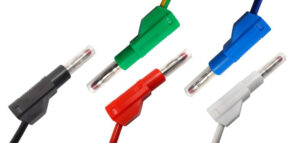
For shared labs or more controlled measurement activities, schools may prefer Banana Plug Test Leads – 4mm Stackable Retractable Shroud. These combine stackable 4mm banana plugs with a retractable shroud design intended to reduce accidental contact and accidental shorts during testing.
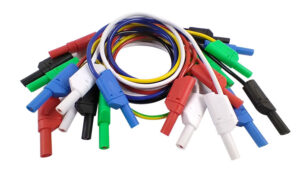
Another option is the 4mm Banana Test Leads with Shrouded Safety Plug, which may suit schools, STEM learning and lab users wanting shrouded safety plug leads with multiple length and colour options.
Best for:
- Shared lab equipment
- Senior practicals
- Staff demonstration benches
- Controlled measurement activities
- Mixed-experience student groups
Recommended role: safer lab and demonstration option.
Staff and technician benches: Hirschmann Banana Plug Test Lead 4mm
Higher-quality test leads are useful for equipment that sees frequent use by teachers, technicians or senior students.
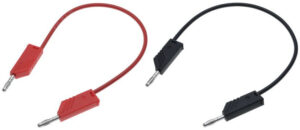
Wiltronics’ Hirschmann Banana Plug Test Lead 4mm has 4mm stackable plugs, is 250mm long, and is rated at 60V and 16A.
Best for:
- Technician benches
- Staff demonstration areas
- Electronics servicing
- Senior secondary labs
- TAFE, university or workshop use
Recommended role: premium lead for high-use stations.
While available: mixed 15-pack stackable leads
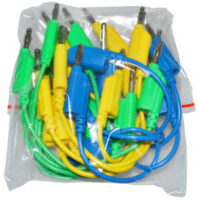
For short-term lab refreshes, compact bench activities or spare lead stock, the Stackable Banana Plug Test Leads – 4mm, Mixed Pack of 15 x 10cm may be a useful value option while available.
Because clearance or reduced-to-clear products may not be a permanent range item, schools should treat this as a convenient option when in stock rather than the core evergreen recommendation.
Best for:
- Short test connections
- Compact bench activities
- Group activities
- Spare lead stock
- Short-term lab refreshes
Recommended role: value option while available.
Practical buying recommendation for schools
For a school electronics or science lab, a sensible starting setup would include:
- Stackable 4mm banana plug test leads for everyday use
- Red and black leads for power and polarity
- Extra colours for signals, groups or test points
- Shrouded or retractable-shroud leads where extra contact protection is useful
- Separate stackable banana plugs for repairs and custom leads
- Banana sockets and binding posts from the broader Banana Plugs & Sockets category for panels and demonstrations
- Hirschmann or other premium leads for staff or technician benches
- Mixed short-lead packs where available for compact activities or spare stock
This gives teachers flexibility without making the buying process complicated.
Safety and maintenance checklist
Banana plug test leads are simple, but they still need regular inspection in a school environment.
Before practical use, check that:
- Insulation is not cracked, cut or damaged
- Plugs are not loose
- Leads do not make intermittent contact
- Voltage and current ratings suit the equipment being used
- Red and black leads are used consistently for polarity
- Damaged leads are removed from student use
- Leads are stored without knots, strain or sharp bends
- Shrouded leads are used where extra contact protection is preferred
The goal is to keep practical lessons reliable, repeatable and easy to supervise.
Simple classroom activity: measuring voltage with stackable banana leads
A useful beginner activity is to have students build a low-voltage circuit using a power supply, lamp or resistor, and a multimeter.
Students can:
- Build the circuit using banana plug leads.
- Identify the positive and negative supply connections.
- Use red and black leads consistently.
- Measure voltage across the load.
- Add a meter connection using a stackable plug.
- Compare the physical circuit with the circuit diagram.
- Explain why voltage is measured in parallel.
This activity supports circuit understanding, polarity, measurement technique and troubleshooting. It can also lead naturally into microcontroller learning, where students later replace manual switching with a programmed output, transistor driver, relay module or sensor-triggered control system.
For the next step, teachers can connect this activity to Wiltronics’ Best Microcontrollers for Schools: Arduino, Raspberry Pi Pico and ESP32 Compared guide and help students move from simple circuits into programmed systems.
Why buy banana plug test leads from Wiltronics?
Wiltronics’ Banana Plugs & Sockets range includes banana plugs, sockets, binding posts and test leads for educational labs, electronics benches and test setups. The range includes stackable, right-angle, screw-type, solder-type and cross-stacking banana plug options, as well as standard classroom test leads and premium Hirschmann leads.
For schools, that matters because lab equipment needs to be easy to replace, expand and standardise. Buying banana plug leads, plugs, sockets, binding posts, multimeters and related electronics equipment from one supplier can make classroom kit management simpler.
A stackable banana plug test lead is a small item, but it solves a common problem: making practical circuit work easier to connect, inspect, measure and repeat.
Final recommendation
For most school electronics, STEM and science labs, stackable 4mm banana plug test leads should be treated as essential bench equipment.
They help students connect circuits faster, make polarity clearer, simplify measurements and reduce setup issues during practical lessons.
Start with everyday stackable 4mm leads, add shrouded options where extra contact protection is useful, and keep spare plugs and sockets available for repairs, panels and demonstrations.
For schools already teaching microcontroller projects, banana plug leads also support the wider lab setup around Arduino, Raspberry Pi Pico and ESP32 activities — especially where students need to test power, measure voltage or connect demonstration equipment.
Curriculum relevance
This article supports Australian school learning in practical science, electronics and STEM.
Relevant areas include:
Science:
Electric circuits, voltage, current, resistance, energy transfer, measurement and practical investigation.
Design and Technologies:
Testing components, creating electrical systems, evaluating prototypes and improving designed solutions.
Digital Technologies:
Physical computing, programmed systems, inputs and outputs, microcontrollers, sensors and actuators.
STEM skills:
Troubleshooting, systems thinking, safe equipment use, measurement, problem-solving and interpreting evidence.
FAQ
What are banana plug test leads used for?
Banana plug test leads are used to connect power supplies, multimeters, circuit boards, binding posts, sockets and test equipment. They are common in school labs, electronics benches and workshop testing.
Why are stackable banana plug leads useful?
Stackable banana plug leads allow another banana plug to connect into the back of the plug. This makes it easier to add a meter connection, split a supply point or modify a circuit without rebuilding the whole setup.
Are banana plug test leads useful for school labs?
Yes. They help students build circuits faster, follow polarity more clearly and troubleshoot connections more easily. They are especially useful for science, STEM, physics and electronics lessons.
Can banana plug leads connect directly to Arduino?
Usually not directly. Arduino boards normally use jumper wires, headers, breadboards or screw terminals. Banana plug leads are more useful around the project, such as for power supplies, meters, loads, test panels and demonstration equipment.
What colour banana plug leads should schools buy?
Red and black are the most important colours for positive and negative or supply and ground connections. Extra colours can help identify signal paths, test points, student groups or different circuit sections.
Are shrouded banana plug leads better?
Shrouded banana plug leads are useful where extra contact protection is preferred. They are a good option for shared lab benches, senior practicals and controlled measurement activities.
How often should schools check banana plug leads?
Schools should check leads before practical lessons and remove any lead with damaged insulation, loose plugs, intermittent contact or visible wear.
Why Stackable Banana Plug Test Leads Belong in Every School Electronics Lab
© Electrotech Brands Pty Ltd 2026
Write a Comment
You must be logged in to post a comment.