

Soldering Iron or Soldering Station: Which Should You Buy?
July 24, 2026
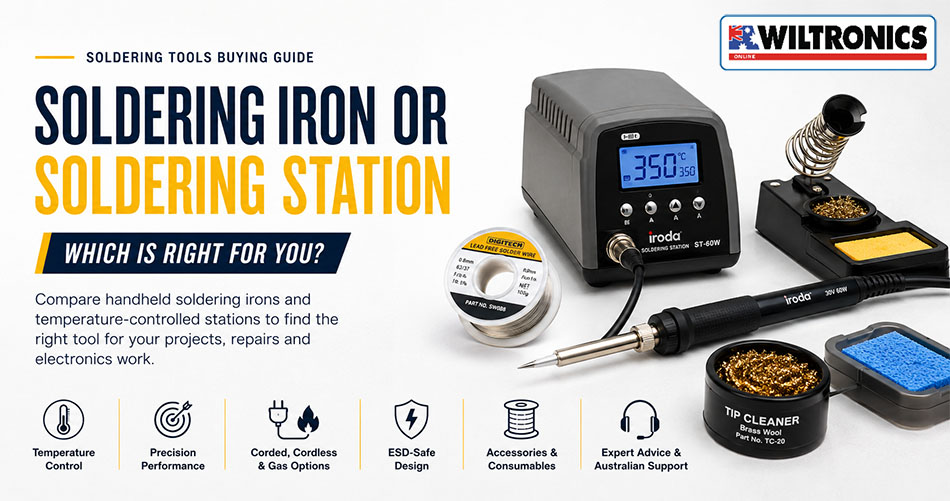
Soldering Iron vs Soldering Station: Which Should You Buy?
A handheld soldering iron and a soldering station perform the same basic task: heating a metal tip so solder can form an electrical and mechanical connection.
The difference is in how much control, consistency and convenience each tool provides.
A basic soldering iron is compact, affordable and easy to store. It can be a practical choice for occasional repairs, simple wire connections and mobile work.
A temperature-controlled soldering station is generally better for regular electronics assembly, PCB projects and repair benches. It provides adjustable heat, a secure stand and more consistent performance across different components.
This guide compares soldering irons and soldering stations, explains the features that matter and recommends suitable tools for beginners, hobbyists, technicians, classrooms and workshops.
Browse the complete Wiltronics range of soldering tools and equipment.
Quick recommendation: Choose a handheld soldering iron for occasional or portable work. Choose a temperature-controlled soldering station for regular electronics projects. Add hot-air or vacuum desoldering equipment only when your repair work requires it.
Soldering Iron vs Soldering Station at a Glance
| Feature | Handheld soldering iron | Soldering station |
|---|---|---|
| Temperature control | Fixed or limited on basic models | Adjustable on most stations |
| Portability | Excellent | Mainly designed for bench use |
| Storage | Compact | Requires more space |
| Heat consistency | Depends on the model and joint | Generally more consistent |
| Integrated stand | Usually separate | Normally included |
| Tip options | Varies by model | Often supports several profiles |
| Best for | Occasional repairs and mobile work | Regular electronics and PCB assembly |
| Learning curve | Simple | Slightly more setup required |
| Typical investment | Lower | Higher |
| Extended use | Less convenient | More comfortable and controlled |
What Is a Handheld Soldering Iron?
A handheld soldering iron contains the heating element, handle and tip in one compact tool.
Corded irons plug directly into mains power. Rechargeable irons use an internal battery, while gas irons use a refillable fuel source.
A basic iron may operate at a fixed temperature. Other handheld models provide selectable power or limited heat adjustment.
Explore handheld, rechargeable and gas soldering irons for portable and general-purpose options.
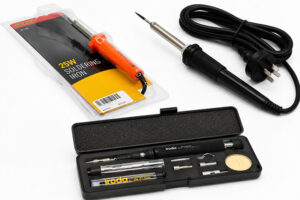
A Handheld Iron Is Best When:
- Soldering is only an occasional task
- The work involves basic wire connections
- Portability is more important than precise adjustment
- Storage space is limited
- The tool needs to travel in a service kit
- There is no suitable mains outlet near the project
- A compact backup iron is required
Main Advantages
Handheld irons are easy to transport and store. A corded model can also be ready to use without setting up a separate control unit.
Rechargeable and gas models provide additional freedom for field repairs, automotive accessory work and other suitable low-voltage applications.
Main Limitations
Basic irons may not provide stable or adjustable temperature control.
This can make it harder to move between small PCB pads, larger terminals and joints connected to broad copper areas. A separate heat-resistant stand is also required if one is not included.
What Is a Soldering Station?
A soldering station normally includes:
- A control unit
- A separate soldering pencil
- Adjustable temperature
- A heat-resistant iron holder
- Tip-cleaning material
- Interchangeable tips on compatible models
The control unit regulates power to the heating element and helps maintain the selected operating temperature.
Browse the Wiltronics range of temperature-controlled soldering stations.

A Soldering Station Is Best When:
- Electronics work is completed regularly
- Projects involve printed circuit boards
- Several component and joint sizes are encountered
- Temperature-sensitive parts are used
- The tool remains on a dedicated workbench
- Multiple tip profiles are needed
- Repeatable performance matters
- The user solders for extended sessions
Main Advantages
A station provides greater control over the tip temperature.
It can be adjusted for different solder alloys, component sizes and tip shapes. Many stations also offer better heat recovery when the tip contacts a larger joint.
The included holder creates a defined location for the hot iron and helps organise the workspace.
Main Limitations
A station is less portable than a standalone iron and occupies more bench space.
It also costs more than a basic fixed-temperature tool. That extra investment may not be necessary for someone completing one simple project each year.
Which One Should a Beginner Buy?
For most beginners planning to continue with electronics, a temperature-controlled soldering station is the stronger long-term choice.
Temperature adjustment makes it easier to work with different joints while developing good soldering habits. A station also provides a stable holder and generally supports replaceable tips.
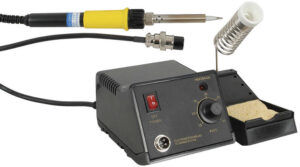
The 48W Temperature-Controlled Soldering Iron Kit is designed for hobby and advanced users. It provides analogue adjustment from 150°C to 450°C, a ceramic heating element and an exchangeable fine conical tip.
A simple handheld iron may still be suitable when:
- The budget is very limited
- Only one basic kit is being assembled
- The tool is needed for occasional wire repairs
- Portability is essential
- The user already has a safe stand and suitable accessories
New users can also read What Is Soldering? before beginning their first project.
Which Tool Is Better for PCB Assembly?
A temperature-controlled station is generally the better choice for printed circuit board assembly.
PCB projects can include fine component leads, larger connectors and broad copper areas that absorb heat differently. Adjustable temperature and suitable tip selection make it easier to adapt to these changes.
A station is particularly useful for:
- Through-hole electronics kits
- Arduino-compatible projects
- Prototype circuit boards
- Robotics controllers
- Component replacement
- Repeated assembly tasks
- Electronics training
Temperature control does not replace correct technique. The tip must still be clean and appropriately sized, and the surfaces must be heated correctly before solder is applied.
See How to Solder Electronics Properly for step-by-step technique guidance.
Which Tool Is Better for Portable Repairs?
A handheld rechargeable or gas iron is normally more practical for work away from a bench.
Rechargeable Soldering Irons
Rechargeable irons avoid both a power lead and a gas canister.
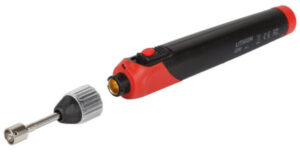
The Lithium-Ion USB Rechargeable Soldering Iron provides selectable 30W and 50W operation and up to approximately 45 minutes of continuous use from a full charge.
A rechargeable iron can be useful for:
- Quick low-voltage repairs
- Mobile electronics work
- Service toolkits
- Locations with limited power access
- Short installation tasks
Check the operating time, charge level and available tip selection before relying on a battery-powered iron for a long job.
Gas Soldering Irons
Gas irons provide portable heat without relying on a battery.
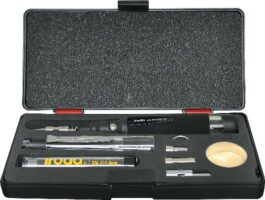
The Iroda Solderpro 70 Gas Soldering Iron Kit is a compact 80W-equivalent option for appropriate field, maintenance and repair applications.
Gas tools require careful fuel handling, ventilation and cooling before storage. Hot exhaust can also affect nearby plastic, insulation or components.
For delicate bench electronics, a controlled electric station is usually easier to manage.
Is More Wattage Better?
A higher wattage does not automatically make one soldering tool better than another.
Wattage indicates the power available to the heating system. More available power can help a tool heat quickly and recover after contacting a joint that absorbs substantial heat.
However, soldering performance also depends on:
- Temperature regulation
- Heating-element design
- Tip size and shape
- Thermal contact with the joint
- Sensor position
- Heat-recovery speed
- Tool condition
- Intended duty cycle
A well-regulated station may provide better electronics performance than a higher-wattage fixed-temperature iron.
Choose the tool for the size and type of work rather than comparing wattage alone.
Features to Compare Before Buying
Adjustable Temperature
Temperature control is one of the most useful features for regular electronics work.
It allows the user to adapt the station to different solder, tips, joints and components instead of applying the same heat to every task.
Replaceable Tips
Check the available tip range before purchasing.
Common profiles include:
| Tip type | Typical application |
|---|---|
| Fine conical | Small pads and closely spaced leads |
| Standard conical | General electronics work |
| Small chisel | PCB assembly and wire connections |
| Large chisel | Connectors and joints requiring greater heat transfer |
| Specialised tip | Application-specific component work |
The narrowest tip is not always the best. A tip needs enough contact area to transfer heat efficiently into the joint.
Heat Recovery
A tool may display the selected temperature but still cool significantly when it touches a large connection.
Good heat recovery allows the tip to return to its operating temperature quickly between joints.
This becomes increasingly important during repeated assembly work.
Standby and Sleep Modes
Some digital stations reduce the tip temperature when the iron is left in its holder.
This can reduce unnecessary heating and tip oxidation during interruptions.
ESD-Safe Design
Electrostatic discharge protection should be considered when working with sensitive components.
An ESD-safe station is particularly useful for professional repair benches, production environments and advanced electronics laboratories.
Spare-Part Availability
Check whether the supplier supports:
- Replacement tips
- Heating elements
- Soldering pencils
- Cleaning accessories
- Nozzles
- Filters
- Tool stands
A station with replaceable parts may provide better long-term value than a cheaper unit that cannot be maintained.
Recommended Tools by Application
| User or project | Recommended tool | Example |
|---|---|---|
| First electronics projects | Entry-level temperature-controlled station | 48W Temperature-Controlled Soldering Iron Kit |
| Occasional mobile repairs | Rechargeable handheld iron | Lithium-Ion USB Rechargeable Soldering Iron |
| Field maintenance | Gas soldering iron | Iroda Solderpro 70 Gas Soldering Iron Kit |
| Regular electronics bench | Digital temperature-controlled station | Weller WE1010 70W Soldering Station |
| Surface-mount repair | Combined soldering and hot-air station | 2-in-1 Soldering and Hot-Air Rework Station |
| Frequent through-hole repair | Combined soldering and vacuum desoldering station | Micron Soldering and Vacuum Desoldering Station |
When Should You Choose a Higher-Performance Station?
A higher-performance station becomes worthwhile when soldering forms a regular part of your work.
The Weller WE1010 70W Temperature-Controlled Soldering Station is designed for consistent bench operation and supports compatible Weller ET Series tips.
Consider moving to a higher-performance station when:
- The tool is used several times each week
- Several tip profiles are required
- Fast recovery matters
- Settings need to be repeated
- Replacement parts must remain available
- The station will be shared
- Downtime would interrupt workshop activity
A more expensive station is not essential for every hobby project. Its value comes from regular use, control, maintainability and workflow improvements.
When Do You Need Hot-Air Rework?
A hot-air rework station uses controlled heated airflow rather than direct tip contact.
It is useful for compatible surface-mount tasks, including:
- Removing multi-leaded components
- Reflowing solder paste
- Heating a defined area
- Working around small surface-mount packages
- Completing specialist electronics repairs
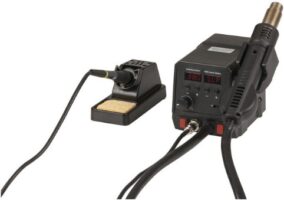
The 2-in-1 Soldering and Hot-Air Rework Station combines a 60W soldering pencil with a 300W hot-air blower, adjustable temperature and ESD-safe operation.
Hot air is not required for most beginner electronics kits. Airflow, nozzle selection and temperature must be controlled carefully to avoid moving nearby components or overheating the PCB.
When Do You Need a Vacuum Desoldering Station?
A vacuum desoldering station heats a solder joint and draws the molten solder through a hollow nozzle.
This can save considerable time when repeatedly removing through-hole components, sockets or connectors.
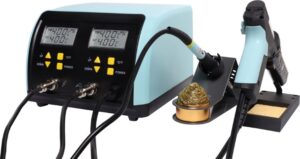
The Micron Combination Soldering and Vacuum Desoldering Station combines a 60W soldering iron with a 90W vacuum desoldering tool.
A powered desoldering station is most suitable for:
- Electronics repair technicians
- Equipment refurbishment
- Repeated through-hole component removal
- Production rework
- Advanced training workshops
- Multi-pin connectors
For occasional mistakes, desoldering wick or a manual solder sucker will normally be more economical.
Browse desoldering tools and equipment or read the guide to basic desoldering methods.
Essential Accessories for Either Tool
The soldering iron or station is only part of a complete setup.
Solder
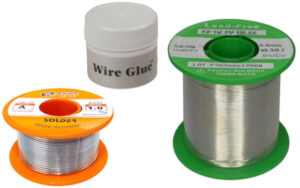
Choose solder with an alloy, diameter and flux core suited to the project and workplace requirements.
Fine solder wire offers greater control around small component pads. A larger diameter can be more convenient for substantial terminals and wire connections.
Browse solder wire for electronics and workshop applications.
Flux
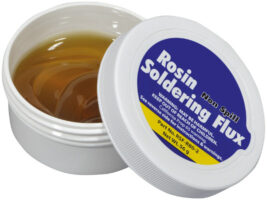
Flux helps remove surface oxidation and encourages solder to wet the connection.
Additional flux can be especially useful during rework, component replacement and solder removal.
Explore solder flux, paste and flux pens or read What Is Flux in Soldering?.
Secure Iron Stand
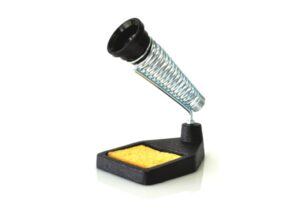
A hot iron should always be returned to a stable, heat-resistant holder.
A station normally includes a holder. Standalone irons require a separate stand unless one is supplied with the tool.
Compare soldering iron stands and workbench accessories.
Fume Extraction
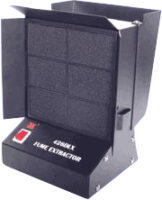
Arrange the workspace so fumes move away from the breathing zone.
A local extractor can help capture fumes close to the joint and should be used alongside suitable ventilation and safe working procedures.
Browse solder fume extractors and replacement filters.
Cutting and Component-Handling Tools
A practical soldering setup may also include:
- Side cutters
- Wire strippers
- Fine-nose pliers
- Precision tweezers
- PCB holder
- Magnification
- Desoldering wick
- Tip-cleaning material
- Heat-resistant work surface
- Eye protection
What Is Best for a School Electronics Lab?
A temperature-controlled station is generally more suitable than a basic fixed-temperature iron for repeated classroom electronics work.
Schools should also consider:
- Durable holders
- Replaceable tips
- Clear controls
- Fume management
- Supervised storage
- Bench protection
- Suitable solder
- Class-set consistency
- Availability of spare parts
Because classroom purchasing has its own durability, supervision and workstation requirements, see the dedicated guide to soldering stations for Australian STEM classrooms.
Common Buying Mistakes
Choosing by Wattage Alone
Power is only one part of the heating system.
Compare temperature control, recovery, tips and intended application as well.
Buying a Fixed-Temperature Iron for Frequent PCB Work
A basic iron may complete the task, but regular users will normally benefit from adjustable temperature and a secure station.
Buying Specialist Equipment Too Early
Hot-air and vacuum functions add cost and complexity.
Purchase them when surface-mount or through-hole repair work genuinely requires those capabilities.
Ignoring Replacement Tips
Check the tip range before purchasing the tool.
A reliable station becomes less useful when an appropriate replacement profile cannot be sourced.
Forgetting the Stand and Fume Setup
A complete buying decision should include the workspace.
Allow for a secure holder, ventilation, extraction, cleaning supplies and safe storage.
Assuming a Fine Tip Is Always Better
Very fine tips have limited contact area and may transfer heat poorly into larger joints.
Match the tip to the connection rather than using one profile for every task.
Soldering Tool Buying Checklist
Before ordering, ask:
- Will the tool be used occasionally or regularly?
- Will it remain on a bench or travel?
- Do I need adjustable temperature?
- What sizes of joints will I solder?
- Will I work mainly with wires, through-hole parts or surface-mount components?
- Are replacement tips available?
- Is a stable holder included?
- Do I need ESD-safe equipment?
- Will I remove components regularly?
- How will fumes be managed?
- Are replacement parts and consumables available?
- Does the tool suit my current skills and future projects?
Frequently Asked Questions
Is a soldering station better than a soldering iron?
A soldering station is generally better for regular electronics work because it provides adjustable temperature, a dedicated holder and broader tip options.
A handheld iron may be more convenient for occasional or portable tasks.
Should a beginner buy an iron or a station?
A beginner planning to build several electronics projects will normally gain more value from an entry-level temperature-controlled station.
A basic iron can still suit a single project or occasional wire repair.
How many watts should a soldering iron have?
There is no single wattage that suits every task.
Consider temperature control, tip size and heat recovery alongside the power rating.
Do I need a digital display?
A display makes settings easier to view, but it does not guarantee better performance.
Temperature stability, recovery, tips and construction are more important than the display alone.
Do I need a hot-air rework station?
Hot air is mainly useful for compatible surface-mount component removal, solder-paste reflow and specialist repair work.
It is not essential for most beginner through-hole projects.
Do I need a desoldering station?
Occasional corrections can normally be handled with wick or a manual solder sucker.
A vacuum station becomes worthwhile when through-hole components are removed regularly.
Can I use one soldering tip for everything?
One general-purpose tip can handle many tasks, but different joint sizes benefit from different profiles.
A small chisel tip is often more versatile for electronics than an extremely fine point.
Is a cordless soldering iron suitable for bench work?
A cordless iron can complete short bench tasks, but battery capacity and heat recovery may limit longer sessions.
A powered station is usually more convenient for regular bench use.
Final Verdict: Soldering Iron or Soldering Station?
Choose a handheld soldering iron when portability, compact storage and occasional use are the main priorities.
Select a temperature-controlled soldering station when you regularly assemble electronics, work on PCBs or need more consistent heat and tip options.
Choose a hot-air rework station for compatible surface-mount work.
Select a vacuum desoldering station when repeated through-hole component removal is part of the job.
For most electronics hobbyists, makers and technicians working at a bench, a temperature-controlled station provides the best balance of versatility, control and long-term value.
Explore the full Wiltronics range of soldering irons, stations, solder and accessories to build a setup suited to your projects.
© Electrotech Brands Pty Ltd 2026
Write a Comment
You must be logged in to post a comment.