

Ohaus High Capacity Balances: Pioneer vs Adventurer vs Explorer
September 10, 2026
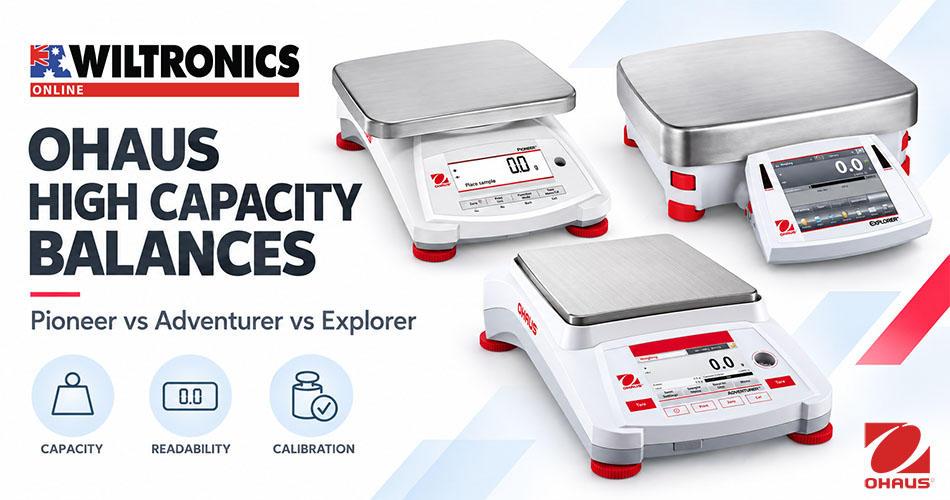
Ohaus High Capacity Balances: Pioneer vs Adventurer vs Explorer
A large sample does not always allow a large weighing error. Whether you are preparing a batch, weighing materials in a substantial container or comparing sample masses, you may need kilogram-scale capacity alongside a display that resolves tenths of a gram.
The Ohaus high capacity precision balance range at Wiltronics includes Pioneer, Adventurer and Explorer models, with listed capacities from 12kg to 35kg and 0.1g readability.
The right choice depends on the load, the smallest quantity you need to measure and the way your team works. This guide compares the three ranges, explains the specifications that matter and shows how to shortlist a balance for your application.
Pioneer vs Adventurer vs Explorer: a quick guide
| Your priority | Start with | What makes it worth comparing |
|---|---|---|
| Straightforward weighing up to 12kg | Pioneer | Backlit LCD, routine weighing applications and a 248 × 193mm pan |
| Touchscreen operation at 12kg capacity | Adventurer | Colour touchscreen, USB Host connectivity and a choice of calibration arrangements |
| Bulky containers or loads above 12kg | Explorer | 377 × 311mm pan and 12kg, 24kg or 35kg capacity options |
These are starting points, not automatic recommendations. All seven models compared below have 0.1g readability, so a higher-capacity model does not provide a finer display increment.
Start with the job, then choose the balance
Before comparing models, write down three requirements:
- The heaviest combined load: sample, container and anything else supported by the pan.
- The smallest addition or mass change that matters to the result.
- The container footprint and the records you need to produce.
A balance may have enough capacity yet be awkward to use with a wide vessel. Another may display enough decimal places but still be unsuitable for a very small ingredient. Treat capacity, measurement performance and physical fit as separate checks.
Capacity includes the container
Taring subtracts the container from the displayed result; it does not remove its physical load from the balance. The listed models use tare by subtraction, as shown in the specifications for the Pioneer PX12001/E and Explorer EX24001.
Consider this illustrative example:
| Load component | Mass |
|---|---|
| Empty container | 2.5kg |
| Material to be weighed | 10kg |
| Total load on the balance | 12.5kg |
A 12kg balance cannot accommodate that combined load, even after the container is tared. A higher-capacity model belongs on the shortlist.
Allow for foreseeable additions, changes in container weight and normal process variation. Plan around your actual maximum gross load rather than operating continually at the capacity limit.
Readability is not the same as accuracy
Readability describes the smallest displayed increment. A balance with 0.1g readability displays mass in steps of one tenth of a gram. It does not follow that every result is accurate to ±0.1g.
Manufacturers specify other performance characteristics separately. For example, Wiltronics lists 0.1g readability, typical repeatability of 0.1g and linearity of ±0.2g for the Explorer EX35001. These describe different aspects of performance; none should be substituted for an assessment of the complete weighing process.
The importance of a display increment also changes with sample size. As a simple arithmetic illustration, 0.1g represents 1% of 10g but only 0.01% of 1,000g. Those percentages are not uncertainty estimates or accuracy guarantees. They show why a display that is useful for a large batch may be too coarse for a small addition.
If a recipe combines a heavy bulk material with a tiny additive, two balances may be appropriate: one for the bulk load and another with finer readability for the additive. Confirm suitability against the smallest quantity and permitted error in your method.
Compare the Ohaus models at Wiltronics
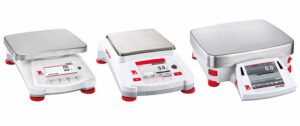
| Model | Capacity | Calibration arrangement | Weighing pan |
|---|---|---|---|
| Pioneer PX12001/E | 12,000g | External | 248 × 193mm |
| Pioneer PX12001 | 12,000g | InCal, semi-automatic internal | 248 × 193mm |
| Adventurer AX12001/E | 12,000g | External | 195 × 175mm |
| Adventurer AX12001 | 12,000g | AutoCal, automatic internal | 195 × 175mm |
| Explorer EX12001 | 12,000g | AutoCal, automatic internal | 377 × 311mm |
| Explorer EX24001 | 24,000g | AutoCal, automatic internal | 377 × 311mm |
| Explorer EX35001 | 35,000g | AutoCal, automatic internal | 377 × 311mm |
Pioneer: a straightforward starting point for 12kg weighing
The Pioneer high capacity range is worth considering when you want routine weighing functions and a conventional display.
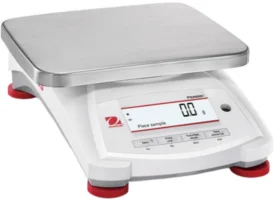
The PX12001 combines a two-line backlit LCD with RS232 and USB connectivity. Listed applications include parts counting, percent weighing and formulation. Its removable stainless steel pan measures 248 × 193mm.
Choose between the PX12001 with semi-automatic InCal and the PX12001/E with external calibration. The external version is a candidate where suitable calibration masses and an established operator procedure are already available.
Adventurer: touchscreen operation for a shared laboratory
The Adventurer high capacity range adds a 4.3-inch colour touchscreen and USB Host, USB Device and RS232 interfaces.
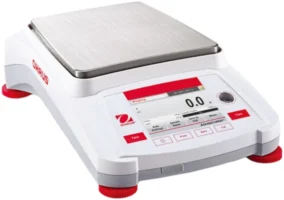
The AX12001 offers automatic internal AutoCal, while the AX12001/E uses external calibration. Both provide 12kg capacity and a 195 × 175mm pan.
Adventurer is a useful shortlist option when touchscreen navigation and data output matter to daily work. However, its pan is smaller than the Pioneer pan listed above. A more sophisticated interface does not necessarily mean more room for your container.
Explorer: larger pans and capacity up to 35kg
The Explorer high capacity range is the next place to look when container size or gross load rules out the smaller platforms.
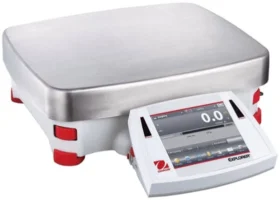
The EX12001 retains 12kg capacity but provides a 377 × 311mm pan. That makes it relevant even when you do not need a higher maximum load.
For heavier samples, compare the 24kg EX24001 and 35kg EX35001. Both retain 0.1g readability and the same pan dimensions.
These Explorer models list a 5.7-inch colour touchscreen, automatic internal calibration and two touchless sensors. USB and RS232 are included; Ethernet is an accessory. Confirm the required connection and accessories before planning integration with your record-keeping system.
Three examples: choosing for the actual task
The following scenarios are illustrative. Each shortlist still needs to be checked against the method’s measurement tolerance and operating conditions.
1. Laboratory batch preparation
A laboratory prepares an 8kg batch in a 1.5kg container. The 9.5kg gross load fits within a 12kg capacity, so Pioneer, Adventurer and Explorer can all remain under consideration on capacity alone.
If the vessel fits securely on the smaller pan and operators frequently navigate formulation functions, the Adventurer AX12001 is worth comparing. Its touchscreen and internal calibration may suit that routine. A Pioneer PX12001 remains an alternative when an LCD interface is preferred.
Check the smallest ingredient separately: fitting the whole batch within capacity does not establish that every small addition can be measured adequately.
2. Bulky sample weighing
A materials laboratory weighs a sample and tray totalling 7kg. The load is not especially heavy for this range, but the tray has a 300 × 250mm base.
That footprint exceeds both the Pioneer and Adventurer pan dimensions in this comparison. The Explorer EX12001, with its 377 × 311mm pan, is a more promising physical fit. Confirm that the actual tray sits stably and clears surrounding surfaces.
This is a case where upgrading for pan size can make sense without increasing capacity.
3. Manufacturing quality control
A quality-control team checks assemblies weighing up to 18kg in a 2kg support fixture. The combined 20kg load exceeds the 12kg models, making the Explorer EX24001 a candidate. If expected assemblies and fixtures will exceed 24kg, compare the EX35001 instead.
Explorer’s documented checkweighing functions allow comparison with configured target limits. Before using the result to accept or reject an assembly, establish suitable tolerances, verify measurement performance and test the intended data output. A connection port alone does not establish compatibility with your production software. See the Ohaus Explorer application overview.
Match calibration to your working routine
External calibration uses separate masses. Internal systems provide built-in calibration capability, with Pioneer InCal and Adventurer/Explorer AutoCal offering different levels of automation.
Consider who will perform checks, how often the balance is moved and how results will be recorded. Internal calibration can simplify operation, but it does not replace documented performance checks or any independent calibration required by your quality system. Follow the model-specific instructions, including initial setup and calibration procedures. The Ohaus Pioneer manual provides the operating reference for the PX series.
Check the weighing location before upgrading
A suitable location helps a precision balance perform consistently. Use a firm, level support away from vibration, draughts and rapid temperature changes. Allow the required warm-up, level the instrument and complete the prescribed calibration before use. These installation steps are covered in the Ohaus Explorer instruction manual.
For a large container, also check that its base sits securely on the pan, the display remains visible and no part of the load touches surrounding objects. Include the space needed to lift and position the load when planning the workstation.
A practical buying checklist
Before ordering, confirm:
- Maximum gross load, including the container and any supported accessories.
- Smallest quantity to be weighed and the permitted measurement error.
- Pan dimensions and stable support for the actual vessel.
- Preferred calibration arrangement and any required external masses.
- Required applications, such as formulation or parts counting.
- Data connections, software compatibility and separately purchased accessories.
- Bench space, operating conditions and power requirements.
Frequently asked questions
What does /E mean on these models?
For the Pioneer and Adventurer models listed here, /E identifies the external-calibration version. The corresponding models without /E offer internal calibration: InCal on Pioneer and AutoCal on Adventurer.
Are rechargeable batteries and Ethernet included?
Do not assume so. The Explorer high-capacity documentation lists the rechargeable battery pack and Ethernet connection as options. Check the supplied configuration when ordering; an accessory shown in a photograph is not necessarily included. See the Explorer accessories list.
Does a balance with GLP/GMP data output make a process compliant?
Data-output functions can support records, but they do not establish compliance for the complete process. Your procedures, verification, record handling and applicable quality requirements still need to be addressed.
Choose a balance that fits your whole process
The most useful balance has enough capacity for the complete load, suitable performance for the smallest measurement and a platform that accommodates your container securely.
Explore Ohaus high capacity precision balances at Wiltronics to compare Pioneer, Adventurer and Explorer.
Need help narrowing the choice? Give the Wiltronics team your maximum combined load, container dimensions, smallest quantity to be weighed and acceptable measurement tolerance. Include any calibration or data-connection requirements so the discussion covers the complete setup.
© Electrotech Brands Pty Ltd 2026
Write a Comment
You must be logged in to post a comment.