

Glass vs Plastic Labware : A Guide for School Science Labs
August 14, 2026
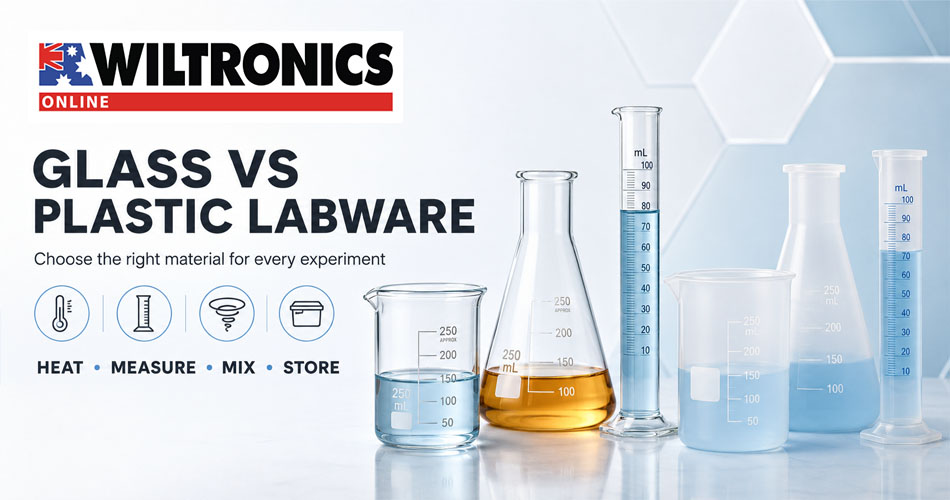
Glass vs Plastic Labware: A Guide for School Science Labs
Choosing between glass and plastic labware is not simply a matter of cost or durability. The right material depends on what students need to heat, measure, mix, observe or store.
Borosilicate glass is valued for its clarity, chemical resistance and ability to cope with temperature changes. Plastic labware is lightweight, economical and less likely to break during busy practical classes. Specialised plastics such as polypropylene and TPX can also provide excellent chemical resistance and, in suitable products, autoclavability.
For most school laboratories, the best solution is a carefully selected combination of both. This guide compares the main materials and explains where each type of labware performs best.
Glass vs plastic labware at a glance
| Consideration | Glass labware | Plastic labware |
|---|---|---|
| Visibility | Excellent optical clarity | Varies from translucent to highly transparent |
| Heating | Borosilicate glass is generally preferred for appropriate heating applications | Usually not intended for direct flame or hotplate heating |
| Breakage | Can chip, crack or shatter | Lightweight and highly resistant to breakage |
| Chemical resistance | Generally excellent, although compatibility still needs checking | Depends strongly on the polymer and chemical |
| Measurement | Available in highly accurate volumetric formats | Excellent for routine classroom measuring; accuracy varies by product |
| Handling | Heavier and requires careful handling | Lightweight and well suited to frequent student use |
| Cleaning | Reusable and often autoclavable | Many products are reusable or autoclavable; others are disposable |
| Best suited to | Heating, clear observation, titration and precision work | General mixing, transferring, storage and breakage-prone activities |
Always check the specifications and chemical compatibility of the individual product before use. “Glass” and “plastic” describe broad material families rather than a single set of performance characteristics.
Why borosilicate glass is a laboratory standard
Borosilicate glass has a low coefficient of thermal expansion. In practical terms, it expands and contracts less than ordinary glass as its temperature changes, giving it better resistance to thermal shock.
That makes borosilicate glass a strong choice when a classroom procedure involves appropriate heating, cooling or clear observation of a reaction. It is also hard, non-porous and resistant to many commonly used laboratory chemicals.
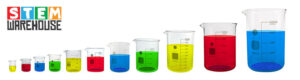
The Wiltronics GG17 borosilicate glass beaker is fully autoclavable and includes graduations for approximate volume measurement. For swirling and mixing with a reduced risk of splashing, the narrow neck and conical profile of an Erlenmeyer flask can be more suitable.
Glass does, however, require sensible handling. Labware should be inspected before use and removed from service if it is chipped, scratched or cracked. Students should also avoid sudden temperature changes unless the product and procedure are designed for them.
Why plastic labware belongs in the classroom
Plastic labware can reduce breakage, replacement costs and the handling risks associated with broken glass. It is especially useful in junior classes, high-throughput practical sessions, fieldwork and activities where direct heating is unnecessary.
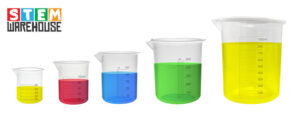
Polypropylene is one of the most useful laboratory plastics. It is lightweight, robust and resistant to many chemicals. Products such as the polypropylene low-form beaker provide an economical option for routine measuring, mixing and pouring. A polypropylene Erlenmeyer flask offers a breakage-resistant alternative for non-heating activities.
TPX, also known as polymethylpentene, is another useful labware material. It combines low density with high transparency and good thermal and chemical resistance. The 25 ml TPX measuring cylinder has clear graduations, a pouring spout and a stable hexagonal base. It is autoclavable and meets Class B accuracy requirements under DIN 1261 and ISO 6706.
No plastic is universally compatible with every chemical. Teachers and laboratory technicians should consult the product information and relevant safety data before introducing a plastic vessel into a new procedure.
Choosing beakers for mixing and heating
Beakers are among the most frequently used items in a science laboratory, but their graduations are generally intended for approximate rather than high-precision measurement.
Choose a GG17 borosilicate glass beaker when the activity calls for suitable heat-resistant labware or when maximum visibility is important. Choose a graduated polypropylene beaker for routine mixing, decanting and student activities where avoiding broken glass is the priority.
A practical school inventory will often include both: glass beakers for teacher-directed heating procedures and plastic beakers for general-purpose student work.
Choosing measuring cylinders for liquid volume
Measuring cylinders are narrower than beakers, making them better suited to reading liquid volume. For the most reliable result, place the cylinder on a level surface and read the appropriate meniscus at eye level.
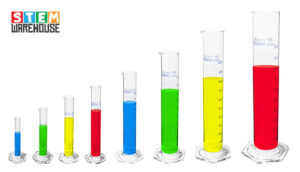
Borosilicate glass measuring cylinders with hexagonal bases provide chemical resistance, clear graduations and sizes from 10 ml to 2000 ml. Their stable bases help reduce accidental tipping.
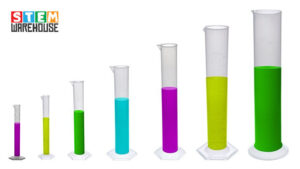
For frequent student handling, polypropylene graduated measuring cylinders offer a lightweight, breakage-resistant alternative. Where enhanced clarity is useful, the TPX measuring cylinder combines transparent construction with an easy-pour spout and hexagonal base.
The intended accuracy should guide the purchase. Routine solution preparation may only require a general graduated cylinder, while quantitative work may call for calibrated volumetric glassware.
Choosing flasks for mixing and solution preparation
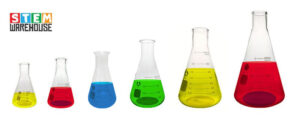
Flask shape and calibration matter just as much as material.
- An Erlenmeyer flask in GG17 borosilicate glass is useful for swirling, mixing and suitable heating procedures.
- A polypropylene Erlenmeyer flask is a robust choice for mixing without direct heating.
- A polypropylene volumetric flask with cap has a single graduation mark for measuring a defined volume and helps reduce accidental glass breakage.
- A Class A glass volumetric flask with polypropylene stopper is the better option when the procedure requires Class A volumetric accuracy.
Volumetric flasks should be used for preparing a specified volume of solution, not as general heating vessels. Erlenmeyer flasks are ideal for controlled swirling but their graduations, where present, should not be treated as a substitute for calibrated volumetric equipment.
Choosing test tubes and pipettes
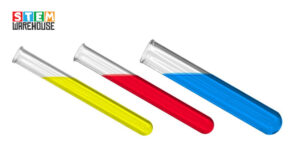
Rimmed borosilicate glass test tubes provide chemical and thermal-shock resistance for a wide range of classroom demonstrations and experiments. Plastic test tubes can be preferable for routine sample handling, biological activities and situations where disposable or breakage-resistant vessels are more practical.
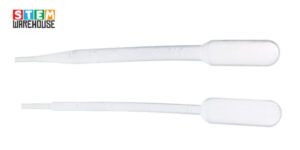
The same principle applies to liquid transfer. A glass measuring pipette can support accurate reusable measurement, while disposable transfer pipettes provide an unbreakable, all-in-one option for dispensing small amounts. Polystyrene serological pipettes include graduations and colour-coded filters for easy size identification.
Select the pipette type according to the required accuracy, liquid compatibility and contamination controls. A disposable transfer pipette is convenient, but it does not automatically provide the precision of calibrated volumetric equipment.
Choosing reagent bottles for storage
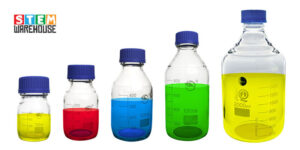
Storage containers should be chosen for their material compatibility, closure, opening size and light protection—not appearance alone.
Clear glass reagent bottles with GL45 blue screw caps make the contents easy to see and are available in several capacities. For light-sensitive materials, amber glass reagent bottles can help reduce exposure to light.
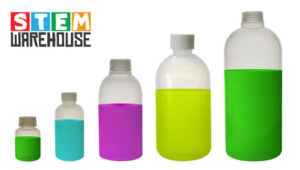
Where breakage resistance and low weight are more important, narrow-mouth polypropylene reagent bottles provide a practical alternative. Narrow mouths support controlled pouring, while wide-mouth containers are generally easier to fill with powders and easier to clean.
Every storage container should be correctly labelled and used only with compatible substances and closures. Chemical storage requirements, school procedures and safety documentation must always take priority.
Small labware choices that make practical work easier
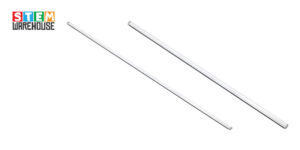
Even simple tools benefit from material selection. Glass stirring rods are economical, corrosion resistant and easy to clean. A plastic stirring rod made from polypropylene can reduce the chance of damaging glass vessels or scratching delicate surfaces.
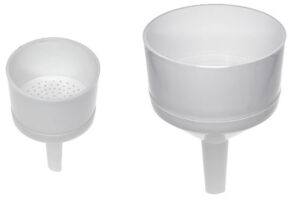
For filtration, a polypropylene Buchner funnel offers lightweight, chemical-resistant construction. For weighing and transferring powders or liquids, a borosilicate glass weighing funnel has a flat-sided design that can sit securely on a balance.
These smaller purchasing decisions can improve workflow, reduce spills and make equipment easier for students to handle correctly.
Recommended material by classroom task
| Classroom task | Recommended starting point | Why |
| Direct or strong heating | Suitable borosilicate glassware | Better thermal-shock performance than ordinary glass; verify the product and procedure |
| General mixing and pouring | Polypropylene beaker | Lightweight, economical and breakage resistant |
| Observing colour or phase changes | Clear borosilicate glass or transparent TPX | High visibility |
| Routine student volume measurement | Polypropylene or TPX measuring cylinder | Stable, lightweight and resistant to breakage |
| Higher-accuracy solution preparation | Calibrated volumetric glassware | Designed for defined volumetric accuracy |
| Frequent sample transfer | Disposable plastic pipette | Convenient and unbreakable |
| Visible chemical storage | Clear reagent bottle | Contents and condition are easy to inspect |
| Light-sensitive chemical storage | Amber reagent bottle | Coloured glass reduces light exposure |
| Junior or outdoor practical work | Plastic labware | Easier transport and fewer broken-glass hazards |
Building a balanced school labware inventory
Rather than choosing one material exclusively, organise purchasing around the experiments taught at each year level.
- List the procedures. Identify which activities involve heat, accurate measurement, chemical storage, biological samples or fieldwork.
- Match the vessel to the task. Choose the correct shape, capacity, material and accuracy class.
- Standardise common sizes. A smaller set of frequently used capacities simplifies storage, replacement and lesson preparation.
- Plan for handling risk. Use plastic options where breakage is more likely and glass where heat resistance, visibility or accuracy justifies it.
- Check compatibility. Confirm chemical, temperature, cleaning and autoclaving requirements for every product.
- Inspect and replace. Remove damaged glassware and degraded or distorted plasticware from service.
The best choice is the one suited to the experiment
Glass and plastic labware each have an important place in school science. Borosilicate glass is a reliable choice for suitable heating applications, clear observation and specialised measurement. Polypropylene, TPX, polystyrene and other plastics offer lightweight, economical and breakage-resistant solutions for everyday classroom work.
By choosing according to the task rather than relying on a single material, schools can create a laboratory inventory that is safer, more practical and better aligned with the curriculum.
Explore the full Wiltronics range of chemistry glassware and plasticware, including beakers, bottles, burettes, flasks, funnels, measuring cylinders, pipettes, reagent bottles, test tubes and stirring rods.
© Electrotech Brands Pty Ltd 2026
Write a Comment
You must be logged in to post a comment.