

7 Heat Transfer & Thermal Expansion Experiments for School Science
October 23, 2026
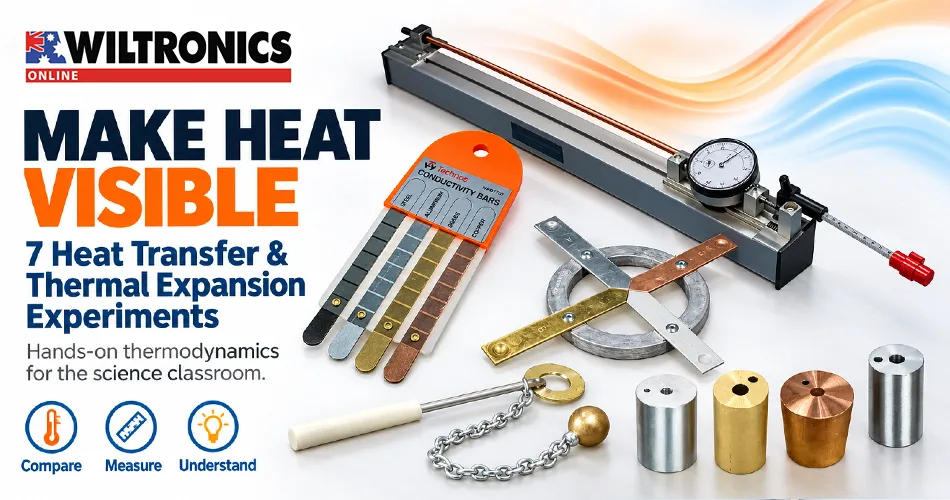
7 Heat Transfer & Thermal Expansion Experiments for School Science
Heat is something students encounter every day, but the physics behind it becomes much more meaningful when they can observe what happens as thermal energy moves through materials.
Why does a metal spoon become hot when one end is placed in hot water? Why do different metals conduct heat at different rates? Why does a metal ball that fits through a ring at room temperature stop fitting after it is heated?
These questions turn thermodynamics into something students can observe, measure and investigate.
At Wiltronics, we supply thermodynamics and heat experiment equipment for Australian schools, laboratories and physics classrooms. In this guide, we explore seven practical activities covering thermal conductivity, thermal expansion, specific heat capacity and energy transfer.
Heat, Temperature and Thermal Energy: What Is the Difference?
Heat and temperature are related, but they are not the same thing.
Temperature describes the thermal state of a material and is related to the average kinetic energy of its particles.
Thermal energy is energy associated with the microscopic motion and interactions of particles within a system.
Heat refers to energy transferred because of a temperature difference.
When two objects at different temperatures interact, energy tends to transfer from the higher-temperature object towards the lower-temperature object until the system approaches thermal equilibrium.
That energy can be transferred by three main mechanisms:
- conduction
- convection
- radiation
The experiments below concentrate primarily on conduction, expansion and calorimetry.
1. Compare Thermal Conductivity Without an Open Flame
Learning goal:
Compare how quickly different metals conduct thermal energy.
One of the simplest ways to introduce conduction is to give students several metals under similar conditions and ask them to predict which will transfer heat fastest.
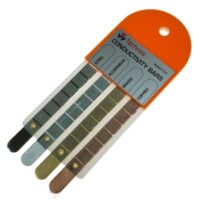
Wiltronics’ Thermal Conductivity Bars – No Flame, Beaker Only – HL0077-01 provide a particularly straightforward classroom demonstration.
The set contains copper, brass, aluminium and steel bars. Each bar incorporates visual indicators that change as heat travels along the metal. The apparatus is designed to work with hot water rather than an open flame.
Investigation
Place the appropriate end of each bar into hot water according to the product instructions.
Ask students to observe:
- which bar changes first
- how quickly the visible change progresses
- whether all metals conduct heat at the same apparent rate
- which metal appears to transfer thermal energy most effectively
Ask students:
- Which metal did you predict would conduct heat fastest?
- What evidence supports your conclusion?
- Why must the bars be heated under comparable conditions?
- What variables would need to remain constant for a fair comparison?
This is an excellent introduction to the idea that materials differ in thermal conductivity.
Classroom extension
Ask students where this property matters in real life.
Examples might include:
- cookware
- heat sinks
- building insulation
- electrical equipment
- heat exchangers
- handles on cooking equipment
The key idea is that selecting a material often depends on whether we want heat to move easily or resist its movement.
2. Investigate Heat Conduction Along Metal Rods
For a more traditional investigation, students can compare long metal rods.
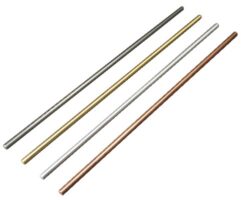
The Heat Conductivity Rods Set of 4 – HL3603-101 contains 300 mm rods made from copper, brass, iron and aluminium.
Learning goal:
Compare heat transfer through different metals.
Investigation
Set up the rods according to their supplied instructions and apply the same heating conditions to each.
Students can compare how thermal energy moves along the different rods.
The most important experimental principle is consistency.
Keep variables such as these as similar as possible:
- rod length
- heating position
- heating time
- starting temperature
- observation method
Why this experiment matters
Students often learn that “metals are good conductors”, but this can accidentally suggest that all metals conduct heat equally well.
They do not.
Comparing several metals makes thermal conductivity a material property that can be investigated, rather than a simple yes-or-no classification.
Challenge question
Ask:
If copper and iron are both metals, why might engineers choose one rather than the other when heat transfer matters?
This moves the activity from observation towards material selection and engineering.
3. See Four Metals Conduct Heat at the Same Time
Another useful approach is to place different metals into the same experimental arrangement.
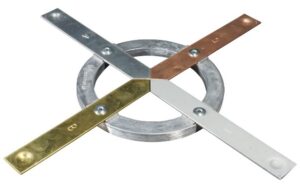
The IEC Heat Conductivity Ring – 4 Different Metals, HL0910-001 contains brass, copper, iron and aluminium strips arranged around a common central heating point.
Wax placed at the ends of the strips melts at different rates as thermal energy travels through each metal.
Learning goal:
Observe differences in thermal conductivity simultaneously.
Why this setup is useful
Because the metal strips share a central heating arrangement, students can compare their behaviour in the same demonstration.
Ask them to predict the order before heating begins.
Then record:
| Metal | Predicted order | Observed order |
|---|---|---|
| Copper | ||
| Aluminium | ||
| Brass | ||
| Iron |
After the demonstration, students can explain whether the observations supported their predictions.
Extend the discussion
Ask students why copper is commonly associated with applications where effective heat transfer is required.
Then reverse the question:
When would low thermal conductivity be more useful?
This naturally introduces insulation.
4. Demonstrate Thermal Expansion With a Ring and Ball
Thermal expansion can seem abstract until students see an object physically change enough to affect whether two components fit together.
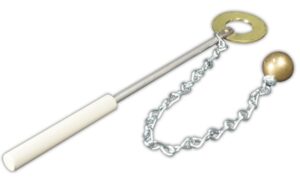
The IEC Ring and Ball Apparatus – HL0200-001 is designed specifically for demonstrating the expansion and contraction of metal.
At appropriate temperatures, changes in the dimensions of the brass components alter whether the ball can pass through the ring.
Learning goal:
Observe dimensional change caused by temperature change.
Start with a prediction
Before heating or cooling anything, show students the ball and ring.
Ask:
What do you predict will happen if the ball is heated?
Students may suggest that the ball becomes softer, changes shape or somehow gains material.
The demonstration allows these explanations to be tested.
Key idea
Heating a solid usually increases the average spacing associated with its atomic structure, producing a small increase in its overall dimensions.
No additional metal has been added.
The material has expanded.
When it cools, it contracts again.
Real-world connections
Thermal expansion matters in:
- bridges
- railway tracks
- pipelines
- engines
- power lines
- building structures
- precision machinery
Expansion gaps and flexible joints exist because even small dimensional changes can matter over large distances or tight tolerances.
5. Measure Linear Expansion Instead of Simply Observing It
Once students understand that solids expand when heated, the next step is to measure how much they expand.
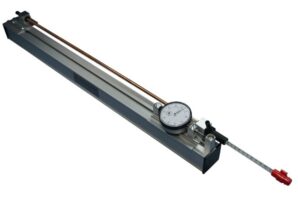
The IEC Linear Expansion Apparatus – HL2020-001 is designed to measure the linear expansion of metals as their temperature changes.
The apparatus uses metal tubes heated by steam and a dial indicator capable of measuring small dimensional changes. Wiltronics lists interchangeable aluminium, brass and copper expansion tubes for comparative investigations.
Learning goal:
Relate temperature change to measurable dimensional expansion.
Students can investigate:
- initial temperature
- final temperature
- change in temperature
- original tube length
- measured change in length
- material type
This allows thermal expansion to move from a qualitative demonstration into a quantitative experiment.
Key relationship
For many classroom investigations over a suitable temperature range, linear expansion can be represented approximately by:
ΔL = αL₀ΔT
where:
- ΔL = change in length
- α = coefficient of linear expansion
- L₀ = original length
- ΔT = temperature change
Students do not need to begin with the equation.
A more effective sequence is often:
observe → measure → identify a pattern → introduce the model
Investigation question
If copper, brass and aluminium tubes experience similar temperature changes, do they expand by the same amount?
That turns thermal expansion into a material-comparison investigation rather than just a demonstration.
6. Investigate Specific Heat Capacity With Calorimeter Blocks
Two materials can receive similar amounts of energy and experience different temperature changes.
That leads to the concept of specific heat capacity.
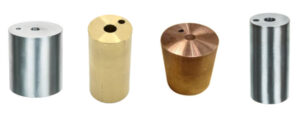
Wiltronics supplies 1 kg Calorimeter Blocks in aluminium, brass, copper and steel.
The blocks are designed for practical investigations into specific heat capacity and include a hole for an appropriate immersion heater or thermometer.
Learning goal:
Investigate the relationship between energy input, mass, material and temperature change.
For a suitable controlled experiment, students can record:
- block material
- block mass
- initial temperature
- final temperature
- temperature change
- electrical energy supplied
The basic thermal relationship is:
Q = mcΔT
where:
- Q = thermal energy transferred
- m = mass
- c = specific heat capacity
- ΔT = temperature change
Rearranging gives:
c = Q ÷ (mΔT)
Why use different metals?
Using blocks with comparable masses but different materials allows students to see that the temperature response depends on more than simply how much energy is supplied.
Different materials have different specific heat capacities.
Important experimental consideration
Real classroom experiments are not perfectly isolated.
Some energy will be transferred to:
- surrounding air
- the heater
- the thermometer or sensor
- supports
- nearby equipment
This makes the activity particularly useful for discussing experimental uncertainty and energy loss.
Instead of treating the difference from a reference value as failure, ask students to identify where energy may have gone.
7. Measure Electrical Energy Converted to Thermal Energy
Thermodynamics becomes especially interesting when it connects with electricity.
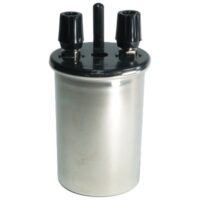
The IEC Joule’s Calorimeter Complete Assembly – HL0840-001 uses a resistance heating element inside a copper calorimeter.
The apparatus is designed to investigate the electrical energy required to heat a known quantity of water through a measured temperature change.
Learning goal:
Connect electrical energy input with temperature change.
Students can measure quantities such as:
- voltage
- current
- heating time
- mass of water
- starting temperature
- final temperature
Electrical energy can be estimated using:
E = VIt
where:
- E = electrical energy
- V = potential difference
- I = current
- t = time
The thermal response of the water can then be compared with:
Q = mcΔT
This creates an excellent link between two areas of physics:
electricity and thermodynamics.
Investigation question
Ask:
Does all of the electrical energy supplied appear as measured thermal energy in the water?
Students will usually find differences.
That creates a meaningful discussion about:
- energy transfer to the calorimeter
- heat loss to the surroundings
- measurement uncertainty
- insulation
- experimental design
Rather than simply calculating an answer, students are evaluating an energy system.
Conduction, Convection and Radiation
The experiments above concentrate heavily on conduction, but students should understand that thermal energy can also be transferred by convection and radiation.
Conduction
Conduction transfers thermal energy through interactions within a material.
It is particularly important in solids and is clearly demonstrated by metal conductivity apparatus.
Convection
Convection involves bulk movement within fluids such as liquids and gases.
Warmer, less dense regions can move while cooler regions replace them, producing convection currents under appropriate conditions.
Radiation
Thermal radiation transfers energy by electromagnetic waves and does not require a material medium.
The Sun can transfer energy to Earth across the vacuum of space because radiation does not depend on direct contact or moving air.
A useful teaching question is:
Which heat-transfer mechanism is dominant in this particular situation?
Many real systems involve more than one mechanism at the same time.
A Suggested Thermodynamics Lesson Sequence
Rather than presenting every concept separately, teachers can build a progression across several practical activities.
Step 1 — Establish that materials conduct heat differently
Begin with the no-flame Thermal Conductivity Bars.
Step 2 — Compare metals more systematically
Use the Heat Conductivity Rods Set of 4 or the IEC Heat Conductivity Ring.
Step 3 — Introduce thermal expansion
Use the IEC Ring and Ball Apparatus to make expansion visible.
Step 4 — Measure expansion
Progress to the IEC Linear Expansion Apparatus.
Step 5 — Introduce specific heat capacity
Compare the thermal response of Calorimeter Blocks made from different metals.
Step 6 — Connect heat and electricity
Use the IEC Joule’s Calorimeter to investigate electrical energy converted into thermal energy.
Students then experience a logical progression:
heat transfer → conductivity → expansion → measurement → heat capacity → energy conversion
Common Thermodynamics Misconceptions
“Metal is naturally colder than other materials.”
A metal object and a plastic object left in the same room can reach approximately the same temperature but feel different because they transfer thermal energy to or from your skin at different rates.
The sensation of “coldness” is not itself a direct temperature measurement.
“Heat and temperature are the same thing.”
They are not.
Temperature describes the thermal state of a system, while heat describes energy transferred because of a temperature difference.
“All metals conduct heat equally.”
Metals are generally associated with good thermal conductivity, but their conductivities differ substantially.
That is exactly what the conductivity experiments in this guide allow students to investigate.
“Objects expand because extra material is added.”
Thermal expansion does not require adding more material.
Heating changes the microscopic behaviour and average spacing within the material, producing a change in its macroscopic dimensions.
“Energy lost from the water has disappeared.”
Energy is conserved.
If measured thermal energy in one component is lower than expected, some energy may have been transferred elsewhere in the system or surroundings.
Practical Classroom and Laboratory Tips
Thermodynamics experiments often involve hot water, heated metals, electrical heaters or steam.
Before beginning an activity:
- follow the manufacturer’s instructions
- conduct the school’s required risk assessment
- use appropriate personal protective equipment
- identify hot surfaces before students begin
- keep heated equipment stable
- allow apparatus to cool before handling or packing away
- use electrical heating equipment only within its specified ratings
- supervise steam and hot-water experiments appropriately
For comparative experiments, establish the variables that need to remain constant before collecting data.
If students are comparing different materials, try to make the material itself the major changing variable.
And where results differ from reference values, encourage students to explain why rather than adjusting observations to make them appear correct.
Frequently Asked Questions
What is a simple heat transfer experiment for school students?
Comparing how quickly different metal bars conduct heat is a straightforward starting point. Wiltronics’ no-flame thermal conductivity bars use hot water and visual indicators to demonstrate differences between copper, brass, aluminium and steel.
What are the three methods of heat transfer?
The three major mechanisms are conduction, convection and radiation.
Conduction occurs through interactions within materials, convection involves movement in fluids, and radiation transfers energy through electromagnetic waves.
What is thermal conductivity?
Thermal conductivity describes how effectively a material conducts thermal energy.
Materials with higher thermal conductivity transfer heat more readily than materials with lower thermal conductivity under comparable conditions.
Why does metal expand when heated?
Heating changes the microscopic motion and average spacing within the material. For most solids under ordinary classroom conditions, this produces an increase in overall dimensions.
What does the ring and ball experiment demonstrate?
The ring and ball experiment demonstrates thermal expansion and contraction. Heating changes the dimensions of the components sufficiently to alter whether the ball can pass through the ring.
What is linear thermal expansion?
Linear thermal expansion is the change in the length of a material caused by a change in temperature.
For suitable conditions it can be represented by:
ΔL = αL₀ΔT
What is specific heat capacity?
Specific heat capacity is the amount of energy required to raise the temperature of a unit mass of a substance by one degree.
Different materials have different specific heat capacities.
What is a calorimeter used for?
A calorimeter is used to investigate thermal energy transfer.
Depending on the apparatus, students can investigate heat capacity, electrical heating or other energy-transfer processes by measuring quantities such as mass and temperature change.
Why don’t school calorimetry experiments exactly match theoretical values?
Real experiments exchange energy with their surroundings and with the apparatus itself.
Other sources of difference can include thermometer resolution, timing uncertainty, mass measurements and incomplete thermal equilibrium.
Evaluating those factors is part of the experiment.
Where can Australian schools buy thermodynamics experiment equipment?
Wiltronics supplies heat-conduction apparatus, thermal-expansion equipment, calorimeters, calorimeter blocks and other physics equipment for Australian schools, universities and laboratories.
Browse Thermodynamics Equipment at Wiltronics
Make Heat Visible
Thermal energy itself is invisible, but its effects are not.
A conductivity bar changes as heat moves through it. A metal ball expands enough to stop passing through a ring. A dial indicator records a tiny change in length. A calorimeter turns electrical measurements into a measurable temperature rise.
Together, these experiments help students move from simply knowing that objects get hot to understanding how energy is transferred, how materials respond and how those changes can be measured.
By progressing from observation to measurement, thermodynamics becomes a practical investigation rather than a collection of equations.
Explore heat transfer, thermal expansion and calorimetry equipment from Wiltronics for your next classroom physics investigation.
Explore the Wiltronics Thermodynamics Range
© Electrotech Brands Pty Ltd 2026
Write a Comment
You must be logged in to post a comment.