

Using a Spring Balance: Classroom Force Experiments
October 15, 2026

Using a Spring Balance: Classroom Force Experiments
How much force does it take to lift an object or pull it across a desk? A spring balance helps students turn those questions into measurements they can compare and explain.
For Term 4 practical work, force investigations offer a useful progression from reading a scale to planning a fair test. Students can explore weight and friction while learning why the instrument’s range and the way it is used matter.
At Wiltronics, our spring balances and push/pull dynamometers provide options for classroom force measurements. This guide includes two practical activities, equipment highlights and an extension for students ready to investigate spring behaviour.
Choose a suitable range, check zero and record force in newtons.
What does a spring balance measure?
A spring balance measures force in newtons (N) through the deformation of a spring. This guide focuses on taking useful readings and planning classroom comparisons.
Choose the range before the lesson
A balance must accommodate the largest expected force, including any brief peak when movement begins.
A high-capacity instrument may be difficult to read for small forces. A low-capacity instrument may be overloaded. Compare both the range and the smallest scale division before selecting a class set.
For example, a suspended 200g mass has a weight of approximately 1.96N near Earth’s surface. A 1N balance is unsuitable for that load.
Check the instrument’s operating instructions and permitted orientation. Keep the force aligned with its measuring axis, and use a model designed for pushing if the activity involves compression.
Before students begin:
- Inspect the hook, attachment and casing.
- Check zero in the intended working position; adjust only as instructed.
- Identify the newton scale and the value of each interval.
- Apply loads gently and remain within the instrument’s range.
Activity 1: Compare the weight of classroom objects
Learning goal: take a steady force reading and compare it with a prediction.
For an object hanging at rest with no other support, the balance reading equals its weight.
Mass and weight are different quantities:
| Quantity | Meaning | Unit |
|---|---|---|
| Mass | A property of the object associated with its inertia | Kilograms (kg), or grams (g) |
| Weight | The gravitational force acting on the object | Newtons (N) |
Near Earth’s surface, weight can be calculated using W = mg. A 100g mass is 0.100kg and has a weight of approximately 0.98N when using g = 9.8N/kg.
Some classroom scales use the convenient approximation that 100g corresponds to 1N. This is not an exact conversion. Where a spring balance has both gram and newton markings, the gram scale indicates an equivalent mass under its calibration assumptions.
For force investigations, ask students to use the newton scale consistently.
Choose several small objects that can be securely attached and whose expected weights are comfortably within the balance’s capacity. The teacher should check the complete setup first.
Ask students to predict the order from smallest to largest weight.
For each object:
- Attach it securely while supporting it.
- Transfer the load gently to the balance.
- Let it hang freely without touching the bench.
- Wait until movement settles.
- Read the scale at eye level and record the force in newtons.
Keep objects close above a clear bench or suitable tray. Do not suspend loads over people.
| Object | Predicted order | Force reading (N) | Observation |
|---|---|---|---|
| A | |||
| B | |||
| C |
If using an extra carrier or attachment, include its contribution in the measurement or account for it explicitly.
Ask students whether their observations support their predictions. For an extension, measure each object’s mass with a suitable balance and compare the spring-balance reading with the calculated weight.
Teaching prompt: “Why must the object hang freely when we take the reading?”
Activity 2: Compare the force needed to slide an object
Learning goal: investigate friction while controlling other variables.
Use a suitable force meter, a securely attached block or small container, and two or three flat, secured test surfaces.
Pull horizontally along the same straight path. Keep the object, load, contact face and approximate sliding speed consistent.
For each surface:
- Increase the pull gently until the object starts moving.
- Observe the largest reading just before movement begins, if it can be read reliably.
- Continue pulling at an approximately steady speed.
- Record the force during steady sliding.
- Repeat three times.
| Surface | Trial | Peak before movement (N) | Steady sliding force (N) |
|---|---|---|---|
| A | 1 | ||
| A | 2 | ||
| A | 3 | ||
| B | 1 | ||
| B | 2 | ||
| B | 3 |
A brief starting peak can be difficult to capture with an analogue meter. If students cannot read it reliably, focus the comparison on steady sliding.
When the object moves horizontally at constant speed and other horizontal forces are negligible, the pulling force approximately balances sliding friction. If students jerk the object or accelerate it, the reading includes the force associated with that acceleration.
Pulling upwards at an angle changes the contact force against the surface, making the comparison less controlled.
Ask students to report which surface required the greater pull in their test, supported by repeated readings. Avoid assuming that appearance alone predicts friction.
Wiltronics equipment for force investigations
Dual-scale spring balances

Our Spring Balance range features colour-coded instruments with gram and newton scales. Listed force ranges extend from 1N to 50N.
Select the range for the expected load and check the scale divisions before preparing the activity. Different ranges are useful for different tasks, rather than being interchangeable.
Economy spring balances
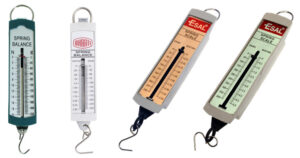
Our Spring Balance Economy range offers dual-scale options from 1N to 20N.
The product listing notes that brand and appearance can vary with supplier availability. When preparing shared instructions, check the markings and controls on the actual instruments students will receive.
Push/pull dynamometers
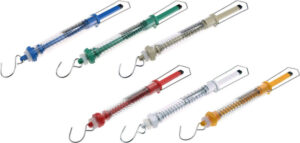
Our Push/Pull Dynamometers provide options for investigating both pushing and pulling forces. Listed ranges run from 2.5N to 50N.
These are useful when the teaching task requires more than a hanging-load measurement. Follow the model’s instructions for each loading direction and select a suitable capacity.
Hooke’s law spring set
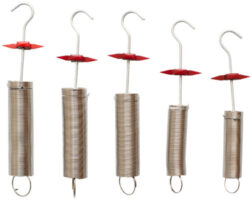
Our Hooke’s Law Spring Set of 5 provides an option for extending the lesson from reading force to investigating spring extension.
These experimental springs are separate from a calibrated spring balance. Plan the required support, ruler and loads, and confirm the permitted loading conditions before use.
Extension: investigate force and spring extension
Use a suitable experimental spring, stable support and teacher-approved loads to compare applied force with extension:
Extension = loaded length − unloaded length.
Students can plot force against extension and identify the region where they are proportional. Stay within the supplier’s permitted loading conditions; do not deliberately overload the spring. Follow the equipment instructions and your school’s procedures.
Common problems and what to check
| Problem | Practical check |
|---|---|
| The reading is not zero before loading | Working orientation and permitted zero adjustment |
| The pointer moves continuously | Swinging load or uneven pulling |
| Groups obtain different friction readings | Pull angle, speed, load and surface condition |
| The object still rests partly on the desk | Another support is carrying some of its weight |
| Small differences cannot be resolved | Instrument range and scale spacing |
| The instrument does not return to zero | Remove it from use for inspection |
Frequently asked questions
Should students record grams or newtons?
Use newtons when reporting force. Gram markings are an equivalent-mass scale, not a second unit of force.
Can every spring balance measure a pushing force?
No. Use an instrument designed for push measurements and follow its operating instructions.
Why can it take more force to start an object moving?
The maximum static friction before sliding often exceeds the friction during sliding. Check that any observed peak is not caused by a sudden jerk.
Is the largest-range balance the best choice?
Not automatically. It must handle the load, but its scale must also allow students to distinguish the forces being compared.
Do students need to study Hooke’s law first?
No. Begin with steady readings and comparisons. Introduce the spring’s force–extension relationship when students are ready to measure and graph it.
Bring force investigations into your classroom
Explore our spring balances and motion, force and density equipment to prepare your next practical lesson.
Start with a measurable question, choose equipment that suits the expected force and help students explain how their method affects the result.
© Electrotech Brands Pty Ltd 2026
Write a Comment
You must be logged in to post a comment.