

The Right Cooling Fan for Your Electronics Enclosure
October 2, 2026
The Right Cooling Fan for Your Electronics Enclosure
A project can work well on an open bench, then run too hot once it goes inside a case. Choosing a suitable cooling fan means checking more than whether it fits the panel.
Choose a fan that matches your supply voltage and mounting space, then assess airflow through the enclosure’s vents, filters and internal layout. Confirm cooling performance by testing the completed enclosure under load.
At Wiltronics, our cooling fan range includes compact models, larger fans and ventilation accessories. This guide explains how to compare the options and avoid common installation mistakes.
1. Check size, voltage and connections first
Start with the requirements that determine whether a fan will fit and operate correctly.
| Specification | What to check |
|---|---|
| Frame dimensions | Width, height and depth |
| Mounting holes | Hole spacing, screw diameter and panel clearance |
| Rated voltage | Whether the fan requires 12V DC, 24V DC or another supply |
| Operating voltage range | Whether your actual supply stays within the permitted range |
| Current requirement | Running current and any specified starting requirement |
| Connection | Connector type, polarity and signal-wire functions |
| Installation clearance | Space for guards, filters, wiring and airflow |
A nominal 120mm fan is not a complete dimensional specification. A 38mm-deep model needs more internal space than a 25mm model.
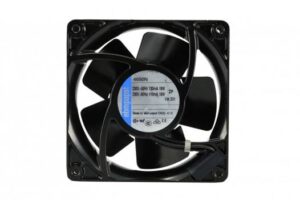
Small differences also matter. Our FA1067 120mm × 25mm 12VDC Cooling Fan has a specified depth of 25.4mm. Use the detailed dimensions when planning mounting clearances. www.wiltronics.com.au
For replacement work, record the original fan’s model number, voltage, dimensions and connection arrangement before selecting an alternative.
2. Understand airflow and static pressure
Airflow describes the volume of air a fan moves over time. Specifications commonly use cubic feet per minute, or CFM, and cubic metres per minute, written as m³/min.
However, the headline airflow figure does not guarantee the same flow inside your enclosure.
Filters, grilles, narrow vents and closely packed components resist airflow. The fan’s operating airflow changes as that resistance increases.
Static pressure becomes particularly relevant when the fan must move air through restrictions. Where a manufacturer provides a pressure-versus-airflow curve, use it to assess performance under those conditions.
Maximum airflow and maximum static pressure occur at different operating points. A fan does not deliver both simultaneously. jp.sameskydevices.com
We recommend assessing the complete airflow path before choosing a fan. A high CFM number alone does not establish how well it will perform behind a restrictive filter or grille.
3. Give the air somewhere to go
A fan mounted inside a sealed enclosure circulates internal air; it does not create an exchange with cooler outside air. Internal circulation may help distribute heat, but heat still needs a path out of the enclosure.
For a ventilated design, sketch the layout and mark:
- Components that generate heat.
- Proposed intake and exhaust openings.
- Boards, cables and partitions that may obstruct airflow.
- Clearance around the outside of each vent.
Position the openings so air passes through the area that needs cooling. An intake immediately beside an exhaust may allow air to bypass warmer sections.
Consider where the equipment will operate, too. A clear exhaust on the workbench may become obstructed when the enclosure sits against a wall.
Also distinguish between a hot component and warm enclosure air. Some components need a suitable heatsink and thermal interface as well as ventilation. Assess the whole path from the heat source to the surrounding air.
4. Compare cooling fans from our range
The following products provide useful starting points for different requirements. Final suitability depends on the heat load, enclosure layout, supply and acceptable noise.
Compact installations: FA0093 40mm × 10mm 12VDC Cooling Fan
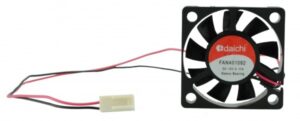
Our FA0093 cooling fan measures 40 × 40 × 10mm and uses a sleeve-bearing design.
Its shallow frame makes it worth considering where panel space and internal clearance are limited.
Noise-sensitive projects: 80mm Silent Hydrodynamic Bearing Case Fan
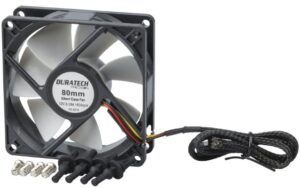
Our 80mm Silent Hydrodynamic Bearing Case Fan is a 12V model with an 80 × 80 × 25mm frame.
Its listed specifications include:
- 20.7 CFM airflow.
- 1,600 RPM speed.
- 80mA current draw.
- 18dB noise.
- Tachometer output.
Rubber mounts help reduce vibration transmitted to the enclosure. This makes it a candidate for projects used near a desk or entertainment area.
Larger 12V installations: FA1067 120mm Cooling Fan
Our FA1067 120mm × 25mm 12VDC Cooling Fan uses ball bearings and a two-wire flylead connection.
Specifications include 2.3m³/min airflow, 3,000 RPM speed and 360mA current draw.
Consider this model where the enclosure accommodates a larger opening and a straightforward two-wire connection suits the project. Allow for the specified 25.4mm depth, mounting hardware and any guard or filter. www.wiltronics.com.au
Higher airflow requirements: Sunon 120mm 12VDC Ball Bearing Cooling Fan
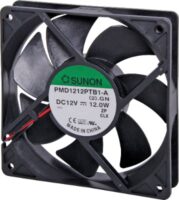
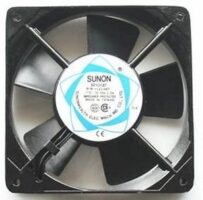
Our Sunon 120mm 12VDC Ball Bearing Cooling Fan has a 120 × 120 × 25mm frame, with listed performance figures of 150 CFM airflow and 0.62 inch-H₂O static pressure.
Other specifications include:
- 4,500 RPM rated speed.
- 1A rated current.
- 12W rated power.
- 54dB(A) noise.
These figures highlight the electrical and acoustic requirements that accompany its airflow capability. Check the manufacturer datasheet linked on our product page when assessing performance against an enclosure’s restrictions. www.wiltronics.com.au
24V projects: FA1011 120mm × 38mm Cooling Fan
Our FA1011 120mm × 38mm 24VDC Cooling Fan is an option for projects with a suitable 24V supply.
Its specifications include a Maglev bearing, flylead connection, 138 CFM airflow and 9.2W input power.
Check the 38mm frame depth carefully when replacing an existing fan. Matching the width and voltage does not guarantee clearance around nearby components. www.wiltronics.com.au
A note on noise comparisons: Published figures are useful reference points, but avoid treating them as a direct ranking unless the measurement conditions and weighting are comparable. Mounting, vibration and ventilation openings also affect the sound of the finished installation.
5. Include guards and filters from the beginning
Guards and filters perform different jobs.
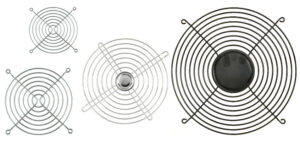
Our wire fan guards provide a physical barrier against larger objects reaching the blades. They do not provide dust filtration. www.wiltronics.com.au
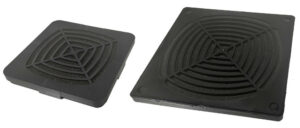
For filtered ventilation, our Plastic Fan Guard/Filter includes a foam filter and comes in two sizes:
| Size | Product code |
|---|---|
| 80mm | FA1136 |
| 120mm | FA1137 |
The foam needs periodic cleaning to prevent clogging and restricted airflow. Position it where you can remove and service it easily. www.wiltronics.com.au
Test with the intended guard and filter fitted. Adding them after testing changes the airflow conditions.
6. Check the wiring and airflow direction
Follow the fan’s documented polarity, connector arrangement and signal functions.
Extra wires may support monitoring or control, but wire count alone does not establish a universal pinout. Our 80mm hydrodynamic model lists a tachometer output, while the FA1067 has a two-wire connection. A speed-monitoring output should not be treated as a speed-control input. www.wiltronics.com.au
Before permanent mounting, confirm airflow direction using the fan’s markings or documentation. Secure leads so they cannot reach the blades during operation or assembly.
7. Test the completed enclosure
We recommend checking the equipment in the configuration it will actually use.
- Fit the lid, guards and filters. An open enclosure does not reproduce the finished airflow conditions.
- Run the expected sustained load. A brief idle test may miss the highest operating temperatures.
- Record ambient and relevant internal temperatures. Allow enough time for readings to settle.
- Compare readings with the equipment and component limits. Feeling air at a vent does not confirm that every component receives sufficient cooling.
- Check the installation. Look for vibration, blocked openings and warm exhaust air returning to the intake.
Record the configuration and results. They provide a useful reference when investigating temperature changes or planning filter maintenance.
Frequently asked questions
What size cooling fan do I need?
Start with the available mounting area and internal depth, then assess the airflow required for the heat load. Frame size alone does not determine cooling performance. Check mounting-hole spacing, accessory clearance and the airflow path before purchasing.
Can I connect a 12V fan to a 24V supply?
Only if the manufacturer explicitly specifies operation at that voltage. Otherwise, use a correctly rated fan or a suitable regulated supply arrangement. Similar-looking 12V and 24V fans are not automatically interchangeable.
Is a higher CFM fan always better?
No. Higher rated airflow may come with greater noise and power consumption. Restrictions also change the airflow delivered inside the enclosure. Compare the fan’s performance information with the actual installation requirements.
What is the difference between airflow and static pressure?
Airflow measures the volume of air moved over time. Static pressure describes a pressure difference. Both matter when selecting a fan for an enclosure with filters, narrow vents or other restrictions.
Should the fan blow into or out of the enclosure?
Either arrangement can work. Plan a clear route that moves air through the area needing cooling, with sufficient openings for air to enter and leave. Consider filtration, obstructions and whether warm exhaust air could return to the intake.
Does a fan filter reduce airflow?
A filter adds resistance, and accumulated dust can restrict airflow further. Include the filter in the original design, test with it fitted and clean it periodically.
Find a cooling fan for your project
Explore our cooling fans, guards and filters to compare options for your enclosure. Match the physical and electrical requirements first, then assess airflow, noise and performance in the completed installation.
© Electrotech Brands Pty Ltd 2026
Write a Comment
You must be logged in to post a comment.