

School Optics Equipment: Should You Buy Light Boxes or an Optical Bench?
November 10, 2026
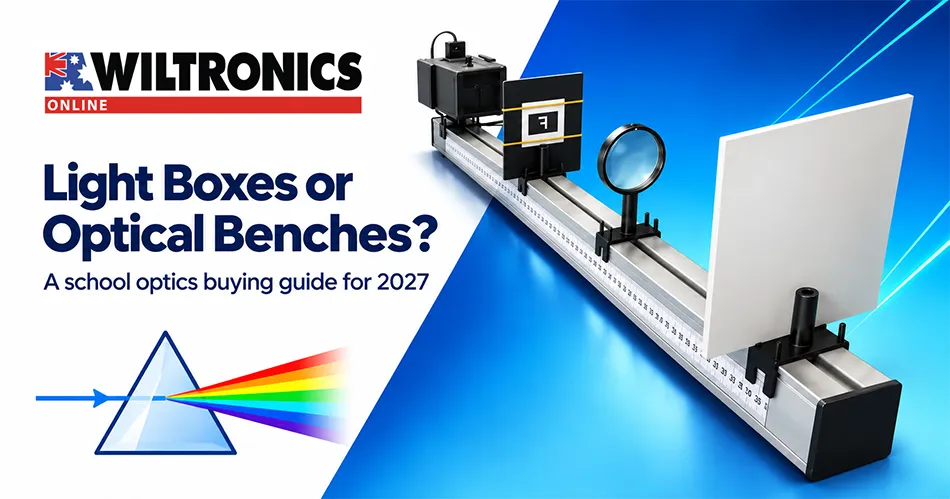
School Optics Equipment: Should You Buy Light Boxes or an Optical Bench?
If your first physics practical of 2027 asks eight groups to trace a ray through an acrylic block, one optical bench leaves seven groups waiting. If the task is to form a sharp image on a screen and measure its distance from a lens, eight light boxes alone won’t give students a way to hold the lens and screen in line.
Before you place your school’s final order before Christmas, look at what students need to hand in. For a ray diagram drawn on paper, start with a light box and the appropriate mirror or block. For a table of object and image distances, choose an optical bench with a lens, target and screen. Here’s how we’d use the Wiltronics light and optics range to equip both lessons.
What should you buy for a ray-tracing station?
| Wiltronics product | When it belongs on the order |
|---|---|
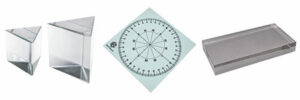
| IEC Hodson 12 V Light Box & Optical Set | Start here for groups investigating reflection and refraction on a tabletop. The set includes slit formers, mirrors and colour accessories. Match the contents to your practical and check the specified power supply before counting a station as complete. |
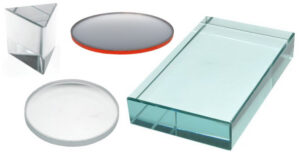
| Rectangular acrylic prism, 125 × 65 × 18 mm | Choose a rectangular block when students need to trace a ray entering and leaving through parallel faces. Its footprint matters: leave enough paper around the block to mark both rays. Check that the ray from your source passes through the block at the intended height. |
| IEC Light Box Angular Scale for Rays | Add this accessory if students need to read angles at the light box. If the learning task is to draw a normal and measure their own diagram, existing classroom protractors may already do the job. |
| Equilateral triangular glass prism | Choose this for a comparison with the rectangular block. The faces meet at 60°, so students see a different emerging ray. Select the 38 mm or 50 mm version to suit the setup. |
For a quick stocktake, put one of your existing sets on the bench with the actual student worksheet. Can you produce one distinct ray, hold the mirror upright and trace the beam on both sides of the block? A missing slit former can be more consequential than an empty space in the tray for a colour filter the class won’t use.
Which IEC optical bench kit suits your school?
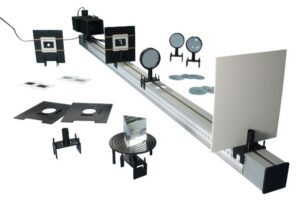
The IEC Optical Bench and Kit with Hodson Light Box is the starting point for a new lens station. Its 1.5 m bench gives the source, lens and screen a shared line and a scale along which students can record positions. The kit includes convex and concave lenses, targets, a screen and sliding supports. For a first image-distance practical, use the convex lens to form a real image of a lit target on the screen.
The IEC Optical Bench and Kit without the light box is worth considering when you already own a compatible source. Check both fit and timetable. A light box that fits perfectly but is in use for Year 8 ray tracing during the senior physics lesson is not an available source. Before choosing either version, measure the clear run on the teaching bench and check where students will stand to focus the image and read the scale.
Which parts can complete an existing optical bench?
| What’s missing from the practical? | What to look at first |
|---|---|
| A component can’t be positioned on the rail | Compare the existing mount with the IEC optical bench slider and stem. Identify whether the missing piece is the slider, stem or the holder above it. |
| There is no suitable object to project onto the screen | Check the IEC set of six 35 mm transparencies and confirm you have the matching holder. A recognisable target gives students a way to judge focus and image orientation. |
| The prism investigation is missing its prism | Compare the IEC optical bench 60° glass prism with the original part and prism table. Angle alone doesn’t tell you whether a loose classroom prism will fit. |
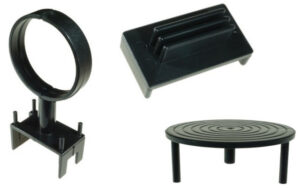
For other gaps, browse IEC optical bench parts. If the apparatus predates your current inventory, send us its model details and a photo of the mounting point before ordering a replacement.
How many light boxes does a class of 24 need?
Suppose 24 students work in eight groups of three and every group must trace rays at the same time. The target is eight working stations. If the prep room has six usable light boxes with suitable supplies but only five suitable rectangular blocks, the gaps are two light-box stations and three blocks. Check what comes with the two new sets before ordering loose blocks: if each includes a suitable block, only one extra block remains on the list.
If the lesson allows two rotations, four groups can collect data while the other four construct and label diagrams, then swap. That arrangement needs four simultaneous stations. With the same stock, no additional boxes or blocks are needed for that lesson. The department could put its budget towards an optical bench for senior physics instead.
Frequently asked questions
Can one light box serve both junior and senior physics?
Yes, if the source is compatible with both setups and the classes use it at different times. Count it once on your inventory and check what happens in the busiest timetable period.
Do we need one optical bench per group?
Only if all groups need independent measurements at the same time. One bench can serve a teacher demonstration or a rotation. Allow time for each group to align the optics, find a sharp image and record its own readings before deciding how many rotations fit.
Explore our light and optics equipment for schools to compare light boxes, optical benches and prisms for Term 1.
© Electrotech Brands Pty Ltd 2026
Write a Comment
You must be logged in to post a comment.