

PASCO Wireless Sensors for Schools: What to Buy for 2027
November 5, 2026
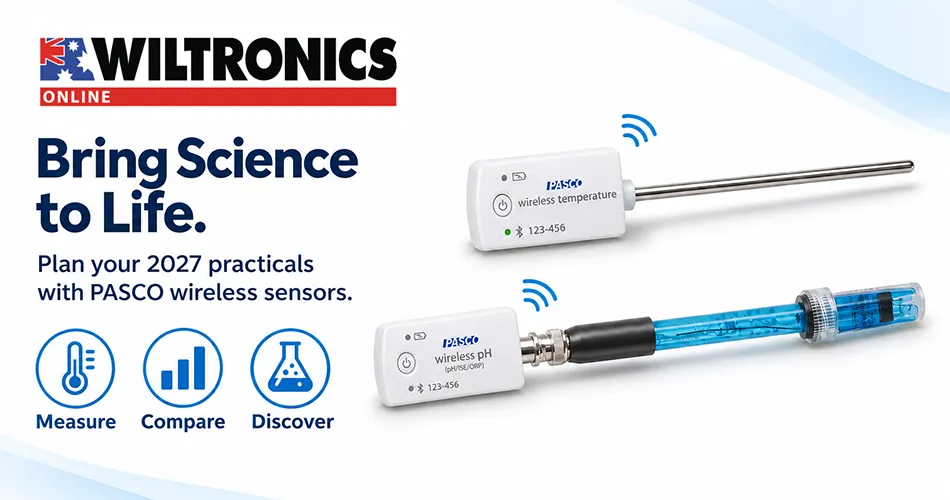
PASCO Wireless Sensors for Schools: What to Buy for 2027
A temperature reading tells students how warm a sample is. A temperature graph lets them investigate how quickly it changes—and compare that change with another trial.
That is a useful starting point for planning your school’s next sensor purchase. Before choosing equipment, ask what students need to measure, what evidence they should collect and how they will use it to explain their results.
At Wiltronics, our PASCO wireless sensor range gives schools options for bringing digital measurements into practical lessons. As you review equipment for 2027, use this guide to match sensors to planned investigations and build a set your department will use.
Start with the investigation, then choose the sensor
A productive equipment list begins with a teaching question. “We need more data logging” is difficult to turn into an order. “Eight groups need to compare cooling curves in Term 1” gives you a measurement, a quantity and a purpose.
Write down three things for each planned practical:
- The variable: Temperature, force, pressure or pH.
- The evidence: A single reading, repeated measurements or a continuous graph.
- The class arrangement: Teacher demonstration, rotating stations or simultaneous group work.
Then check the sensor range, response and sampling options against that investigation. More measurements are useful only when students can connect them to the question.
Four PASCO wireless sensors to consider
| Planned investigation | Sensor | What students can examine |
|---|---|---|
| Compare cooling under different conditions | Wireless Temperature Sensor PS-3201 | Temperature against time and differences between trials |
| Investigate effort in a lever system | Wireless Force Acceleration Sensor PS-3202 | How measured force changes as the setup changes |
| Explore the relationship between gas pressure and volume | Wireless Pressure Sensor PS-3203 | Pressure measurements at selected volumes |
| Compare solutions or follow changes during an approved practical | Wireless pH Sensor PS-3204 | Differences in pH or a pH trend over time |
These are lesson-planning ideas rather than complete experimental procedures. Use the relevant equipment instructions and your school’s approved practical methods.
Temperature: move beyond the final reading
The PS-3201 provides a straightforward introduction to recording change over time. Students can compare cooling curves and discuss why two samples with similar final temperatures may have followed different paths.
For a fair comparison, plan how groups will keep starting conditions, sample volume, timing and probe position consistent. Ask students to predict the curve before collecting data, then identify where their prediction matches—or differs from—the evidence.
Explore the PASCO Wireless Temperature Sensor.
Force: connect a physical change to a measured result
For a lever investigation, students can compare measured effort at different positions and explain the relationship using their observations.
Plan the mechanical equipment as well as the sensor. A force sensor alone does not provide a complete lever apparatus. Check what supports, attachments and other components the lesson requires before placing the order.
Explore the PASCO Wireless Force Acceleration Sensor.
Pressure: give a gas-law relationship measurable evidence
The PS-3203 measures absolute gas pressure. Its listing includes a syringe, tubing and connectors, making it relevant to planning pressure–volume investigations.
Ask students to organise their results so they can compare the variables, describe the pattern and consider whether their evidence supports the predicted relationship. Check the supplied components against the intended practical; included accessories do not automatically make every pressure experiment possible.
Explore the PASCO Wireless Pressure Sensor.
pH: budget for preparation as well as measurement
The PS-3204 supports individual pH measurements and continuous readings. That creates opportunities to compare samples or investigate how a reading changes during a lesson.
Include electrode care, the required calibration buffers and appropriate storage supplies in your planning. A sensor count is only useful when the equipment is ready for the next class.
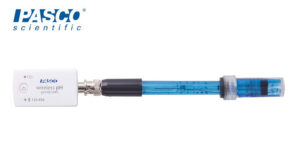
Explore the PASCO Wireless pH Sensor.
Check the software on a school device before buying a class set
PASCO’s Sparkvue software supports sensor data collection, graphs and analysis, including comparing runs. PASCO currently lists Sparkvue as free across its supported platforms. PASCO Capstone is a separate option for more advanced analysis; check its requirements and licensing separately.
Before expanding your equipment, test the intended sensor and software on a device configured as students will use it. Check:
- The operating system, Bluetooth capability and supported connection method.
- School permissions for installing software or using its browser-based version.
- Whether students can connect, record a short run, save it and open it again.
- Whether the planned lesson needs features available in the chosen software version.
Do not assume every laptop requires a separate Bluetooth adapter—or that every school device will connect without one. Use PASCO’s compatibility guidance for the particular device and configuration.
Sparkvue identifies sensors by their device IDs. Matching the displayed ID to the physical sensor helps groups connect to the correct unit in a busy classroom.
How many sensors does your school need?
Count simultaneous measurements, not just students.
For example, a class of 24 working in groups of three has eight groups. If every group needs one temperature sensor at the same time, the activity requires eight. If each group must measure two samples simultaneously, that becomes sixteen.
A rotating station can reduce the quantity needed, provided the timetable leaves enough time for each group to collect and interpret results. Separate measurements taken one after another are not always equivalent to simultaneous measurements, so make that decision around the investigation.
Also check whether two classes will need the same set at once. Record working units, unavailable units and quantities already on order before calculating the shortfall.
A practical end-of-year sensor checklist
Before finalising your 2027 order:
- List the first planned investigations. Identify the measurement and learning objective for each.
- Test existing sensors. Record their model, device ID, condition and connection status.
- Count complete setups. Include the apparatus and accessories needed alongside each sensor.
- Review batteries and charging. Requirements differ between models; allocate the right supplies and charging arrangements.
- Confirm software access. Trial the complete collect–save–reopen process on a student device.
- Prioritise the gaps. Order what enables scheduled lessons first, then consider expanding the department’s capabilities.
A smaller set attached to clear lesson plans can be a more useful starting point than a broad collection without an agreed teaching purpose.
Frequently asked questions
Do PASCO wireless sensors need a separate data-logging interface?
Many connect directly to compatible devices using Bluetooth. Connection options vary by sensor and computer configuration, so confirm the specific model and software requirements. Existing wired PASPORT sensors have different interface requirements.
Can students see measurements as they are collected?
With a supported sensor and software setup, students can display incoming measurements and build graphs during an investigation. Choose a suitable sampling rate for the activity rather than automatically selecting the fastest setting.
Can sensors record without remaining connected to a computer?
Some models support onboard logging for later retrieval. Confirm that capability, the setup procedure and the available recording duration for the chosen sensor. Wireless connectivity and onboard logging are different features.
Should we buy a mixed selection or multiple sensors of one type?
Choose a mixed selection when your department needs several measurement types for demonstrations or stations. Choose repeated units when a planned practical requires groups to make the same measurement simultaneously.
What information should we provide when requesting pricing?
Include sensor models, quantities, existing equipment, intended student devices, the planned activities and your required delivery date. This makes it easier to discuss a setup that fits your teaching plans.
Plan your 2027 practical lessons with Wiltronics
Start with the questions your students will investigate, then build the equipment list around the evidence they need to collect.
Planning your 2027 science equipment order? Contact Wiltronics with your sensor list, quantities and required delivery date to discuss current pricing. Include the student devices you plan to use and any existing PASCO equipment so we can help you consider a suitable setup.
Still comparing options? Browse our PASCO wireless sensor range.
© Electrotech Brands Pty Ltd 2026
Write a Comment
You must be logged in to post a comment.