

Inspection Camera Buying Guide: Which Borescope Do You Need?
August 6, 2026
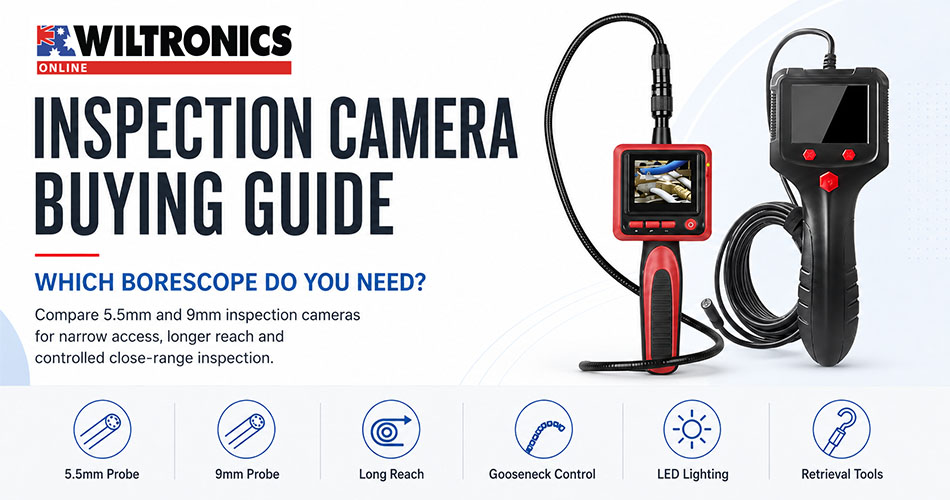
Inspection Camera Buying Guide: Which Borescope Do You Need?
An inspection camera lets you see inside pipes, wall cavities, machinery, engines, vents and other spaces that are difficult to examine directly.
However, camera resolution is only one part of the decision.
The probe must fit through the available opening, the cable must reach the target, and the camera must focus clearly at the required distance. Cable stiffness, lighting, waterproofing, power source and attachments can also determine whether a model is practical for the job.
At Wiltronics, our inspection camera range includes two distinct options:
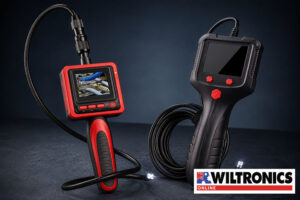
- A compact 5.5mm camera with a five-metre semi-rigid cable
- A 9mm camera with a shorter, controlled gooseneck probe
- A compatible two-metre extension for the 9mm model
This guide compares those options and explains how to choose the right inspection camera for your application.
Our quick recommendation: Choose the 5.5mm model when narrow access and longer reach are most important. Choose the 9mm model when precise positioning with a shorter, firmer gooseneck is the priority.
Quick Inspection Camera Selector
| Your inspection requirement | Feature to prioritise |
|---|---|
| Narrow access hole | 5.5mm probe |
| Long pipe, duct or cavity | Five-metre cable |
| Precise close-range positioning | Shorter gooseneck probe |
| Dark internal space | Adjustable probe LEDs |
| Damp inspection area | Confirm which components are water resistant |
| Viewing the side of a cavity | Mirror attachment |
| Retrieving a steel fastener | Magnet attachment |
| Retrieving a wire or lightweight item | Hook attachment |
| Extended use away from the workshop | Suitable battery system |
| Extra reach for the 9mm model | Compatible two-metre extension |
Compare Wiltronics Inspection Cameras
| Feature | 5.5mm LCD 1080P Borescope | 9mm Inspection Camera |
|---|---|---|
| Model | TL6020 | JQC8710 |
| Camera-head diameter | 5.5mm | 9mm |
| Probe length | 5m | 1m |
| Probe style | Flexible semi-rigid cable | Gooseneck |
| Display | 2.4-inch colour LCD | 2.4-inch colour LCD |
| Listed resolution | 1920 × 1080 camera | 480 × 234 display |
| Lighting | Three adjustable LED levels | Adjustable LED illuminator |
| Focus information | 4–10cm | Not listed on product page |
| Water resistance | IP67 lens assembly only | Check manual for limitations |
| Power | Rechargeable 2600mAh battery | Four AA batteries |
| Included attachments | Hook, magnet and side mirror | Mirror, hook and pick-up magnet |
| Extension option | Not listed | Compatible 2m extension |
| Best suited to | Narrow access and longer reach | Controlled close-range positioning |
The 5.5mm model is listed with a five-metre semi-rigid cable, 4–10cm focal range, adjustable LEDs and a rechargeable battery. The 9mm model uses a one-metre gooseneck, forward-facing controls and replaceable AA batteries.
Start with the Probe Diameter
Probe diameter should be one of the first specifications you compare.
The camera head must fit through the smallest opening along the entire access path—not only the entrance. Bends, pipe joints, internal fittings and attached accessories may reduce the available clearance.
Choose a 5.5mm Probe When:
- Access is particularly narrow
- You want to minimise the size of an access hole
- The camera must pass around compact components
- You are inspecting small pipes or confined machinery
- A 9mm head may be too large
Our 5.5mm LCD 1080P Borescope is the narrower of the two current Wiltronics options.
Choose a 9mm Probe When:
- The opening provides sufficient clearance
- A shorter, more controlled probe is preferable
- Precise positioning matters more than minimum diameter
- The camera will mainly be used for close mechanical or building inspections
Our 9mm Inspection Camera combines a 9mm head with a one-metre gooseneck and forward-facing controls. (Wiltronics)
Measure the Complete Access Path
Before ordering:
- Measure the narrowest opening.
- Check for bends and restrictions farther inside.
- Allow space to rotate and reposition the probe.
- Include the size of any fitted hook, magnet or mirror.
- Confirm that the probe can be withdrawn safely.
An attachment can make the camera head wider than its listed diameter.
Choose the Right Probe Length
Probe length determines how far the camera can reach from the access point.
A longer cable is useful for:
- Pipes and drains
- Wall and ceiling cavities
- Ducting
- Chimneys
- Machinery housings
- Areas behind fixed equipment
The 5.5mm Borescope includes a five-metre cable, while the 9mm Inspection Camera has a one-metre reach. (Wiltronics)
A longer cable is not automatically better. Excess length can coil, twist, catch on internal edges and become harder to guide.
Choose enough reach for the job with a modest working allowance.
Semi-Rigid Cable vs Gooseneck Probe
Cable construction affects how easily the camera can be directed.
Semi-Rigid Cable
A semi-rigid cable can bend while retaining part of its shape.
This is useful when the camera must:
- Travel several metres
- Follow a curved route
- Be shaped before insertion
- Reach through a pipe or cavity
- Navigate around machinery
The five-metre cable on our 5.5mm model is described as flexible and semi-rigid. (Wiltronics)
Gooseneck Probe
A gooseneck is generally shorter and firmer.
It can be easier to position when the target is nearby and the operator needs deliberate control over the viewing angle.
The 9mm model’s one-metre gooseneck is suited to close-range inspection, and its forward-facing controls allow the camera to be operated from the handle. (Wiltronics)
Which Is Better?
Choose the semi-rigid five-metre cable for reach and narrow access.
Choose the one-metre gooseneck for more controlled positioning close to the operator.
When to Add a Probe Extension
The 2m Inspection Camera Gooseneck Extension is designed for the compatible JQC8710 inspection camera.
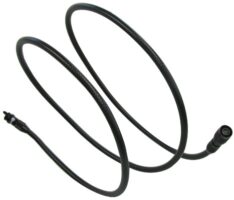
It is useful when the standard one-metre probe provides the preferred handling characteristics but does not quite reach the target.
Before adding an extension, consider whether the combined probe will still be easy to direct. Extra length can provide access but may reduce control, particularly through complex bends.
Screen and Resolution
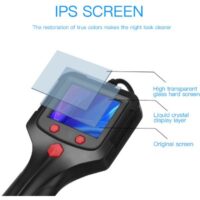
Both Wiltronics inspection cameras use integrated 2.4-inch colour LCD screens, allowing them to operate without a phone, application or separate computer.
A built-in display can be useful because it provides:
- Quick setup
- Self-contained operation
- No phone compatibility concerns
- No application or driver installation
- Easier use in a workshop or maintenance environment
The 5.5mm camera is a 1920 × 1080 camera resolution. The 9mm model is a 480 × 234 display resolution.
Image quality also depends on lighting, focus, camera movement, lens cleanliness and distance from the subject.
Check the Focal Range
An inspection camera may not focus clearly when the lens is pressed directly against the surface.
Our 5.5mm Borescope Camera has a focal range of 4–10cm
For the clearest view:
- Keep the camera within its working focal distance
- Move backwards slightly when the image is blurred
- Avoid resting the lens against the object
- Clean moisture, dust or grease from the camera window
- Hold the probe steady before assessing detail
A higher resolution cannot compensate for incorrect focus.
Lighting in Dark Cavities
Inspection cameras normally use LEDs around the lens to illuminate the area ahead.
The 5.5mm model provides three adjustable LED levels, while the 9mm model includes an adjustable LED illuminator and adjustable LCD brightness.
Adjustable lighting is useful because maximum brightness is not always best.
Highly reflective metal, wet pipe walls and pale surfaces can bounce light back into the lens and wash out detail. Begin at a low setting and increase the brightness gradually.
Battery Type
The two models use different power systems.
The 5.5mm LCD Borescope includes a rechargeable 2600mAh battery, USB-C charging and a listed operating time of approximately four to five hours.
The 9mm Inspection Camera uses four AA batteries.
Choose rechargeable power for convenient regular use. Replaceable batteries may be preferable when charging facilities are unavailable and spare batteries can be carried.
Included Attachments
Both cameras include attachments for viewing and retrieval.
Mirror
A mirror redirects the view towards the side of a cavity or pipe.
Use it for:
- Pipe walls
- Side-mounted components
- Cracks beside the camera
- Areas that cannot be viewed head-on
Hook
A hook may help retrieve:
- Wires
- Small lightweight objects
- Rings or keys
- Loose debris
Magnet
A magnet can help retrieve small ferrous objects such as:
- Screws
- Nuts
- Washers
- Steel clips
- Small tools
The 5.5mm model includes a hook, magnet and side mirror. The 9mm model includes a mirror, hook and pick-up magnet.
Check that the attachment and retrieved item can both pass back through the access opening.
Which Inspection Camera Suits Your Application?
| Application | Our recommendation |
|---|---|
| Narrow pipe or small access hole | 5.5mm model |
| Long wall or ceiling cavity | 5m semi-rigid model |
| Close engine-bay inspection | 9mm gooseneck model |
| Precise mechanical positioning | 9mm gooseneck model |
| Several metres of ducting | 5m semi-rigid model |
| Sidewall inspection | Use the included mirror |
| Retrieving a dropped steel fastener | Use the magnet attachment |
| Additional reach with JQC8710 | Add the compatible 2m extension |
| Damp location | Verify rated components and keep the display dry |
| Frequent mobile use | Compare rechargeable and replaceable battery systems |
Automotive and Machinery
For engine bays, machinery housings and areas behind trim, prioritise:
- Controllable probe movement
- Adjustable lighting
- Suitable focal distance
- A small enough camera head
- Magnet and hook attachments
The 9mm model is well suited to controlled close-range positioning. The 5.5mm model is preferable when the opening is smaller or the inspection point is farther away.
Never insert a camera into moving machinery, a running engine or excessively hot equipment.
Plumbing and Drain Inspection
For pipes and drains, prioritise:
- Probe diameter
- Cable length
- Ability to guide the cable
- Water-resistance limitations
- Ease of cleaning after use
The five-metre 5.5mm model is generally the stronger choice for longer, restricted access paths.
Electrical and Building Maintenance
Inspection cameras can assist with viewing wall cavities, conduits, ceiling spaces, ducting and de-energised enclosures.
Do not insert a general-purpose inspection camera into exposed live electrical equipment unless the product and working procedure are specifically rated and approved for that environment.
Common Inspection Camera Buying Mistakes
Choosing by Resolution Alone
Resolution is irrelevant when the camera cannot fit, reach or focus on the target.
Ignoring the Narrowest Opening
Measure the full route, including bends and internal restrictions.
Buying More Cable Than You Can Control
Long cables improve reach but can be harder to steer and retrieve.
Assuming the Whole Camera Is Waterproof
Check whether the rating applies only to the lens or probe.
Forgetting the Focal Distance
An image may be blurry because the camera is too close to the surface.
Overlooking Attachment Clearance
A mirror, hook or magnet increases the effective head size.
Using Maximum LED Brightness
Strong lighting can create glare inside reflective or wet spaces.
Forcing the Probe
Stop when the cable encounters resistance. Forcing it may damage the probe or cause it to become trapped.
Inspection Camera Buying Checklist
Before ordering, confirm:
- The smallest opening the camera must enter
- The total distance to the inspection point
- Any bends, joints or restrictions
- Whether you need a semi-rigid cable or firmer gooseneck
- The required focal distance
- Whether adjustable lighting is available
- Which components are water resistant
- Whether the display must be self-contained
- Whether rechargeable or replaceable batteries are preferable
- Whether a mirror, hook or magnet is needed
- Whether an extension is compatible
- Whether the equipment is safe to inspect
Frequently Asked Questions
Is a 5.5mm or 9mm inspection camera better?
A 5.5mm camera is better for smaller openings and confined spaces.
A 9mm camera can be a better choice when there is enough clearance and a shorter, firmer gooseneck provides more useful positioning control.
How long should an inspection-camera cable be?
Choose enough length to reach the target with a modest working allowance.
A five-metre cable suits long pipes, ducts and cavities. A one-metre probe is often easier to control during close mechanical inspection.
Can an inspection camera be used underwater?
Only immerse components specifically covered by the product’s water-resistance rating and permitted by its manual.
The IP67 rating listed for the Wiltronics 5.5mm model applies only to the lens assembly. (Wiltronics)
Why is the image blurry?
The lens may be too close to the target, outside its focal range, dirty, moving or receiving too much or too little light.
Adjust the distance, lighting and probe position before assuming the camera is faulty.
Can a borescope see around corners?
A flexible probe can follow some bends, but the camera normally looks forwards.
An included mirror attachment can provide a sideways view where there is sufficient clearance.
Can an inspection camera retrieve objects?
A hook or magnet may retrieve small objects when conditions allow.
Confirm that the object and attachment can be withdrawn through the access route.
Do I need a camera with its own screen?
An integrated display provides self-contained operation and avoids mobile-device compatibility issues.
Both current Wiltronics inspection cameras include 2.4-inch colour screens. (Wiltronics)
Choose the Right Inspection Camera with Wiltronics
The best inspection camera is not simply the model with the highest listed resolution.
Begin with the physical requirements: probe diameter, cable length and cable control. Then compare focal range, lighting, water resistance, battery system and attachments.
Choose our 5.5mm LCD 1080P Borescope with 5m Cable when narrow openings and longer reach are the main priorities.
Choose our 9mm Inspection Camera with 2.4-inch LCD when precise close-range positioning with a shorter gooseneck is more important.
Add the compatible 2m Inspection Camera Gooseneck Extension when the 9mm model needs additional reach.
Explore our complete inspection camera range or browse our wider tools and test equipment for maintenance, installation and fault-finding products.
© Electrotech Brands Pty Ltd 2026
Write a Comment
You must be logged in to post a comment.