

Hybrid Solar Inverter & Battery Storage Buying Guide
August 28, 2026
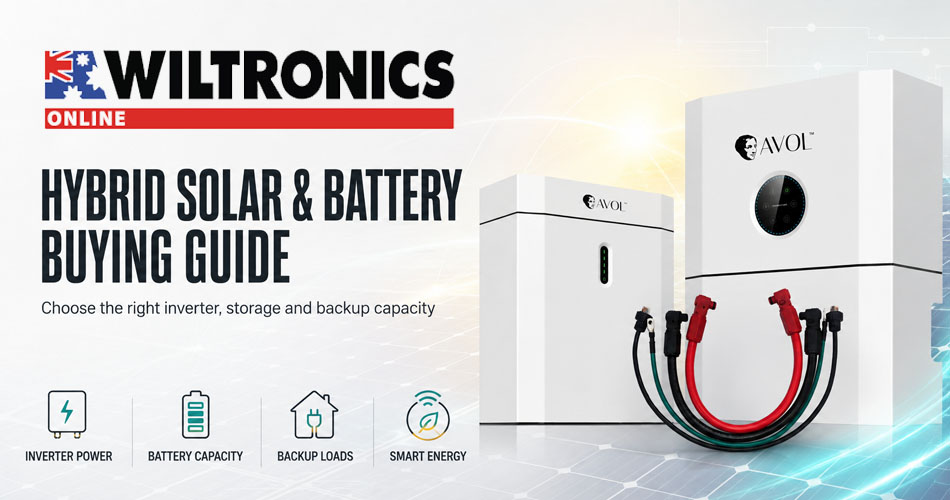
Hybrid Solar Inverter & Battery Storage Buying Guide
A hybrid solar system can generate electricity from rooftop panels, store surplus energy in a battery and supply selected loads when solar production is low. Depending on the system design, it may also provide backup power during a grid outage.
However, choosing a hybrid inverter and battery involves much more than matching two headline numbers. A 5kW inverter and a 5kWh battery describe different capabilities. One measures power—the rate at which energy can be delivered—while the other measures stored energy. Compatibility, usable capacity, backup output, charge and discharge limits, solar-array design, battery communication and installation requirements are equally important.
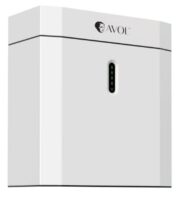
This guide explains the main purchasing decisions for Australian homes, businesses and technical buyers. It also introduces the modular AVOL Genius solar-storage range available from Wiltronics, including the 5kW Hybrid Solar Power Inverter and 5.1kWh LFP Battery Pack.
Important: Grid-connected solar and battery systems are not DIY projects. System design, product eligibility, network approval and installation must be handled by appropriately licensed and accredited professionals. Product approval and incentive rules can change; verify the current requirements before purchase.
Australian requirements reviewed: August 2026. Approved-product lists, STC values, network rules and government incentives can change. Confirm the exact model, configuration and current eligibility before ordering.
AVOL Genius system at a glance
| Product or configuration | Key specification | Best used for |
|---|---|---|
| AVOL Genius 5kW Hybrid Solar Power Inverter | 5000W nominal AC; dual MPPT; compatible battery and backup functions | Managing solar, storage, grid exchange and a professionally designed backup circuit |
| AVOL Genius 5.1kWh LFP Battery Pack | 5.12kWh nominal; 4.6kWh usable | Modest evening demand or selected essential loads |
| Two battery modules | 10.24kWh nominal; 9.2kWh listed usable | Larger evening demand or longer backup duration |
| Four battery modules | 20.48kWh nominal; 18.4kWh listed usable | Maximum listed expansion for this battery family |
| 10kWh Power and Communication Cable | Matched AVOL expansion accessory | Compatible two-module system configuration |
| 20kWh Power and Communication Cable | Matched AVOL expansion accessory | Compatible four-module system configuration |
Use this table to shortlist the hardware, then have an accredited designer confirm energy yield, loads, string design, approvals and the complete balance of system.
Hybrid solar system at a glance
| System component | What it does | Specification to compare |
| Solar panels | Convert sunlight into DC electricity | Array power, voltage, current and orientation |
| Hybrid inverter | Manages solar, battery, grid and compatible backup power | AC output kW, MPPT range, current limits and backup capability |
| Battery | Stores energy for later use | Nominal and usable kWh, charge/discharge power and cycle life |
| Battery management system | Monitors and protects battery cells | Inverter compatibility and communications protocol |
| Meter or current sensor | Measures import and export at the connection point | Compatibility and installation arrangement |
| Backup circuit | Supplies selected loads during an outage where supported | Maximum backup power, surge demand and circuit design |
| Isolators, cabling and protection | Allow safe connection, protection and maintenance | Approved specification, ratings and installation requirements |
What is a hybrid solar inverter?
A conventional grid-connected solar inverter converts DC electricity from solar panels into AC electricity for the building and grid. A hybrid inverter adds battery management capability, allowing compatible storage to be charged and discharged as part of the same energy system.
Depending on the model and installation, a hybrid inverter may:
- power household or business loads from solar
- charge a compatible battery using surplus solar
- discharge the battery when solar production falls
- import electricity from the grid when required
- export permitted surplus energy
- provide a dedicated backup output during outages
- support scheduled charging and discharging
- communicate with monitoring software or a mobile app
The AVOL Genius 5kW Hybrid Solar Power Inverter is rated for 5000W nominal AC output and supports compatible grid-connected and off-grid operating modes. It includes dual MPPTs, compatible LFP battery communication, a dedicated backup capability, IP65 protection and remote monitoring options.
Hybrid inverter versus battery-ready inverter
The terms are sometimes used inconsistently. A hybrid inverter is generally designed to operate with a battery, but “battery-ready” does not guarantee compatibility with every battery or confirm that all required hardware is already installed.
Before buying, ask:
- Which exact battery models and firmware versions are supported?
- Is a separate meter, current transformer, gateway or backup box required?
- Does the system provide backup power, or only time-shift solar energy?
- Can a battery be added later without replacing the inverter?
- What are the permitted battery voltage and communication protocols?
Treat the inverter, battery, communications and protection equipment as one engineered system—not interchangeable boxes selected independently.
Understanding kW and kWh
Confusing power with energy is one of the most common solar-storage mistakes.
Kilowatts: how much power can be delivered at once
Kilowatts measure the rate of power flow. A 5kW inverter can provide up to its rated output under the specified operating conditions. The actual system may have separate limits for grid-connected output, battery charging, battery discharge and backup operation.
A battery may store plenty of energy but still be unable to start or run several high-power appliances simultaneously. Instantaneous demand matters for appliances such as kettles, ovens, pumps, air conditioners and workshop equipment.
Kilowatt-hours: how much energy is stored or consumed
Kilowatt-hours measure energy. A 5.1kWh battery can theoretically store 5.1kWh, but the usable amount may be lower because the battery management system reserves part of the capacity to protect the cells.
The AVOL Genius 5.1kWh LFP Battery Pack lists 5.12kWh nominal capacity and 4.6kWh usable capacity at 90% depth of discharge.
Simple runtime examples
Runtime is approximately:
Usable battery energy ÷ average load power
Using 4.6kWh of usable energy as a simple theoretical example:
| Average connected load | Idealised runtime before system losses |
| 250W | 18.4 hours |
| 500W | 9.2 hours |
| 1,000W | 4.6 hours |
| 2,000W | 2.3 hours |
Real runtime will be shorter or longer depending on inverter efficiency, battery temperature, state of charge, battery ageing, reserve settings and changing appliance demand. The table is a comparison tool—not a guaranteed operating time.
How to size a solar battery
The best battery size depends on the outcome you want. Start with energy data rather than selecting the largest pack available.
Step 1: examine electricity consumption
Review interval data or recent electricity bills to understand:
- total daily consumption
- daytime consumption while solar is producing
- evening and overnight consumption
- seasonal differences
- peak demand
- essential loads during an outage
Battery storage is most valuable when there is enough surplus solar to charge it and enough later consumption to use the stored energy.
Step 2: define the objective
Common objectives include:
- increasing self-consumption of rooftop solar
- reducing evening grid imports
- shifting energy away from expensive tariff periods
- keeping selected essential circuits operating during outages
- building a modular system that can expand later
- participating in a compatible virtual power plant
One battery size will not optimise every objective. Backup design, in particular, must consider both stored energy and peak power.
Step 3: compare usable—not only nominal—capacity
Nominal capacity is the total energy capacity stated for the battery. Usable capacity is the portion available within the allowed operating range.
For the AVOL Genius battery:
- Nominal capacity: 5.12kWh
- Listed usable capacity: 4.6kWh
- Listed depth of discharge: 90%
- Maximum modules: four
The modular design supports configurations up to approximately 20kWh nominal capacity when correctly designed with compatible equipment. The required 10kWh power and communication cable or 20kWh power and communication cable depends on the approved system configuration.
Step 4: avoid automatic oversizing
An oversized battery may remain partly unused if the solar array cannot charge it or the property does not consume enough energy after sunset. An undersized battery may regularly empty before the required load period ends.
A qualified designer can model expected solar production, consumption and tariffs across the year. This is more reliable than dividing a single quarterly bill by 90 days.
Worked sizing example: match surplus solar to evening use
Suppose interval data shows that a home exports about 8kWh of surplus solar on a typical suitable day and then consumes 6kWh between sunset and the next morning.
- One AVOL module provides 4.6kWh of listed usable capacity. It could absorb much of the surplus and offset most—but not all—of the 6kWh evening requirement before conversion losses.
- Two modules provide 9.2kWh of listed usable capacity. They offer more backup duration and room to capture the 8kWh surplus, but may be underused on low-solar days or if evening consumption falls.
- At a constant 1kW essential load, one module gives an idealised 4.6-hour calculation before losses and reserve settings. Backup power limits still determine which appliances may operate together.
The better choice depends on seasonal exports, tariffs, desired reserve and outage objectives—not simply the largest capacity. Compare the 5.1kWh LFP battery module with your interval data before requesting a final system design.
Backup power: what will actually stay on?
A solar battery does not automatically mean the entire building operates normally during a blackout.
Backup capability depends on:
- whether the inverter has a supported backup output
- which circuits are connected to that output
- maximum continuous backup power
- short-duration surge capability
- battery discharge limits
- battery state of charge when the outage begins
- required isolation from the grid
- installation design and local rules
Essential-load backup
Many systems use an essential-loads circuit containing selected equipment such as:
- refrigerator and freezer
- lighting
- modem and networking equipment
- security or CCTV system
- selected general-purpose outlets
- medical or communications equipment where appropriately designed
High-demand appliances may be excluded so that they do not overload the backup output or rapidly exhaust the battery.
Power and runtime are separate questions
A system may have enough inverter power to start a load but insufficient stored energy to run it for many hours. Alternatively, a large battery may contain enough energy but have a discharge limit below the combined instantaneous demand.
Ask the designer for two answers:
- Which appliances can operate together?
- How long are the essential loads expected to run at a realistic average demand?
Review the AVOL Genius 5kW Hybrid Solar Power Inverter specifications with your installer, paying particular attention to the separately rated grid and backup functions.
Why LFP batteries are used for stationary storage
Lithium iron phosphate—LiFePO4 or LFP—is widely used in stationary energy storage because it combines useful cycle life, thermal stability and a maintenance-free sealed format.
The AVOL Genius pack lists:
- LFP chemistry
- 5.12kWh nominal energy
- 4.6kWh usable energy
- up to 10,000 cycles at 90% depth of discharge
- IP65 enclosure rating
- CAN and RS485 communications
- modular expansion to four packs
- five-year product and ten-year performance warranty terms
Cycle-life figures are measured under specified test conditions and should not be interpreted as a guaranteed number of years in every installation. Temperature, charge rate, depth of discharge, operating strategy and warranty conditions affect long-term performance.
The battery also weighs 54kg, reinforcing the need for correct handling, mounting, clearances and professional installation planning.
Inverter specifications that matter
Grid output, backup output and battery power are different limits
| System pathway | What the rating controls | What to verify |
| Grid-connected AC output | Power delivered during normal grid-connected operation | The AVOL product page lists 5000W nominal AC and 4999W maximum output for Australia |
| Dedicated backup output | Loads that can operate when the grid is unavailable | The product page lists 20A maximum backup output current; confirm continuous power, surge capability and circuit design from current documentation |
| Battery charge and discharge | How quickly energy can enter or leave storage | Confirm inverter, battery, cabling, temperature and configuration limits as one compatible system |
Do not assume the inverter’s headline 5kW grid rating automatically applies to every backup or battery operating condition.
AC output power
The nominal AC rating indicates the inverter’s continuous power class. Compare it with the building load, approved connection arrangement and backup requirements—not just the solar-array size.
MPPT voltage range
Maximum power point trackers allow the inverter to optimise output from compatible solar strings. The AVOL 5kW inverter has two MPPTs and a listed MPPT voltage range of 80–560V.
Dual MPPTs can be useful when the array has two orientations or groups with different solar conditions. String voltage, current, temperature behaviour and panel compatibility must still be calculated by the system designer.
Input current per MPPT
Modern solar panels can produce substantial current. Confirm that the proposed string arrangement remains within the inverter’s voltage and current limits under all design conditions.
Charge and discharge limits
Battery energy capacity does not reveal how quickly the system can charge or discharge. Compare battery and inverter current or power limits as a compatible pair.
Efficiency
The AVOL inverter lists up to 97.6% maximum PV efficiency. Efficiency varies with operating point and energy pathway; solar-to-load, solar-to-battery and battery-to-load energy can pass through different conversion stages.
Environmental rating
IP65 indicates protection against dust ingress and water jets under the relevant test conditions. It does not mean any exposed outdoor location is suitable. Direct sun, heat, flooding risk, clearances, ventilation, corrosive environments and manufacturer instructions still influence placement.
Communications and monitoring
The AVOL inverter supports RS485, CAN, Wi-Fi and optional 4G communication. Monitoring can help users view solar generation, battery state of charge, household use and grid exchange. Confirm which accessories, network connection and app services are required.
Modular battery storage: 5kWh, 10kWh or 20kWh?
Modular systems allow capacity to grow in planned increments.
| Configuration | Approximate nominal capacity | Listed usable capacity based on 4.6kWh per module | Typical planning role |
| One module | 5.12kWh | 4.6kWh | Modest evening load or selected backup circuits |
| Two modules | 10.24kWh | 9.2kWh | Larger evening consumption or longer essential-load backup |
| Three modules | 15.36kWh | 13.8kWh | Higher-consumption property with suitable solar generation |
| Four modules | 20.48kWh | 18.4kWh | Maximum listed modular configuration for this battery family |
Plan the complete expansion before the first installation. Ask whether future modules must use the same model and firmware, whether the manufacturer permits differences in battery age, which communications cable the system requires, and whether the original protection, mounting and inverter configuration can support the final capacity.
Ready to plan for future capacity? Browse the Wiltronics solar-battery range and include the final intended module count in the original design brief.
Compatible cables, isolators and installation hardware
The inverter and battery are only part of a compliant system. Correctly specified balance-of-system equipment may include:
- battery power and communication cables
- DC and AC isolation equipment
- overcurrent and surge protection
- compatible meters and current sensors
- warning and identification labels
- solar-rated cable and connectors
- rigid or corrugated conduit
- conduit clips, bends and fittings
- mounting and mechanical protection
Wiltronics options include:
- 10kWh Power and Communication Cable
- 20kWh Power and Communication Cable
- ZJBENY 35A AC Isolator
- Battery Label Kit for Grid-Connected DC Isolators
- 25mm Heavy-Duty Corrugated Solar Conduit
- 25mm Heavy-Duty Rigid Solar Conduit
- 25mm Stainless Steel Solar Conduit Clips
- broader solar cables and accessories
These products must be selected by the installer for the particular design. A physical connector fit does not establish electrical, communications or regulatory compatibility.
Australian approvals, accredited installation and incentives
The following Australian requirements were reviewed in August 2026. Confirm current information again when the system is quoted.
To qualify under the Small-scale Renewable Energy Scheme, applicable solar PV, battery and inverter components must appear on the Clean Energy Council’s approved-product lists and meet relevant standards. Appropriately accredited professionals must also design and install the system. Review the regulator’s small-scale renewable energy systems guidance before purchasing.
The Clean Energy Council maintains current approved inverter and approved battery lists. A product being offered for sale does not by itself confirm eligibility for a particular grid connection, rebate or certificate program.
Solar batteries became eligible under the federal SRES from 1 July 2025, subject to current scheme requirements. The Clean Energy Regulator’s solar battery guidance explains eligibility, STCs and interaction with other programs.
At quote stage, confirm:
- current CEC product approval status
- SAA installer and designer accreditation appropriate to the system
- state or territory electrical licensing requirements
- distribution-network approval
- current federal, state or territory incentives
- whether incentives can be combined
- metering or retail-plan changes
- VPP requirements and control permissions
- warranty registration and maintenance obligations
Never assume that an incentive advertised earlier in the year still applies or that every battery configuration qualifies.
Grid-connected, backup and off-grid are different designs
| Design | Normal operation | Critical planning point |
| Grid-connected self-consumption | Solar and stored energy reduce grid imports; permitted surplus may be exported | Network approval, export settings and tariff |
| Grid-connected with backup | Selected circuits use a dedicated backup output during a compatible outage | Isolation, circuit selection, surge power and runtime |
| Off-grid | Solar, batteries and often a generator operate without the grid as a routine fallback | Seasonal yield, poor-weather autonomy, peak loads and generator integration |
An off-grid-capable product is not automatically a complete off-grid solution. It requires detailed load profiling and worst-case energy modelling by an appropriately accredited designer.
Common hybrid solar and battery buying mistakes
| Mistake | Better approach |
| Matching inverter kW directly to battery kWh | Check instantaneous power and stored energy separately |
| Assuming the whole property is backed up | Confirm circuits, continuous output, surge demand and runtime |
| Matching a battery by voltage alone | Verify BMS communications, hardware, firmware and manufacturer compatibility |
| Sizing from a quarterly bill | Use interval data to reveal daytime surplus and evening demand |
| Comparing only nominal capacity | Compare usable kWh within the permitted operating range |
| Deferring expansion planning | Design for the final module count, cables, protection and mounting from the beginning |
| Treating runtime as guaranteed | Model realistic loads, losses, reserve settings and battery condition |
| Buying before approvals are checked | Confirm current product lists, network rules, accreditation and incentive eligibility |
Questions to ask before accepting a quote
- What are the measured daytime surplus and evening energy use?
- What are the inverter’s separate grid, battery and backup limits?
- What are the battery’s nominal and usable capacities?
- Which circuits and simultaneous appliances will backup support, and for how long?
- Are the exact models currently approved for the proposed installation?
- Who will design, install, commission and register the system?
- Which meters, gateways, cables, isolators and protection are included?
- Can storage expand later, and under what conditions?
- What warranty, connectivity and maintenance conditions apply?
- Does the quote depend on an incentive, STC value or VPP agreement?
Frequently asked questions
What size battery do I need for a 5kW solar system?
There is no universal battery size for a 5kW solar system. Battery capacity should be based on surplus solar generation, evening consumption, backup objectives, tariff structure and seasonal conditions. A 5kW inverter rating does not imply that a 5kWh battery is automatically correct.
Is a 5kWh battery enough to run a house overnight?
It depends on the overnight load. A battery with 4.6kWh usable capacity could theoretically support a 500W average load for about 9.2 hours before losses, but high-demand appliances and changing consumption can reduce runtime significantly.
Does a hybrid inverter work during a blackout?
Can I add more batteries later?
Some modular systems allow expansion. The AVOL Genius family lists up to four 5.1kWh modules, but later expansion must comply with manufacturer compatibility, battery-age, firmware, cabling, protection and installation requirements.
What is the difference between nominal and usable battery capacity?
Nominal capacity describes the battery’s total energy capacity. Usable capacity describes the energy the battery can deliver within its approved operating limits. Usable capacity is the more practical number for runtime comparisons.
Is LiFePO4 the same as LFP?
Yes. LiFePO4 is the chemical notation for lithium iron phosphate, commonly abbreviated to LFP.
Can I install a hybrid inverter or solar battery myself?
No. Grid-connected and stationary battery systems involve hazardous DC energy, mains electricity, network connection and regulatory requirements. Use appropriately licensed and accredited professionals.
Are Australian solar battery rebates available?
Federal SRES support for eligible solar batteries began on 1 July 2025. Other programs may also apply, but eligibility, certificate values and interaction between schemes can change. Check the current Clean Energy Regulator and relevant state or territory information when obtaining quotes.
Final recommendation
A strong hybrid solar-storage system begins with three numbers:
- the property’s real energy use by time of day
- the maximum power required from the inverter and backup circuit
- the usable battery capacity needed to meet the chosen objective
From there, confirm panel-string design, MPPT compatibility, charge and discharge limits, communications, approved-product status, installation requirements and expansion plans.
The AVOL Genius 5kW Hybrid Solar Power Inverter and modular 5.1kWh LFP Battery Pack provide a scalable platform for compatible professionally designed systems. Wiltronics also carries the matched communications cables, isolators, labels and solar conduit required around a complete installation.
Explore solar batteries, hybrid inverters and accessories at Wiltronics.
© Electrotech Brands Pty Ltd 2026
Write a Comment
You must be logged in to post a comment.