

How to Choose a Fuse: Types, Ratings & Fuseholders
August 10, 2026
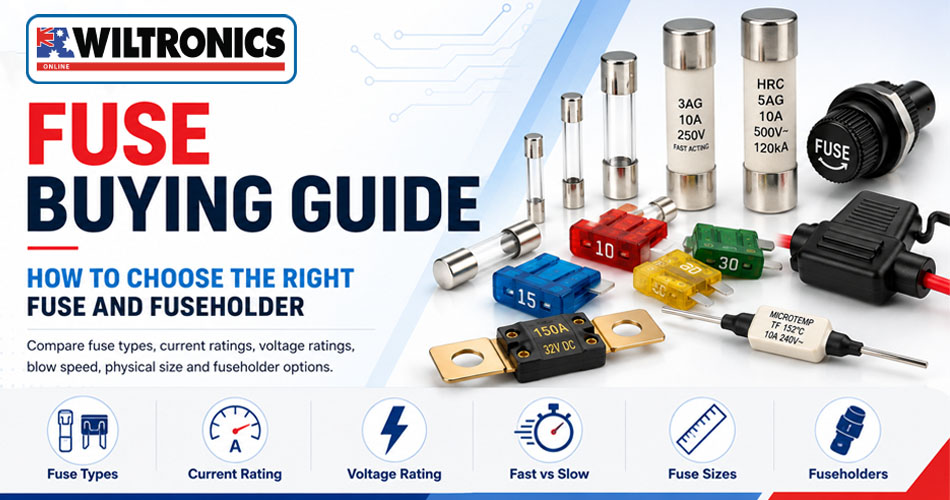
Fuse Buying Guide: How to Choose the Right Fuse and Fuseholder
A fuse is one of the simplest forms of circuit protection, but choosing the correct replacement involves much more than matching the number of amps printed on the body.
Two fuses can have the same current rating while differing in voltage rating, operating speed, physical size and breaking capacity. A fuse can also physically fit a holder without being suitable for the circuit.
At Wiltronics, we stock cartridge fuses, automotive blade fuses, bolt-down fuses, thermal fuses, PCB fuse clips, inline and panel-mount fuseholders, and circuit breakers for electronics, automotive, electrical and general maintenance applications.
This guide explains the key specifications we recommend checking before selecting or replacing a fuse.
Our quick recommendation: Whenever possible, replace a fuse with the exact type and rating specified by the equipment manufacturer. Match the fuse type, current rating, voltage rating, operating characteristic, physical size and required breaking capacity.
Fuse Selection at a Glance
| Check | Why it matters |
|---|---|
| Fuse type | Must suit the circuit and holder |
| Current rating | Determines the intended overcurrent protection level |
| Voltage rating | Must be suitable for the circuit voltage |
| Fast or time-delay | Determines how the fuse responds to short-duration surges |
| Physical size | Must fit the holder correctly |
| Breaking capacity | Determines the fault current the fuse can safely interrupt |
| Fuseholder | Must suit the fuse and circuit ratings |
The most important rule is simple: do not choose a fuse solely because it fits.
Quick Wiltronics Fuse Selector
| Application | Product to consider |
|---|---|
| 5 × 20mm general electronics | M205 Fast Acting Fuses |
| 5 × 20mm circuit with startup surge | M205 Time Delay Fuses |
| Larger cartridge format | Quick Acting 3AG Fuses 250V |
| Larger cartridge with startup surge | Time Delay 3AG Fuses |
| High fault-current interruption | HRC 5AG Fuse-Links |
| PCB-mounted time-delay protection | Micro Radial Lead ETF Time Lag Fuse |
| Automotive fusebox | ATC Regular Blade Fuses |
| Compact automotive fusebox | Mini Blade Fuses |
| High-current 32V DC wiring | MIDI ANS Bolt-Down Fuse |
| High-current battery installation | ANL Fuse Set with Fuse |
| Appliance temperature protection | Microtemp Thermal Fuse |
Always check the equipment specification before selecting from a general-purpose table like this.
1. Start with the Fuse Type
Different fuse families are designed for different mounting methods and applications.
Common types in the Wiltronics range include:
- M205 cartridge fuses
- 3AG cartridge fuses
- HRC ceramic fuses
- Automotive blade fuses
- Mini blade fuses
- MIDI/ANS bolt-down fuses
- ANL fuses
- Thermal fuses
- Radial-leaded PCB fuses
Browse our wider fuses, fuseholders and circuit breakers range to compare the available formats.
When replacing an existing fuse, the original fuse markings and the equipment manual should normally be your first references.
2. Match the Current Rating
The current rating is one of the most visible fuse specifications, but it is not the only one.
A fuse is selected so that normal operating current can pass while excessive current causes the fuse element to open according to its designed operating characteristic.
Do Not Increase the Fuse Rating to Stop Nuisance Blowing
If a fuse repeatedly opens, investigate the reason.
Possible causes include:
- A short circuit
- Failed component
- Overloaded circuit
- Damaged wiring
- Incorrect replacement fuse
- Excessive inrush current
- Equipment fault
Installing a higher-rated fuse simply because the correct fuse keeps blowing can reduce the protection designed into the circuit.
3. Check the Voltage Rating
Current and voltage ratings perform different jobs.
The fuse must have a voltage rating suitable for the circuit in which it is installed. The voltage rating relates to the fuse’s ability to interrupt the circuit safely after the element opens.
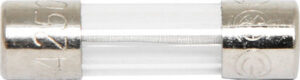
For example, Wiltronics’ M205 Time Delay Fuses are 5 × 20mm fuses rated at 250V and available across a range of current values.
Do not substitute a fuse with a lower voltage rating than the equipment specifies.
4. Check the Breaking Capacity
Breaking capacity—or interrupting rating—is the maximum prospective fault current that a fuse is designed to interrupt safely under its specified conditions.
This distinction is particularly important in:
- Mains-powered equipment
- High-energy battery systems
- Test equipment
- Industrial circuits
- High-current DC installations
A fuse can have the correct physical dimensions, current rating and voltage rating while still having an inadequate breaking capacity.
HRC Fuses
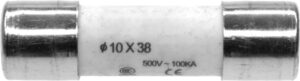
For applications requiring high fault-interruption capability, Wiltronics carries HRC 5AG High Rupture Ceramic Fuse-Links.
These 10.2 × 38mm gG/gL fuse-links are listed with a 120kA AC breaking capacity, with most versions rated to 500V AC.
Where equipment specifies an HRC or other high-breaking-capacity fuse, do not substitute an ordinary glass fuse just because it has the same current rating.
5. Fast-Acting vs Time-Delay Fuses
The fuse operating characteristic determines how quickly it responds to an overcurrent.
Fast-Acting Fuses
A fast-acting fuse is intended to respond relatively quickly when the current exceeds its designed limit.
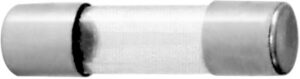
For 5 × 20mm applications, Wiltronics stocks M205 Fast Acting Fuses across a wide range of current ratings. The range uses a 20mm-long, 5mm-diameter body.
For a larger cartridge format, we also carry Quick Acting 3AG 250V Fuses, measuring approximately 6.35mm × 30mm.
Time-Delay Fuses
A time-delay or slow-blow fuse can tolerate a brief surge before opening.
This can be necessary in equipment with normal startup inrush, such as some:
- Motors
- Transformers
- Power supplies
- Lighting equipment
- Audio equipment
For compact installations, use the specified rating from our M205 Time Delay Fuse range.
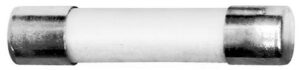
For 3AG applications, Wiltronics stocks 3AG Time Delay Fuses in multiple current ratings.
Do Not Swap Fast and Slow Fuses Casually
A fast fuse and time-delay fuse can share the same:
- Current rating
- Voltage rating
- Body size
but behave differently during startup and fault conditions.
Match the characteristic specified by the equipment manufacturer.
6. Match the Physical Fuse Size
Cartridge fuse dimensions matter because the fuse must fit securely between the holder contacts.
M205
M205 fuses in the Wiltronics range generally use a 5mm × 20mm body, including:
3AG
Our 3AG ranges use the larger 6.35mm × 30mm format, including:
Do not force a cartridge fuse into an incompatible holder.
7. PCB-Mounted Fuse Options
Not every fuse is designed to sit inside a removable panel holder.
For printed circuit board applications, Wiltronics stocks several mounting options.
M205 Fuse Clips
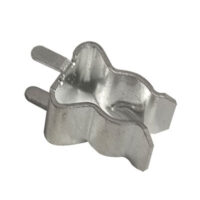
The M205 PCB Fuse Clip accepts a 5 × 20mm cartridge fuse and uses through-hole PCB mounting. It is listed for 10A and 250V.
Covered PCB Fuseholder
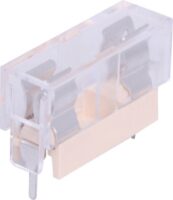
For a more enclosed installation, the M205 PCB Mount Fuse Holder and Cover provides a protective cover and is listed for suitable operation at up to 6.3A and 250V AC.
Radial-Lead Fuse
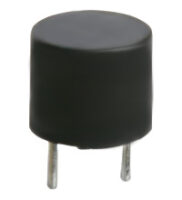
For direct PCB installation, the Micro Radial Lead ETF Time Lag Fuse uses radial leads and is available in numerous current ratings. It is rated at 250V and provides a time-lag characteristic.
8. Automotive Blade Fuses
Blade fuses are widely used in cars, caravans, boats and low-voltage accessory circuits.
Standard ATC Blade Fuse
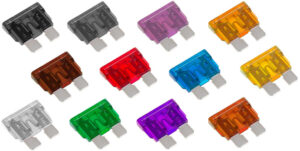
Our ATC Regular Blade Fuse range covers ratings from 1A through to 40A. The standard blade body measures approximately 19.1 × 18.5 × 5.1mm.
Mini Blade Fuse
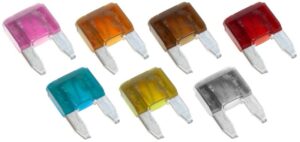
For more compact fuseboxes, use the correctly specified Mini Blade Fuse range. These measure approximately 10.9 × 16.3 × 3.6mm and are available from 3A to 25A.
Standard and mini blade fuses are not physically interchangeable.
Automotive Fuse Kit
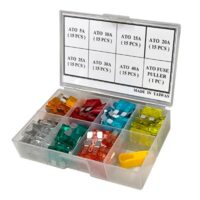
For workshops, maintenance kits and vehicle spares, the 105 Piece Auto Blade Fuse Pack with Puller contains seven commonly used ratings from 5A to 40A plus a fuse puller.
9. Automotive Fuse Taps
A fuse tap can add a fused accessory circuit to a compatible automotive fusebox.
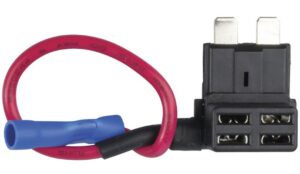
For standard blade systems, Wiltronics carries a Double Blade Fuse Tap.
For compact fuseboxes, use the correctly sized Mini Blade Fuse Tap – Double. The mini version provides a secondary accessory connection and is specified with a 16 AWG secondary wire.
A fuse tap should only be installed when the vehicle circuit, fusebox and available current capacity are suitable for the additional load.
10. Inline Automotive Fuseholders
When protection needs to be installed directly in a wiring run, an inline holder is often the practical choice.
Standard Blade
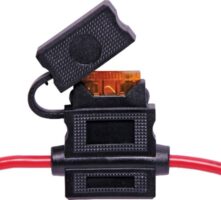
The 30A In-Line Automotive Blade Fuse Holder accepts standard automotive blade fuses and uses 12 AWG leads.
3AG
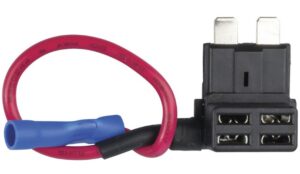
For cartridge fuses, the 3AG Inline Fuse Holder with Cable has pre-wired fly leads and a bayonet closure.
Maxi Blade
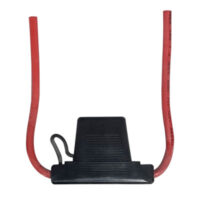
For heavier-duty blade-fuse applications, Wiltronics also stocks a Maxi Blade Inline Fuse Holder with 8 AWG leads.
11. Fuse Blocks for Multi-Circuit Installations
A fuse block can provide cleaner distribution when several circuits need individual protection.
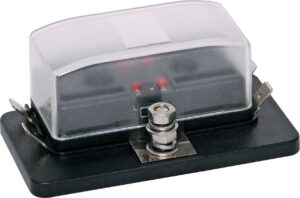
The 4 Way Auto Blade Fuse Block Panel with LEDs uses standard automotive blade fuses and supports four separately protected circuits.
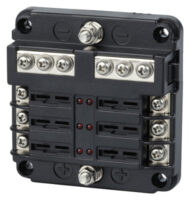
For caravans, boats and other installations that benefit from an integrated negative bus, the 6 Way Fuse Block with Bus Bar accepts up to six standard blade fuses and includes blown-fuse LED indication.
12. High-Current DC Fuses
Higher-current battery and auxiliary-power systems need fuse hardware designed for that application.
MIDI / ANS Bolt-Down Fuses
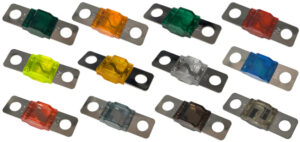
Wiltronics’ MIDI ANS Bolt-Down Fuse range is available from 20A through to 200A.
These fuses are rated at 32V DC and have a listed interrupting rating of 2000A at 32V DC.
They can be matched with:
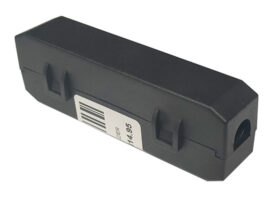
Both holders are listed for up to 200A at 32V.
ANL Fuse Systems
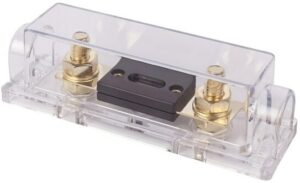
For other high-current 32V applications, the ANL Fuse Set with Fuse is available in 80A, 100A, 150A, 200A and 250A versions.
Correct cable sizing, termination and installation practices are particularly important in high-current battery circuits.
13. Thermal Fuses
A thermal fuse differs from a conventional current-operated fuse.
Its primary purpose is to permanently open a circuit when a specified temperature is exceeded.
Thermal fuses are commonly found in:
- Heating appliances
- Motors
- Transformers
- Power supplies
- Whitegoods
- Temperature-sensitive equipment
Wiltronics’ Microtemp Thermal Fuse range is rated at 240V and 10A, with temperature options from approximately 76/77°C through to 216°C.
When replacing a thermal fuse, match the specified temperature, current and voltage ratings and follow the equipment manufacturer’s installation requirements.
Never bridge a thermal fuse with wire.
14. Choosing a Fuseholder
The fuseholder forms part of the current path and needs to suit both the fuse and the circuit.
Check:
- Fuse format
- Fuse dimensions
- Current rating
- Voltage rating
- Terminal style
- Mounting method
- Environmental conditions
M205 Panel Mount
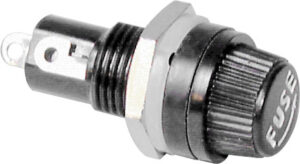
The M205 Panel Mount Fuse Holder accepts M205 fuses and uses solder-tag connections.
M205 Safety Chassis Mount
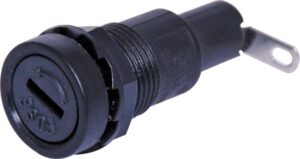
For applications requiring a screwdriver-access cap, consider the M205 Chassis Mount Safety Type Fuse Holder, which is listed at 10A and 250V AC.
3AG Panel Mount
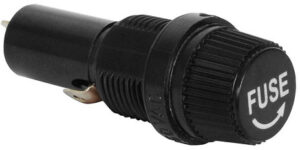
The 3AG Panel Mount Fuse Holder accepts 3AG fuses and uses a screw cap with solder-tag termination.
Browse all current panel-mount fuseholders or our inline fuseholders for additional options.
15. Fuse or Circuit Breaker?
Fuses and circuit breakers both provide overcurrent protection, but they operate differently.
A fuse operates once and must be replaced after opening.
A circuit breaker can normally be reset after the fault is identified and cleared.
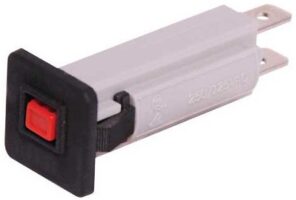
Where a resettable device is appropriate, Wiltronics carries the Flush Mount Circuit Breaker 32VDC/250VAC in several current ratings from 3A to 16A.
Our broader circuit breaker range also includes PCB auto-reset, chassis-mount, panel-mount and waterproof options.
Do not automatically replace a fuse with a breaker unless the circuit has been designed or approved for that change.
Common Fuse Buying Mistakes
Choosing Only by Amp Rating
Two 5A fuses can differ in voltage, speed, physical dimensions and interrupting capacity.
Increasing the Current Rating
A larger fuse may permit the circuit to carry unsafe current before opening.
Ignoring Fast vs Time-Delay Operation
A time-delay fuse is not automatically a substitute for a fast-acting fuse—or vice versa.
Ignoring Breaking Capacity
This is particularly important in mains equipment, test instruments and high-energy DC systems.
Choosing the Wrong Size
M205, 3AG, HRC, blade and mini blade fuses use different dimensions.
Assuming All Ceramic Fuses Are Equivalent
Ceramic construction alone does not define the electrical characteristics.
Assuming Colour Is Enough
Blade-fuse colours are helpful, but always verify the marked current rating.
Using the Wrong Holder
The fuseholder must be compatible with the fuse and electrically suitable for the circuit.
Replacing a Thermal Fuse with an Ordinary Fuse
A thermal fuse performs a different protection function.
Fuse Buying Checklist
Before ordering, confirm:
- Fuse family or type
- Current rating
- Voltage rating
- Fast-acting or time-delay characteristic
- Physical dimensions
- Required breaking capacity
- Glass, ceramic, blade, bolt-down or thermal construction
- Fuseholder compatibility
- Holder current and voltage rating
- Installation method
- Manufacturer-specified replacement
- Reason the original fuse opened
Frequently Asked Questions
Can I replace a fuse with a higher amp rating?
Not simply because the original keeps blowing.
Use the manufacturer-specified rating and investigate repeated fuse failure.
Can I use a lower-rated fuse?
A lower-rated fuse may open during normal operation or startup. Match the specified value.
Can I replace a slow-blow fuse with a fast fuse?
Not unless the equipment specification permits it. A fast fuse may open during normal inrush current.
Can I replace a fast fuse with a slow-blow fuse?
Do not do so without an approved specification. The slower response changes the circuit protection behaviour.
Is a 250V fuse suitable for a lower-voltage circuit?
Voltage rating is only one selection criterion. Current, operating speed, physical size, breaking capacity and application must also match.
Why does my fuse keep blowing?
Common causes include short circuits, damaged wiring, overloaded circuits, failed components and the wrong fuse characteristic.
Are glass and ceramic fuses interchangeable?
Not automatically. Their breaking capacity and operating characteristics may differ even when the current rating and dimensions look similar.
What is the difference between standard and mini blade fuses?
They perform similar roles in compatible low-voltage systems but use different physical sizes. Check the fusebox format before ordering.
What does a time-delay fuse do?
A time-delay fuse tolerates a brief current surge before opening, making it suitable for equipment where normal startup current temporarily exceeds steady-state current.
What is an HRC fuse?
An HRC fuse is designed with a high rupture or breaking capacity so that it can safely interrupt significantly higher fault currents than many general-purpose fuse designs.
What is a thermal fuse?
A thermal fuse opens permanently when its specified temperature threshold is exceeded. It is primarily temperature-operated rather than a conventional overcurrent fuse.
Choose the Right Fuse with Wiltronics
The best fuse replacement is normally the one that matches the original specification exactly.
Start with the fuse type and physical size, then confirm the current rating, voltage rating, operating speed and breaking capacity. Finally, make sure the fuseholder is designed for the fuse and adequately rated for the circuit.
For electronics, compare:
- M205 Fast Acting Fuses
- M205 Time Delay Fuses
- Quick Acting 3AG Fuses
- 3AG Time Delay Fuses
- HRC 5AG Fuse-Links
- Micro Radial Lead ETF Time Lag Fuses
Automotive and high-current DC applications, explore:
- ATC Regular Blade Fuses
- Mini Blade Fuses
- 105 Piece Blade Fuse Pack
- 30A Inline Blade Fuse Holder
- MIDI ANS Fuses
- MIDI ANS Inline Fuse Holder
- MIDI ANS Panel Mount Fuseholder
- ANL Fuse Set
For temperature protection, see our Microtemp Thermal Fuse range.
Browse the complete Wiltronics fuses, fuseholders and circuit breakers range for additional protection products.
© Electrotech Brands Pty Ltd 2026
Write a Comment
You must be logged in to post a comment.