

Fossil Specimens: A Beginner’s Guide to Collecting and Identification
September 17, 2026
Fossil Specimens: A Beginner’s Guide to Collecting and Identification
What can a small piece of fossil-bearing rock tell you about ancient life? Look closely and you might notice a shell outline, repeated ridges or an impression that is easy to miss at first glance.
A labelled fossil collection gives you a practical way to investigate those details at home. You can compare specimens, check your observations against reference information and gradually build your understanding of the life they represent.
This guide explains how to examine fossil specimens and choose from the Wiltronics fossil collection range, whether you’re starting a hobby or expanding an interest in natural history.
What is a fossil specimen?
A fossil is preserved evidence of past life in a geological setting. Body fossils record parts of organisms, such as shells, teeth or plant remains. Trace fossils record activity, such as footprints or burrows. A specimen may preserve only a fragment rather than a complete organism. National Park Service: How Fossils Form
The surrounding rock is often called the matrix. When examining a specimen, look at both the fossil and this background material: the fossil’s boundaries may be less obvious than they appear in an illustration.
How do fossils form?
Fossilisation can follow several pathways. Minerals may fill spaces within remains or replace original material. Organisms can leave impressions, while compression can preserve flattened remains. A shell that dissolves may leave a mould; material filling that space can form a cast.
Rapid burial and durable body parts improve the chances of preservation. Even so, the fossil record is incomplete: organisms living where sediment accumulates are more likely to be preserved than those in environments where their remains are quickly destroyed. National Park Service: Fossilisation Processes
This explains why a collection can contain specimens with very different appearances. A raised shell shape, a flattened plant impression and mineralised material can all preserve evidence of life.
How to examine a fossil: five practical steps
You do not need an elaborate setup to begin. Use a clear workspace, good lighting, a ruler, a notebook and a hand magnifier. A 5× handheld magnifying glass is a simple accessory for closer viewing.
- Keep its identity attached. Give the specimen a notebook entry that matches its tray position or label. Photograph the label as well as the specimen.
- Describe the overall form. Record its dimensions and whether it is rounded, elongated, coiled, flattened or irregular. Distinguish the dimensions of the whole rock from those of the visible fossil.
- Change the light direction. Move a lamp to the side and rotate the specimen carefully. Shadows can make shallow relief easier to see.
- Inspect the details. Look for repeated ridges, segments, pores, growth lines or impressions. Describe what is visible before assigning an identity.
- Compare with the reference. Check the supplied key or a reliable fossil guide. Record a tentative identification when the evidence is incomplete.
A useful notebook separates observation from interpretation:
| Observation | Possible interpretation | Next check |
|---|---|---|
| Repeated curved ridges | Could be shell ornament | Compare with the specimen key |
| A shallow outline in the matrix | Could be an impression | Examine under light from several angles |
| Only part of the structure is exposed | Identification may be limited | Compare the visible portion with reference illustrations |
These are prompts for investigation, not identification rules. One feature alone may fit several possibilities.
Which fossil collection should you choose?
Start with how you want to use the collection. A manageable introduction, a wider variety of fossils and several examples of one fossil type serve different purposes.
| Your starting point | Wiltronics option | What makes it useful |
|---|---|---|
| You want an introduction with identification support | General Fossil Set — 15 specimens | Includes a descriptive key sheet and geological time chart |
| You want more specimens to compare | Comprehensive Fossil Set — 30 specimens | Plant and animal examples spanning three geological eras |
| You want to examine fossil material within limestone | Archaeocyatha Limestone Fossils — pack of 10 | Multiple specimens for comparing visible preservation |
| You want to explore fossils alongside other geological materials | Rocks, Minerals and Fossils — four-kit bundle | Combines fossil, mineral, igneous rock and sedimentary rock collections |
General Fossil Set: a manageable first collection
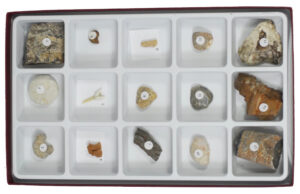
The 15-piece General Fossil Set, EN1966-01, includes a descriptive key sheet and geological time chart in a 280 × 170 × 40mm storage box.
Use the key to check your observations, then place the specimen on the supplied timeline. This connects what you can see with the documented geological context.
Try working through three specimens at a time. Write down their similarities and differences before consulting the key. This encourages careful observation instead of simply memorising names.
Comprehensive Fossil Set: a wider range to investigate
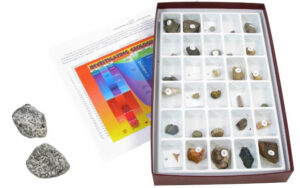
The 30-piece Comprehensive Fossil Set, EN1967-01, includes plant and animal fossils from the Palaeozoic, Mesozoic and Cenozoic eras, with specimens sourced from the USA and Morocco.
The linked collection contents sheet lists examples including trilobites, brachiopods, bivalves, gastropods, cephalopods, echinoids and petrified wood. Use that variety to compare body forms and preservation across the collection.
Check the contents information before choosing a set for a particular fossil. Natural specimens can differ from photographs, and a specimen count does not necessarily equal the number of distinct species.
Archaeocyatha limestone: examine fossils in their rock
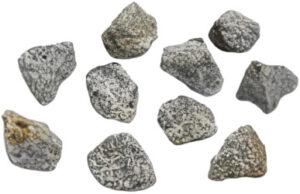
The Archaeocyatha Limestone Fossil Pack, RM6443-03, contains ten specimens approximately 3–4cm across. Wiltronics describes them as remains of Cambrian reef-building organisms embedded in limestone.
This pack offers a different investigation from a mixed collection. Compare how clearly the fossil material appears in each piece, how much surrounding limestone is present and which viewing angle reveals the most detail.
For a shared activity, ask each person to sketch their specimen, then compare which features appear across several pieces.
Four geological kits: expand beyond fossils
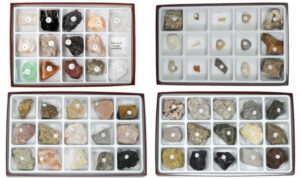
The Rocks, Minerals and Fossils bundle, EN1974-01, contains the 15-piece General Fossil Set, a 14-piece Minerals Study Kit, a 15-piece Igneous Rocks Collection and a 15-piece Sedimentary Rocks Collection.
Set up separate trays for each collection and compare their visible textures and structures. Use the labels to check which observations distinguish the supplied materials.
Keep the different kits and their labels organised separately so that observations remain connected to the correct reference information.
What can fossils tell you about age and environment?
Fossils help geologists reconstruct past environments and compare the ages of rock layers. Some groups are particularly useful for correlating strata, but that work relies on identification and geological context. British Geological Survey: Why We Study Fossils
For a purchased collection, preserve any locality, formation and age information supplied with each specimen. These details provide context that appearance alone cannot supply.
When making a display, reproduce the level of detail supported by its documentation. A broad geological period is more informative than an unsupported precise date.
Build a collection you can keep learning from
Choose your next specimen to answer a question. You might want to compare preservation styles, examine another organism group or explore fossil material within a different rock.
Use divided storage so specimens do not knock together, retain the original labels and support fragile pieces from beneath. Keep routine examination non-destructive; seek specimen-specific advice before washing, scraping or attempting to expose more material.
For a simple weekend project, select three specimens and create a small display with a photograph, documented identity, age information and two observations for each. Add one unanswered question. This turns the display into an ongoing investigation.
Frequently asked questions
Are these real fossils or replicas?
Wiltronics describes the General Fossil Set, Comprehensive Fossil Set and Archaeocyatha limestone pack as containing authentic or genuine specimens. Natural variation means individual pieces may differ in shape, colour and exposed detail from the product photographs.
Which fossil set is best for beginners?
The 15-piece General Fossil Set is a practical starting point because it includes an identification key and geological time chart. Choose the larger collection if you want more examples to compare; choose the geology bundle if rocks and minerals are also part of your interest.
Can you tell how old a fossil is by looking at it?
Colour and size do not establish a fossil’s age. Identification can help narrow possibilities, but reliable age interpretation also draws on geological context. Use the supplied documentation, and record an unknown age as unknown rather than assigning a date from a similar-looking photograph.
Begin your own fossil investigation
Start with a few specimens, a magnifier and a notebook. The value of a collection grows as you record details, compare examples and find answers to new questions.
Browse fossil specimens at Wiltronics to find your starting point.
© Electrotech Brands Pty Ltd 2026
Write a Comment
You must be logged in to post a comment.