

Essential Chemistry Glassware for Australian School Labs
May 18, 2026
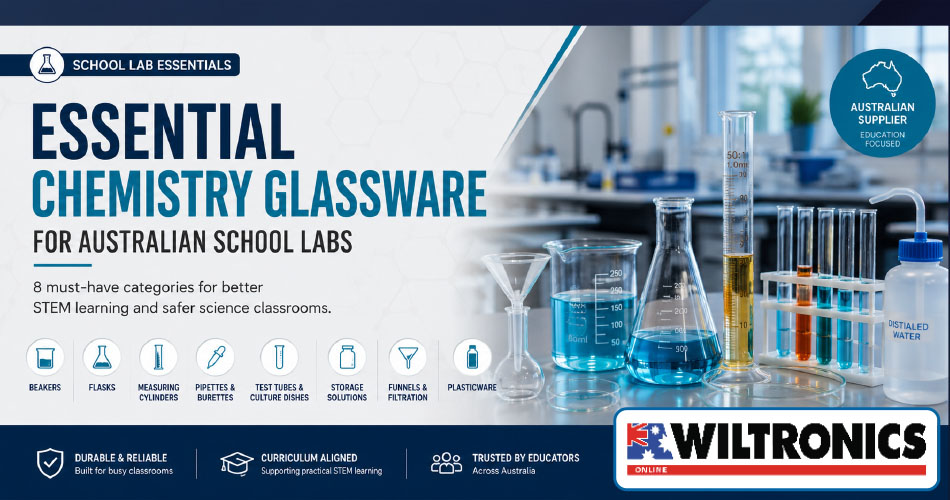
Essential Chemistry Glassware for Australian School Labs: 8 Must-Have Categories for Better STEM Learning
Setting up a modern science laboratory is no longer just about stocking a few beakers and test tubes. Australian educators are increasingly balancing STEM curriculum demands, tighter budgets, laboratory safety requirements, and the need for durable equipment that can withstand constant classroom use.
From Year 7 science through to senior chemistry practicals, the quality of laboratory equipment directly impacts student engagement, experiment accuracy, lesson efficiency, and long-term replacement costs. For schools building stronger STEM programs, choosing the right chemistry glassware is an investment in both learning outcomes and operational efficiency.
Research consistently shows that hands-on practical learning improves student engagement and scientific understanding, particularly in STEM-focused subjects where experimentation reinforces theoretical concepts. As Australian schools continue investing in inquiry-based science learning, demand for durable, classroom-ready laboratory equipment continues to grow.
As an Australian supplier of educational laboratory and STEM equipment, Wiltronics offers a comprehensive range of chemistry glassware and laboratory plasticware designed specifically for educational environments.
In This Guide
- Why Quality Laboratory Glassware Matters
- Beakers
- Conical & Volumetric Flasks
- Measuring Cylinders
- Pipettes & Burettes
- Test Tubes & Culture Dishes
- Bottles, Jars & Storage Solutions
- Funnels & Filtration Equipment
- Laboratory Plasticware
- How to Choose Chemistry Glassware for Schools
- Common Purchasing Mistakes
- Glassware vs Plasticware
- Future-Proofing STEM Laboratories
- Essential School Laboratory Checklist
- Frequently Asked Questions
Why Quality Laboratory Glassware Matters in Education
In school laboratories, equipment durability and usability matter just as much as scientific accuracy.
Unlike research laboratories, educational labs involve:
- Frequent student handling
- Quick setup between periods
- Shared equipment across multiple year levels
- Repeated washing and sterilisation
- Higher breakage risk
- Large-scale practical activities
Choosing laboratory-grade glassware helps schools:
- Reduce long-term replacement costs
- Improve practical lesson consistency
- Increase student confidence during experiments
- Support safer laboratory procedures
- Deliver more reliable scientific outcomes
For many schools, borosilicate laboratory glassware has become the preferred standard because of its excellent resistance to thermal shock and chemical corrosion.
At the same time, durable laboratory plasticware has become increasingly important in junior STEM classrooms where lightweight, shatter-resistant equipment improves safety and reduces annual replacement costs.
1. Beakers — The Foundation of Every Science Lab
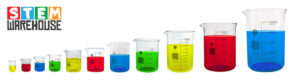
Few laboratory items see more classroom use than beakers.
They are essential for:
- Mixing chemicals
- Heating liquids
- Dissolving substances
- Conducting demonstrations
- Measuring approximate volumes
Because beakers are constantly handled across multiple year levels, investing in durable borosilicate beakers can significantly reduce long-term replacement costs for busy science departments.
Why Educators Choose Borosilicate Beakers
- Excellent heat resistance
- Reduced cracking during heating
- Suitable for repeated classroom use
- Easy-to-read graduations
- Compatible with hotplates and Bunsen burners
Popular School Applications
- Junior chemistry practicals
- STEM inquiry projects
- Demonstration experiments
- General laboratory preparation
Educator Insight
Many schools maintain separate classroom sets for junior and senior science to reduce wear on precision laboratory equipment and improve lesson turnaround times.
2. Conical & Volumetric Flasks — Essential for Accurate Chemistry
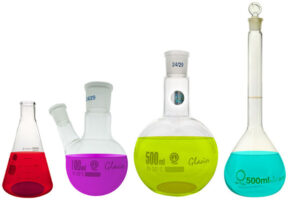
Laboratory flasks are critical for controlled mixing, precise measurements, and quantitative chemistry investigations.
Conical (Erlenmeyer) Flasks
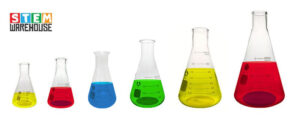
Conical flasks are widely used in Australian secondary science laboratories because their tapered shape helps minimise spills during student practical work.
They are ideal for:
- Titrations
- Swirling reactions
- Heating experiments
- Classroom demonstrations
Borosilicate conical flasks are particularly valuable in senior chemistry because they tolerate repeated heating during titration and reaction experiments.
Volumetric Flasks
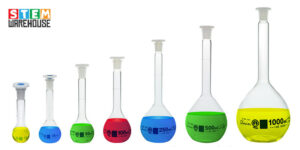
Volumetric flasks are designed for highly accurate solution preparation and are commonly used in:
- Senior chemistry
- Standard solution preparation
- Quantitative analysis
- Analytical chemistry investigations
Why They Matter in Schools
Accurate laboratory work helps students develop proper scientific technique and supports curriculum-aligned assessment tasks in SACE, VCE, and senior STEM pathways.
3. Measuring Cylinders — Building Precision from Early Science Education
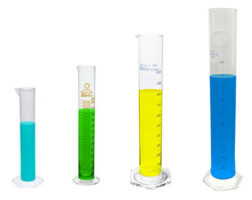
One of the first laboratory skills students learn is accurate measurement.
Measuring cylinders help reinforce:
- Experimental consistency
- Controlled-variable investigations
- Scientific method principles
- Data accuracy
Compared with beakers, measuring cylinders provide significantly greater precision, making them essential across all year levels.
Common Classroom Applications
- Density experiments
- Solution preparation
- Physics displacement investigations
- Chemical reaction measurement
Glass vs Plastic Measuring Cylinders
| Glass Cylinders | Plastic Cylinders |
|---|---|
| Greater chemical resistance | Better impact resistance |
| Superior heat tolerance | Safer for younger students |
| Longer lifespan | Lightweight and easy to handle |
| Ideal for senior chemistry | Lower replacement costs |
Practical Classroom Tip
Polypropylene measuring cylinders are particularly popular in junior science classrooms because they combine durability with clear graduations and lower breakage risk.
4. Pipettes & Burettes — Core Tools for Senior Chemistry
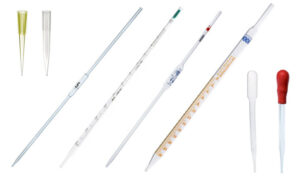
As students progress into advanced chemistry, precision becomes increasingly important.
Pipettes and burettes are essential for:
- Accurate liquid transfer
- Controlled dispensing
- Titration experiments
- Quantitative chemical analysis
Why Quality Matters
Poor-quality volumetric equipment can produce inconsistent results, making it harder for students to build confidence in laboratory technique.
High-quality burettes and pipettes help students:
- Improve measurement accuracy
- Produce repeatable results
- Develop real laboratory competency
- Prepare for tertiary STEM pathways
Best For
- Year 11 and 12 chemistry
- SACE practical investigations
- STEM extension programs
- Analytical chemistry activities
5. Test Tubes & Culture Dishes — Encouraging Hands-On STEM Learning
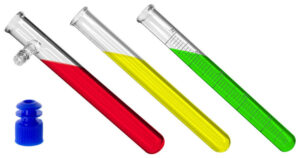
Few laboratory items are as versatile as test tubes and culture dishes.
They remain essential because they allow:
- Small-scale experiments
- Comparative reaction testing
- Safe heating investigations
- Observation-based learning
Petri dishes and culture dishes are equally important for biology and microbiology practicals.
Why Teachers Rely on Them
- Cost-effective for full-class activities
- Easy to clean and organise
- Require smaller chemical quantities
- Ideal for collaborative investigations
Best Applications
- Junior science
- Biology practicals
- STEM inquiry learning
- Introductory chemistry
Classroom Efficiency Tip
Smaller-scale practical setups often reduce laboratory preparation time, chemical usage, and classroom cleanup requirements.
6. Bottles, Jars & Chemical Storage Solutions
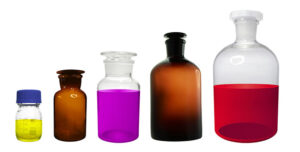
Efficient chemical storage is essential for maintaining a safe and organised laboratory environment.
Wiltronics stocks a wide range of:
- reagent bottles
- storage jars and laboratory vials
- Sample containers
- Chemical-resistant jugs
Why Proper Storage Matters
Good storage systems help schools:
- Improve laboratory organisation
- Reduce contamination risks
- Extend chemical lifespan
- Simplify stock management
- Improve prep-room efficiency
- Maintain laboratory safety compliance
Popular Storage Materials
- Borosilicate glass
- HDPE
- Polypropylene
- Polyethylene
Educator Insight
Standardised storage systems can significantly reduce preparation time between practical classes, especially in high-use secondary science departments.
7. Funnels & Filtration Equipment — Simple Tools That Improve Lab Safety
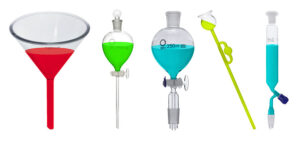
Funnels and filtration equipment are often overlooked, but they play a major role in improving laboratory efficiency and reducing spills.
Common Uses
- Filtration experiments
- Liquid transfer
- Powder transfer
- Reagent preparation
Why Schools Need Them
Using proper transfer equipment helps:
- Minimise chemical waste
- Reduce student spills
- Improve experiment accuracy
- Speed up laboratory setup and cleanup
Best For
- Chemistry practicals
- Science preparation rooms
- Junior laboratory work
8. Laboratory Plasticware — Durable Solutions for Modern STEM Classrooms
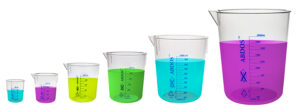
Modern STEM classrooms increasingly combine traditional glassware with durable laboratory plasticware.
For busy junior science classrooms, plasticware often becomes one of the smartest long-term investments a department can make.
Plastic laboratory equipment is especially valuable where:
- Younger students are learning practical skills
- Equipment is handled frequently
- Breakage risk is high
- Fast classroom transitions are required
Popular Plasticware Includes
- Wash bottles
- Transfer pipettes
- Measuring cylinders
- Funnels
- Storage bottles
- Test tubes
Why Schools Choose Plasticware
- Lightweight handling
- Lower replacement costs
- Improved classroom safety
- Excellent durability
- Reduced breakage risk
Best Applications
- Primary STEM
- Junior secondary science
- High-use teaching laboratories
Recommended Equipment by Year Level
Years 7–8
- Plastic measuring cylinders
- Test tubes
- Funnels
- Wash bottles
- Basic beakers
Years 9–10
- Glass beakers
- Conical flasks
- Filtration equipment
- Laboratory storage systems
Years 11–12
- Volumetric flasks
- Burettes
- Pipettes
- Precision laboratory glassware
How to Choose Chemistry Glassware for Schools
When selecting laboratory equipment for educational use, schools should consider more than just purchase price.
Important Factors Include
Durability
Can the equipment withstand frequent classroom use?
Accuracy
Is the equipment suitable for curriculum-aligned experiments?
Safety
Does it minimise breakage and handling risks?
Storage Efficiency
Can it be easily organised between classes?
Long-Term Value
Will lower-quality products create higher replacement costs over time?
Curriculum Suitability
Does the equipment support senior chemistry practical requirements?
Schools sourcing broader science and STEM education equipment may also benefit from standardising suppliers to simplify procurement and classroom consistency.
Common Mistakes Schools Make When Buying Laboratory Equipment
Buying Domestic Glass Instead of Laboratory Glass
Laboratory-grade borosilicate glass is specifically designed for heat and chemical resistance.
Using Precision Glassware in Junior Classes
Plasticware is often safer and more cost-effective for younger students.
Inconsistent Equipment Sizes
Standardised glassware improves storage efficiency and preparation workflows.
Prioritising Lowest Cost Over Durability
Frequent replacements often make cheaper equipment more expensive over time.
Glassware vs Plasticware — Which Is Best for Schools?
The most effective science laboratories typically use both.
| Glassware | Plasticware |
|---|---|
| Excellent heat resistance | Highly impact resistant |
| Superior chemical durability | Safer for younger students |
| Ideal for precision chemistry | Lightweight and easy to handle |
| Longer lifespan | Lower replacement costs |
Recommended Approach
- Use glassware for senior chemistry and heating applications
- Use plasticware for junior STEM and high-frequency classroom use
Future-Proofing School STEM Laboratories
Science education continues to evolve rapidly, with increasing emphasis on:
- Inquiry-based learning
- Hands-on STEM activities
- Scientific literacy
- Laboratory competency
- Real-world problem solving
As schools modernise STEM facilities, laboratory equipment needs to support:
- Flexible classroom environments
- Frequent practical investigations
- Sustainable long-term use
- Safe student experimentation
Many educators are now adopting blended laboratory systems that combine durable borosilicate glassware with lightweight plasticware to improve both safety and operational efficiency.
Schools planning broader STEM upgrades may also explore additional science and STEM education resources available through Wiltronics.
Essential School Laboratory Checklist
A well-equipped secondary science laboratory should typically include:
✅ Beakers in multiple capacities
✅ Conical flasks
✅ Volumetric flasks
✅ Measuring cylinders
✅ Test tubes and racks
✅ Pipettes and burettes
✅ Funnels and filtration tools
✅ Reagent bottles and storage containers
✅ Laboratory plasticware for junior science
Frequently Asked Questions
What glassware is essential for school chemistry labs?
Most school laboratories require beakers, flasks, measuring cylinders, funnels, test tubes, and volumetric equipment for senior chemistry.
Why is borosilicate glass preferred in laboratories?
Borosilicate glass offers superior resistance to heat and chemical corrosion, making it ideal for repeated educational laboratory use.
Is plasticware suitable for chemistry classes?
Yes. Laboratory plasticware is widely used in schools because it is lightweight, durable, and safer for younger students.
What equipment is required for titration experiments?
Typical titration setups require burettes, pipettes, conical flasks, measuring cylinders, and chemical storage equipment.
How can schools reduce laboratory glassware breakage?
Using plasticware in junior classes, improving storage systems, and selecting laboratory-grade materials can significantly reduce breakage rates.
Supporting Better STEM Learning Outcomes
Reliable laboratory equipment plays a major role in creating engaging, safe, and effective science learning experiences.
Whether schools are:
- Upgrading senior chemistry facilities
- Building new STEM laboratories
- Replacing heavily used classroom equipment
- Expanding practical science programs
Wiltronics provides educator-focused laboratory solutions designed specifically for Australian schools and STEM classrooms.
Browse the full chemistry glassware and laboratory plasticware range, explore broader science and STEM education products, or contact the team for assistance with school laboratory purchasing and STEM classroom setup.
© Electrotech Brands Pty Ltd 2026
Write a Comment
You must be logged in to post a comment.