

Colorimetry in the Classroom: Measuring Concentration with Light
October 29, 2026
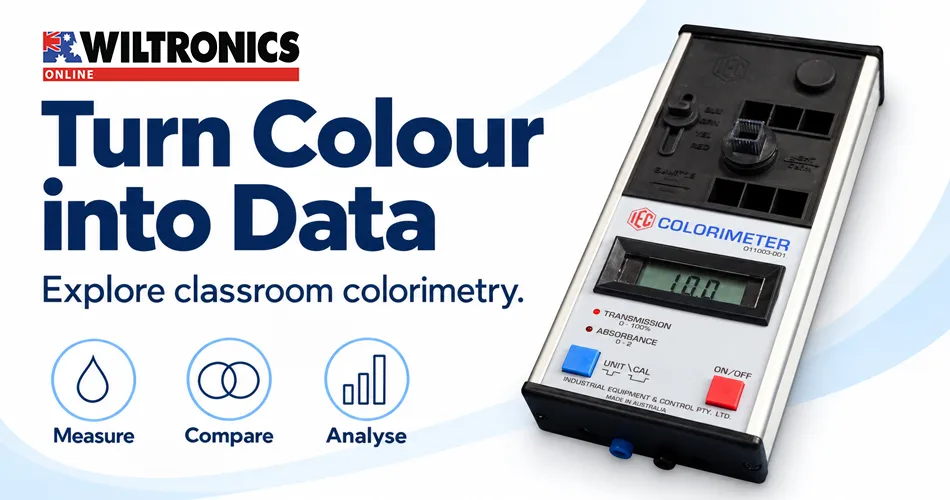
Colorimetry in the Classroom: Measuring Concentration with Light
Two coloured solutions can look similar but contain different concentrations. A colorimeter helps students move beyond judging colour by eye and start working with measurements.
At Wiltronics, our colorimeter range supports practical investigations into light transmission, absorbance and solution concentration. Here, we explain how to plan an introductory activity, choose suitable IEC equipment and help students interpret their results.
What does a colorimeter measure?
A solution colorimeter passes selected light through a sample and measures how much reaches a detector. It can report transmission or absorbance.
Transmission describes the proportion of light passing through relative to a reference. Absorbance is a logarithmic measure derived from that ratio; it is not simply the percentage of light absorbed.
Under conditions where the Beer–Lambert law applies, absorbance is proportional to concentration for the same absorbing substance, wavelength and optical path length. This relationship makes a calibration graph useful: measure known concentrations first, then use the graph to estimate an unknown.
Shimadzu’s explanation of the Beer–Lambert law provides further background on these relationships.
The key teaching point: a colorimeter reading alone does not identify a chemical or automatically establish its concentration. The sample preparation, reference and calibration matter too.
IEC Digital Colorimeter: a focused starting point
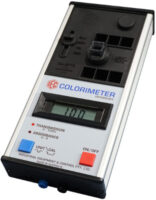
Our IEC Digital Colorimeter — CH1003-001 provides a standalone LCD readout and selectable red, yellow, green and blue light sources.
The internal LEDs remove the need to handle separate colour filters. Students still make a meaningful experimental choice by selecting the light source used for their measurements.
The instrument supports transmission and absorbance readings, operates from a 9V battery and is supplied with six cuvettes. The listing also describes selectable analogue outputs for use with suitable logging equipment; confirm the interface and connection requirements before planning data capture.
We suggest this model when the main lesson is about comparing solutions and building a concentration calibration graph. Its own display allows students to record readings without first setting up a computer.
Use the IEC instruction sheet alongside the instructions supplied with your instrument.
Plan an investigation around one clear question
A useful starting question is: Can we estimate the concentration of an unknown sample using known standards?
We recommend preparing a lesson sheet with space for predictions, sample labels, repeated readings and a graph. Keep the chemical system simple enough that students can focus on how evidence supports their estimate.
Before the lesson, assemble:
- The colorimeter and its light shroud.
- Compatible sample containers and a suitable blank.
- Teacher-prepared standards with known concentrations.
- An unknown sample of the same solution system.
- Appropriate liquid-measuring equipment, labels and recording materials.
Select chemicals, concentrations, protective equipment and disposal arrangements through the school’s approved procedure. Trial the full activity before running it with a class.
Select the light source and establish a reference
IEC’s experimental guidance recommends comparing the available light sources using a representative sample, calibrating with the reference at each selection. Choose the source that gives the strongest useful absorption, then keep it fixed for the investigation.
Do not automatically choose a light source matching the solution’s visible colour. Check the measured response.
The blank establishes the reference for the measurement. For a simple aqueous solution, distilled water may be appropriate; other methods may require a different solvent or reagent blank. Use the blank specified for the experiment.
Follow the instrument’s calibration procedure and fit the light shroud consistently. Blanking and preparing a concentration calibration graph are separate tasks: the first establishes the optical reference; the second relates readings to known concentrations.
Build and use a calibration graph
- Record each standard’s concentration and units.
- Measure its absorbance using the selected light source and consistent sample geometry.
- Repeat measurements to assess consistency.
- Plot concentration horizontally and absorbance vertically.
- Examine the relationship before fitting a line or curve appropriate to the data.
- Measure the unknown under the same conditions and estimate its concentration within the standards’ range.
We recommend several standards for a classroom investigation so students can examine the trend and spot unusual results. A line through only two points cannot reveal whether the intermediate behaviour is linear.
Ask students to explain why their estimate is justified. If the unknown lies outside the measured range, revise the preparation or use an appropriate documented dilution rather than extending the graph without evidence. Account for any dilution when reporting the original concentration.
Make sample handling part of the lesson
Consistent containers help keep the optical path comparable. Avoid switching between different cuvette or test-tube geometries within one calibration series.
Orient the clear optical faces correctly, keep the light path covered by liquid and follow the cleaning guidance for the containers. Check for bubbles, residue, fingerprints and scratches before taking a reading.
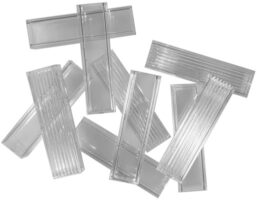
Our IEC Cuvettes 10-Pack — PA3792-005 contains plastic cuvettes listed as compatible with the IEC spectrometer and colorimeter. Additional cuvettes can help organise labelled blanks, standards and unknowns. Check chemical compatibility before choosing plastic containers for a particular solution.
The CH1003-001 also accepts specified glass test-tube sizes, according to its instruction sheet. That flexibility does not make different container shapes interchangeable within a measurement series.
When to consider the IEC Flame AA system
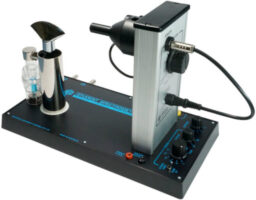
Our IEC Flame AA Spectrometer & Colorimeter — CH3792-001 serves a broader teaching purpose. Its listed functions include colorimetry, flame emission and atomic absorption spectrometry.
The package includes a nebuliser, a student bench meter, cables and Windows-based software. Manual recording is also supported.
| Teaching priority | Equipment to consider |
|---|---|
| Introductory transmission, absorbance and concentration work | IEC Digital Colorimeter CH1003-001 |
| A broader program including flame emission and atomic absorption | IEC Flame AA Spectrometer & Colorimeter CH3792-001 |
| Additional compatible sample containers | IEC Cuvettes 10-Pack PA3792-005 |
Choose around the experiments you intend to teach. For the flame-based activities, confirm the required services, setup and school procedures before purchase. Also check software and interface compatibility with your current computers; a Windows software listing does not establish compatibility with every Windows version.
Questions that make the results more useful
After the measurements, ask students:
- Why did we need both a blank and known standards?
- Which conditions did we keep consistent?
- Did repeated readings agree, and what might explain any differences?
- What evidence supports using the graph for this unknown?
Assess the explanation as well as the numerical answer. A well-supported result should connect the sample preparation, instrument reading and graph.
Frequently asked questions
Is absorbance the same as concentration?
No. Absorbance is an optical measurement. A suitable calibration or validated calculation connects it to concentration under defined conditions.
Do students need a computer for the IEC Digital Colorimeter?
No. The CH1003-001 has its own display. Logging requires a separately checked, compatible setup.
Should we select the same colour light as the solution?
Not automatically. Compare the available sources using the blank and sample, then select an appropriate absorption response and keep that source fixed.
Can we measure every solution using the same calibration graph?
No. A calibration is specific to the solution system and measurement conditions. Changing the substance, light source or optical path can change the relationship.
Does a darker solution always give a better result?
No. Very low transmission can make measurements less useful. Work within a suitable, verified measurement range and dilute samples according to the method when needed.
Explore colorimetry equipment at Wiltronics
Browse our colorimeters and related equipment to prepare your next chemistry investigation.
Start with the question students need to answer, choose the apparatus that supports it, and make the measurement process part of what they learn.
© Electrotech Brands Pty Ltd 2026
Write a Comment
You must be logged in to post a comment.