

Cable Ties Cable Sleeving or Loom Tube: Which Should You Use?
July 26, 2026
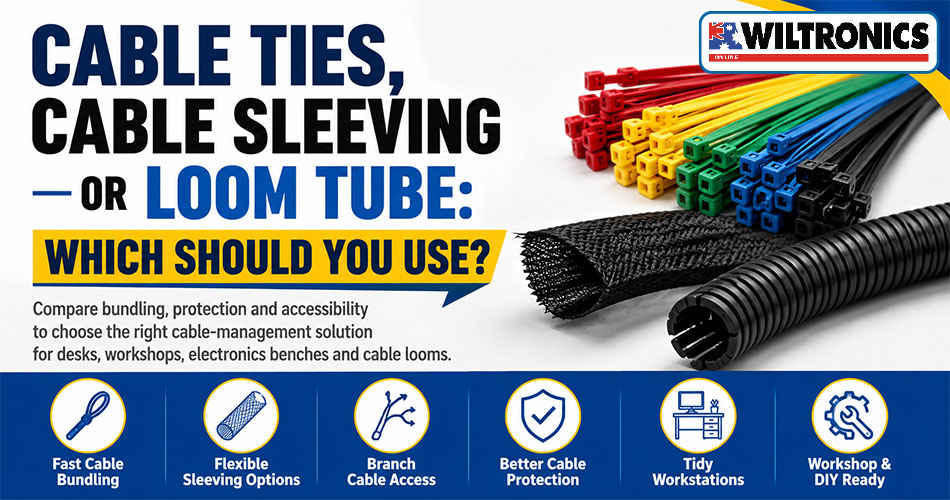
Cable Ties, Cable Sleeving or Loom Tube: Which Should You Use?
Choosing a cable-management product can seem straightforward until you compare the options.
Cable ties create quick, secure bundles. Clips and clamps fix cables to a surface. Spiral wrap allows wires to branch from a bundle, while braided sleeving provides flexible coverage that can be reopened. Corrugated loom tube adds a more enclosed layer around cables that need greater physical protection.
The best choice depends on what you need to achieve:
- Bundle several cables together
- Route cables along a surface
- Protect wiring from abrasion
- Keep cables accessible for future changes
- Identify different circuits or equipment
- Create a cleaner, more professional installation
This guide compares the most useful cable-management products for electronics benches, workstations, AV systems, workshops, classrooms, vehicles and low-voltage projects.
Quick recommendation: Use cable ties for simple long-term bundles, clips or clamps for fixed routing, spiral wrap for branching cables, self-closing braided sleeving for accessible visible bundles, and corrugated loom tube when greater enclosure is required.
Cable-Management Options at a Glance
| Product | Best for | Accessibility | Protection | Installation |
|---|---|---|---|---|
| Cable ties | Quick, secure bundles | Low | Basic | Very easy |
| Adhesive tie mounts | Routing bundles along surfaces | Moderate | Basic | Easy |
| Nylon P clips | Lightweight fixed cable runs | Moderate | Basic | Requires mounting |
| Metal P clips | Firm mechanical support | Moderate | Good | Requires mounting |
| Spiral wrap | Flexible bundles with branch cables | High | Moderate | Easy |
| Self-closing braided wrap | Visible or frequently changed bundles | Very high | Good | Very easy |
| Corrugated split loom tube | More enclosed cable looms | High | Good | Easy |
| Conduit | Fixed routes requiring greater protection | Low | High | Specialist installation may apply |
Begin with the Cable-Management Job
Before choosing a product, identify whether the main requirement is bundling, mounting, protection or accessibility.
Bundling
Bundling brings several cables together so they can be handled as one group.
Good options include:
- Cable ties
- Spiral wrap
- Braided sleeving
- Corrugated loom tube
Mounting
Mounting prevents a cable or loom from moving away from its planned route.
Suitable options include:
- Adhesive cable-tie mounts
- Nylon P clips
- Metal P clips
- Cable clamps
Protection
Cable-management products can help reduce rubbing, movement and contact with nearby surfaces.
For greater coverage, consider:
- Braided wire wrap
- Corrugated loom tube
- Appropriate conduit
- Application-specific sleeving
Accessibility
A permanent bundle is not always the best bundle.
Cables in prototype systems, electronics benches and computer workstations may need to be added, removed or replaced. Spiral wrap, self-closing braided wrap and split loom tube are generally easier to reopen than single-use cable ties.
1. Cable Ties: Best for Fast, Secure Bundling
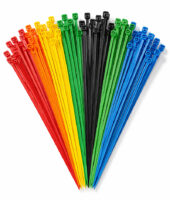
Cable ties are a practical choice when several cables need to remain together for an extended period.
They are compact, economical and available in different lengths, widths, colours and materials. Browse the full Wiltronics range of cable ties and related accessories.
When Cable Ties Work Best
Use cable ties for:
- Electronics project wiring
- Cable preparation before installation
- Workshop organisation
- Equipment cabinets
- AV cable bundles
- Classroom projects
- Storage and transport
- Completed wiring looms
Advantages of Cable Ties
- Quick to install
- Compact around the bundle
- Available in many sizes
- Suitable for colour coding
- Require little storage space
- Useful across many applications
Limitations of Cable Ties
Most cable ties need to be cut when the bundle is reopened.
They can also damage soft insulation when overtightened. The tie should retain the cables without noticeably crushing, flattening or marking them.
Everyday Cable Ties
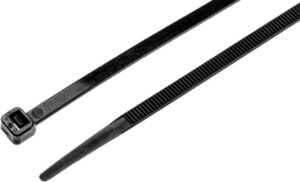
The black UV-resistant cable-tie range is available in multiple sizes for general organisation and bundling.
Choose the length according to the complete bundle diameter rather than the diameter of one cable.
Allow enough excess length to feed the tail through the locking head comfortably. Avoid selecting a tie that only just reaches around the bundle.
Assorted Cable-Tie Packs
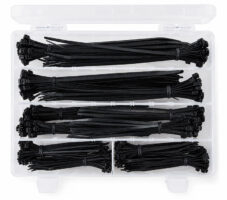
An assorted pack is useful when the workshop handles different bundle sizes.
The 400-piece box of popular cable-tie sizes contains 100mm, 150mm and 200mm black nylon ties in a divided storage case.
This type of pack suits:
- Shared electronics benches
- Maintenance workshops
- School technology rooms
- Service vehicles
- General-purpose toolkits
Coloured Cable Ties
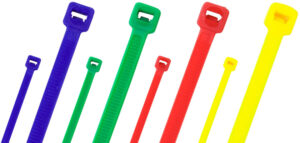
Colour can distinguish separate wiring groups without attaching a large label.
The coloured cable ties in 100-piece packs are available in several colours and two lengths. Wiltronics recommends these coloured versions for indoor use rather than prolonged direct sunlight.
Possible colour-coding systems include:
- Power and signal wiring
- Separate equipment channels
- Inspection status
- Classroom project groups
- Cable destinations
- Matching ends of long cable runs
Do not rely on colour alone where incorrect identification could create a hazard. Add a clear label where the cable’s purpose must be unambiguous.
2. Cable Clips and Clamps: Best for Fixed Routing
A cable tie holds wires together, but it does not necessarily keep the bundle against a desk, panel, chassis or machine.
Clips and clamps create defined mounting points along the cable route.
Browse cable clips and mounting accessories for adhesive mounts, nylon clips and metal P clips.
Adhesive Cable-Tie Mounts
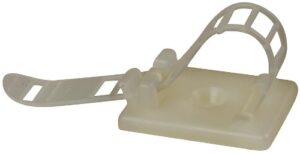
An adhesive mount provides a base through which a cable tie can be fitted.
The adhesive cable-tie mounts in a pack of 10 have a 25 × 18mm base, accommodate bundles up to 17mm and include a mounting hole where a screw fixing is appropriate.
They are useful for:
- Routing cables under desks
- Organising enclosure wiring
- Securing light bundles to panels
- Keeping leads away from moving parts
- Creating evenly spaced routing points
Adhesive performance depends on the mounting surface.
Clean away dust, grease and loose material before fitting the mount. Use a mechanical fixing where the cable load, surface or consequences of failure make adhesive mounting unsuitable.
Nylon P Clips
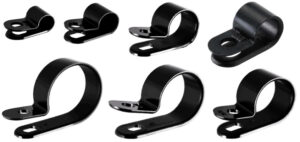
P clips form a loop around the cable and attach through a mounting hole.
The UV-resistant black nylon P clips are available in several diameters. Their smooth edges are intended to support cables and looms without sharp metal edges contacting the insulation.
Nylon P clips suit:
- Lightweight cable looms
- Electronics cabinets
- Low-voltage wiring
- Workshop panels
- Automotive accessory projects
- Outdoor routing where the product rating suits the conditions
Metal P Clips
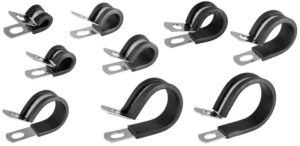
Metal clips provide firmer mechanical support.
The metal P clips with neoprene inserts are available in several diameters and use a protective insert between the metal clip and the supported cable or tube.
They are useful where cables may experience:
- Greater movement
- Vibration
- Heavier loads
- More demanding workshop conditions
- Longer unsupported runs
Choose a clip that holds the cable securely without compressing it. An oversized clip may permit movement, while an undersized clip can deform the insulation.
3. Spiral Wrap: Best for Branching Cable Bundles
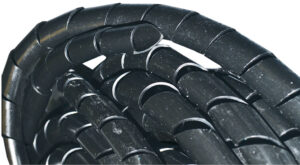
Spiral wrap coils around a group of cables rather than forming a continuous solid sleeve.
This design allows an individual wire to leave the main bundle at almost any point.
The Wiltronics Spiral Wrap 10m range is available in black or natural PA6 nylon and several diameters. It can be applied after cables are connected and removed for reuse.
Spiral Wrap Is Best For
- Electronics test benches
- Computer workstations
- Laboratory equipment
- Prototype wiring
- AV installations
- Control panels
- Bundles with several branch cables
Advantages
- Individual cables can exit anywhere
- Flexible around bends
- Easy to add to an existing installation
- Can be removed and reused
- Available in different diameters
Limitations
- Does not completely cover the cable bundle
- Can take time to wind around long runs
- Offers less impact protection than corrugated tube
- May appear more industrial than braided sleeving
Choose spiral wrap when branch access matters more than complete coverage.
4. Self-Closing Braided Sleeving: Best for Accessible, Visible Bundles
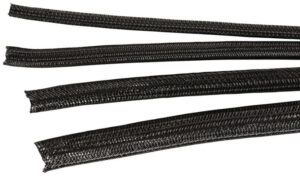
Self-closing braided wrap surrounds a group of cables using overlapping edges.
Unlike a closed sleeve, it does not normally require connectors or plugs to be removed before installation.
The Self-Closing Braided Wire Wrap 2m is made from PET and is available in several internal diameters. Its open structure allows it to be fitted around existing cables, while the braided material provides abrasion protection.
Braided Wrap Is Best For
- Computer and monitor cables
- Home entertainment systems
- Electronics benches
- Robotics projects
- Test-equipment leads
- Visible equipment wiring
- Bundles that need regular access
Advantages
- Easy to open and close
- Can be installed around connected cables
- Flexible around bends
- Provides a clean appearance
- Offers useful abrasion protection
- Lightweight compared with corrugated tube
Limitations
- Provides limited impact protection
- Must be sized to close properly
- Cut ends may require careful preparation
- Not every braided material suits every temperature or environment
Choose self-closing braided wrap when the bundle must remain tidy, flexible and easy to access.
5. Corrugated Split Loom Tube: Best for Greater Enclosure
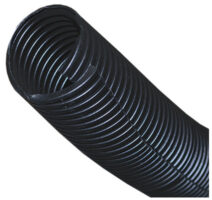
Corrugated split tube forms a more substantial outer layer around the cable bundle.
The slit along its length allows cables to be inserted without removing their connectors. Wires can also enter or leave the tube at different points.
The Corrugated Split Tube, or Loom Tube, is made from flexible black polypropylene and is available in multiple diameters and lengths.
Loom Tube Is Best For
- Workstation cable bundles
- Home entertainment systems
- Automotive accessory wiring
- Workshop equipment
- Robotics and machinery
- Cable groups requiring greater coverage
- Installations with several entry and exit points
Advantages
- Encloses more of the cable than spiral wrap
- Can be installed around connected cables
- Allows branch cables
- Provides a defined cable loom
- Available in a broad range of diameters
- More resistant to minor impacts than lightweight braided wrap
Limitations
- Bulkier than spiral or braided wrap
- Less visually refined for exposed desk installations
- May be less flexible around tight bends
- Can become overfilled if the selected diameter is too small
Choose corrugated loom tube when physical coverage and a structured cable loom are more important than minimum size or appearance.
Spiral Wrap vs Braided Sleeving vs Loom Tube
| Feature | Spiral wrap | Braided sleeving | Split loom tube |
|---|---|---|---|
| Install around connected cables | Yes | Yes | Yes |
| Add or remove cables later | Good | Excellent | Good |
| Allow branch cables | Excellent | Good | Excellent |
| Abrasion protection | Moderate | Good | Good |
| Minor impact protection | Limited | Limited | Better |
| Flexibility | Excellent | Excellent | Moderate |
| Appearance | Functional | Clean and refined | Industrial |
| Best environment | Benches and branching systems | Desks and visible equipment | Workshops and protected looms |
Choose Spiral Wrap When:
- Cables branch in several directions
- The bundle changes regularly
- Maximum flexibility is important
- Complete outer coverage is unnecessary
Select Braided Sleeving When:
- The cable run is visible
- Connectors are already attached
- Cables need to remain accessible
- A lightweight, tidy finish is preferred
Choose Loom Tube When:
- The bundle needs greater enclosure
- Wiring may contact workshop surfaces
- Several cables enter and leave the run
- A more structured loom is required
How to Choose the Correct Size
Sizing affects installation, appearance and protection.
A product that is too small can compress cables or fail to close. One that is too large can move excessively and create a loose, untidy bundle.
Step 1: Assemble the Cable Bundle
Arrange the cables approximately as they will sit in the final installation.
Do not measure each cable individually and simply add the diameters together. The empty spaces between round cables affect the bundle’s finished size.
Step 2: Measure the Widest Section
Measure across the widest point of the completed bundle.
Include:
- Connector strain reliefs where relevant
- Overlapping cable sections
- Junctions
- Existing insulation
- Any cable that enters partway through the run
Step 3: Allow for Future Changes
Add spare capacity where another cable may be installed later.
Do not leave so much unused space that the sleeve or tube moves freely around the existing cables.
Step 4: Check the Product’s Nominal Diameter
Compare the measured bundle with the listed internal diameter or recommended bundle size.
For clamps and P clips, choose a diameter that secures the cable without crushing it.
Step 5: Confirm the Route
Check that the chosen product can:
- Bend around the required corners
- Pass through openings
- Clear moving components
- Fit behind furniture
- Avoid hot surfaces
- Reach each required mounting point
Recommended Cable Management by Application
| Application | Recommended combination |
|---|---|
| Computer desk | Braided wrap with adhesive mounts |
| Electronics bench | Spiral wrap with coloured cable ties |
| Home entertainment system | Braided wrap or split loom tube |
| Prototype project | Spiral wrap or self-closing wrap |
| Classroom electronics | Assorted and coloured cable ties |
| Automotive accessory wiring | Loom tube with suitable P clips |
| Workshop machinery | Loom tube with metal P clips |
| Equipment enclosure | Cable ties with nylon P clips |
| Visible AV installation | Self-closing braided wrap |
| Long-term fixed bundle | Correctly sized cable ties and mounts |
When Ordinary Cable Management Is Not Enough
Cable ties and sleeves suit many low-voltage, desk and equipment applications, but they do not replace proper cable containment.
Electrical Conduit
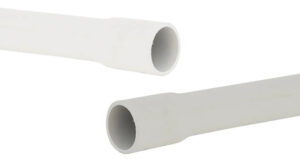
Conduit may be required where cables need a fixed, enclosed route or greater mechanical and environmental protection.
Wiltronics stocks conduit and compatible installation components, but fixed electrical work must comply with applicable requirements and be completed by an appropriately licensed person where required.
Network Racks
Patch leads and data cabinets benefit from products designed for rack spacing and cable density.
For network installations, browse 19-inch rack cabinet accessories rather than treating a large rack as an ordinary cable bundle.
Cable-Installation Tools
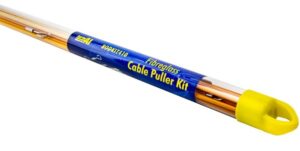
Long runs and enclosed routes may require specialist pulling and installation equipment.
Explore cable-installation kits and accessories when the project involves wall cavities, conduits or difficult access points.
Common Cable-Management Mistakes
Using Cable Ties for Every Installation
Cable ties are effective, but they are inconvenient when equipment changes regularly.
Use spiral wrap or braided sleeving where cables must remain accessible.
Overtightening the Bundle
A cable tie or clip should retain cables without cutting, flattening or deforming their insulation.
Tightening a tie more aggressively does not necessarily make the installation better.
Choosing Sleeving That Is Too Small
Measure the entire bundle rather than estimating.
Include connector strain reliefs and allow sensible room for future changes.
Ignoring Bend Radius
A cable-management product should not force cables into sharp bends.
Follow the cable manufacturer’s installation guidance where bend radius affects performance or durability.
Relying on Adhesive Mounts on Dirty Surfaces
Dust, grease, heat and textured surfaces can reduce adhesion.
Prepare the surface properly and use mechanical mounting where stronger retention is needed.
Mixing Every Cable into One Bundle
A neat-looking bundle is not always a well-planned installation.
Consider cable purpose, heat, interference, maintenance access and equipment instructions before grouping power, signal and data cables together.
Concealing Damaged Cables
Cable wrap and loom tube should only be applied around serviceable cables.
Do not use a sleeve, tape or tie to hide a damaged mains lead, exposed conductor or broken connector.
Cable-Management Buying Checklist
Before ordering, confirm:
- Is the goal bundling, routing, protection or identification?
- Will the cables need regular access?
- What is the complete bundle diameter?
- Are the connectors already fitted?
- Do cables need to branch from the bundle?
- Will more cables be added later?
- Is the installation visible?
- Will the bundle encounter abrasion or minor impacts?
- Does it need to be fixed to a surface?
- Is the location indoors or outdoors?
- Are heat, sunlight, chemicals or vibration present?
- Could overtightening damage the cable?
- Does the project involve fixed electrical wiring?
- Would conduit or rack-specific management be more appropriate?
Frequently Asked Questions
Are cable ties or cable sleeves better?
Cable ties are better for fast, compact and long-term bundles.
Cable sleeves are better when a greater section of the wiring needs to remain enclosed, protected or accessible.
What is the difference between spiral wrap and braided sleeving?
Spiral wrap coils around the cables and makes it easy for individual wires to leave the bundle.
Self-closing braided sleeving creates a more continuous outer layer and usually offers a cleaner appearance for visible installations.
Is braided sleeving or loom tube better?
Braided sleeving is lighter, more flexible and well suited to visible cable runs.
Loom tube provides a more structured enclosure and greater protection from minor impacts.
Can I install sleeving without removing the connectors?
Self-closing braided wrap and split loom tube can be fitted around many existing cable runs without removing the connectors.
Traditional closed sleeving may need to be slid over the cable from one end.
What size cable sleeve should I buy?
Measure the widest part of the finished bundle and select a sleeve that closes comfortably around it.
Allow some expansion for likely future cables without leaving the current bundle excessively loose.
Are coloured cable ties suitable outdoors?
Suitability depends on the individual product.
The Wiltronics coloured 100-piece cable ties are intended for indoor use, while the black cable-tie range includes UV-resistant options.
Are adhesive cable mounts permanent?
Adhesive mounts can provide long-term routing on suitable prepared surfaces, but their performance depends on the surface, environment and load.
Use a screw-mounted clip where failure could create a hazard or damage equipment.
Can cable management repair damaged insulation?
No.
Cable ties, wrap and loom tube organise and protect serviceable cables. They do not replace a correct electrical repair or replacement cable.
Choose the Right Cable-Management Product
Use cable ties when you need a fast, secure and compact bundle.
Use cable clips or P clamps when the cable must follow a fixed route.
Choose spiral wrap when cables branch in several directions, or self-closing braided sleeving when the bundle must look tidy and remain easy to reopen.
Select corrugated split loom tube when wiring needs greater enclosure and protection.
Browse the complete Wiltronics range of cable ties and sleeving, cable clips and clamps and cables and wires to create a cleaner, more accessible and better-protected installation.
© Electrotech Brands Pty Ltd 2026
Write a Comment
You must be logged in to post a comment.